
When people hear the name Incheon, many think of Incheon International Airport.
For many international visitors, Incheon is the first place they see when they arrive in Korea. Incheon is sometimes overlooked by travelers who arrive at the airport and immediately take a train or bus to Seoul. But Incheon is much more than an airport city.
Located on Korea’s west coast, Incheon has a long history shaped by the sea, trade, migration, transportation, and international exchange.
The area was already an important settlement in ancient Korea. It later became connected to the royal history of Goryeo, developed into a major port during the opening of Korea to the outside world, and played a critical role during the Korean War.
Today, Incheon is one of Korea’s largest metropolitan cities, with a major international airport, a large seaport, modern business districts, islands, beaches, industrial complexes, and the futuristic city of Songdo.
Incheon is a city that has repeatedly changed because of its relationship with the outside world.
To understand Incheon, it helps to begin with the sea.
1. Ancient Incheon: Michuhol by the Sea
The history of Incheon goes back more than 2,000 years.
The area was historically known by names including Michuhol (미추홀). During the Three Kingdoms period, the area was associated with the kingdom of Baekje and was an important settlement in the western part of the Korean Peninsula.
Unlike Seoul, which developed around the Han River as a political center, Incheon’s location gave it a different advantage.
It faced the Yellow Sea, providing access to the sea and to the islands and coastal areas around the Korean Peninsula.
This geographic position would become one of the defining characteristics of Incheon.
Over the centuries, the area’s name and administrative status changed several times as different kingdoms and governments reorganized the region.
During the Goryeo and Joseon periods, it continued to serve as an important coastal area connected to the capital and the western sea.
2. Incheon and the Goryeo Dynasty
During the Goryeo Dynasty (918–1392), the area around present-day Incheon became closely connected with the royal family.
It was known as Gyeongwon-gun and later Inju at different points in Goryeo history.
The area was particularly important because it was associated with the birthplace of members of the royal family.
This connection gave the region political importance in addition to its geographic advantages.
The name Incheon itself dates back to the Joseon period.
In 1413, during the reign of King Taejong, the name Inju was changed to Incheon.
The name has remained in use ever since.
Today, October 15 is celebrated as Incheon Citizen’s Day, commemorating the historical adoption of the name Incheon.
3. A Coastal City Facing the Capital
For much of Korean history, Incheon was closely connected to Seoul.
Seoul was the political center of the country, but it did not have direct access to the open sea.
Incheon, located on the coast west of Seoul, became an important gateway to the capital.
Goods and people could travel by sea toward Incheon and then continue toward Seoul.
This relationship between the two cities became even more important during the late Joseon period.
The sea made Incheon a place where Korea could encounter the outside world.
That would change the city’s history forever.
4. 1883: The Opening of Incheon Port
One of the most important dates in Incheon’s history is 1883.
Incheon Port, then known as Jemulpo (제물포), officially opened to international trade.
This was a major turning point for both Incheon and Korea.
Before the opening of the port, Incheon was largely a coastal settlement. After the port opened, foreign merchants, diplomats, sailors, missionaries, and traders began arriving.
The city changed rapidly.
Foreign settlements appeared around the port. New businesses and warehouses were established. Roads and transportation systems developed, and new technologies and cultural influences began entering Korea through Incheon.
The area around the old port became known as the Open Port Area (개항장).
Today, visitors can still walk through this neighborhood and see buildings and streets connected to this period.
The Open Port Area is one of the best places to understand how Korea began its transition into the modern world.
5. Incheon: Korea’s First Contact with Modern Global Culture
The opening of the port brought many new things to Korea.
Modern transportation, electricity, communications, banking, hotels, education, Christianity, Western architecture, and new foods were introduced or developed through international exchange.
Incheon became a place where people from different countries lived and worked.
For this reason, the city is often associated with some of Korea’s earliest examples of modern institutions and technologies.
The Gyeongin Railway, which connected Incheon with Seoul, opened in 1899.
This was particularly important.
Before the railway, traveling between Incheon and Seoul was much slower. The railway made the movement of people and goods much easier and strengthened the relationship between the port and the capital.
Incheon was becoming Korea’s gateway to the outside world.
6. Chinatown and Incheon’s Multicultural History
One of the most visible reminders of this international history is Incheon Chinatown.
After the opening of Incheon Port, Chinese merchants and residents established a community near the port. The area developed into a center for trade and commerce.
Today, Chinatown is famous for its restaurants, colorful streets, and Chinese-influenced architecture.
It is also closely associated with jajangmyeon (짜장면), the Korean-style black bean noodle dish that developed from Chinese culinary traditions in Korea.
For foreign visitors, Chinatown offers an interesting example of how international exchange influenced everyday Korean food and culture.
Incheon therefore provides a useful reminder that Korean culture has never developed in complete isolation.
The city has long been a place where cultures met, mixed, and changed.
7. The Difficult Side of the Open Port
The opening of Incheon was an important step in Korea’s modernization, but it was not a simple or entirely positive process.
Foreign powers competed for influence in Korea, and the country faced increasing political and military pressure from outside.
Incheon became an international port at a time when Korea was struggling to maintain its independence.
Japan eventually colonized Korea in 1910.
During the Japanese colonial period, Incheon developed as an important port and industrial center, but this development took place under colonial rule.
The city’s infrastructure and industries expanded, while Korea experienced political oppression and economic exploitation.
The old port area therefore contains two sides of modern Korean history:
the arrival of new technology and international exchange, and the painful experience of foreign domination.
Both are necessary to understand Incheon’s modern history.
8. Incheon and the Korean Independence Movement
Incheon also played an important role in Korea’s independence movement.
The city was connected to the March 1st Movement of 1919, one of the largest nationwide demonstrations against Japanese colonial rule.
Later that year, Incheon became connected to the establishment of the Korean Provisional Government in Shanghai through meetings and activities associated with the independence movement.
Today, places such as Jayu Park and the historic Open Port Area help visitors explore this period.
The history of Incheon is therefore not only a story about trade and modernization.
It is also a story about Korea’s struggle for independence.
9. Incheon During the Korean War
Another major event transformed Incheon in the 20th century.
In September 1950, during the Korean War, United Nations forces carried out the Incheon Landing Operation.
The operation was led by General Douglas MacArthur and was a highly risky amphibious landing.
Why was Incheon chosen?
The city’s location made it strategically important, but it was also extremely difficult for a military operation because of its large tidal range, narrow waterways, mudflats, and complicated coastline.
The landing nevertheless succeeded and became a major turning point in the early part of the Korean War.
The operation helped United Nations and South Korean forces recapture Seoul and changed the military situation on the peninsula.
Today, the Incheon Landing Operation Memorial Hall and other sites around the city preserve the memory of this important event.
For international visitors, Incheon is therefore a particularly important place for understanding the history of the Korean War.
10. Incheon Becomes an Industrial City
After the Korean War, Korea began rebuilding.
Incheon was in an excellent position for industrial development.
It had a large port, access to the sea, and close connections to Seoul and the surrounding metropolitan area.
Factories and industrial complexes expanded.
The city became an important center for manufacturing, logistics, machinery, automobiles, steel, chemicals, and other industries.
The port became increasingly important for importing raw materials and exporting Korean products.
As South Korea’s economy grew, Incheon grew with it.
The city was no longer simply a port near Seoul.
It was becoming one of Korea’s major industrial and economic centers.
11. Incheon Becomes a Metropolitan City
Incheon continued to expand during the second half of the 20th century.
In 1981, it was separated from Gyeonggi Province and became a directly governed city.
In 1995, it was reorganized as Incheon Metropolitan City.
The city’s boundaries expanded considerably over time, incorporating areas including Ganghwa Island and Ongjin County, which includes many islands.
This is one reason Incheon is geographically unusual.
It is a large metropolitan city, but it also includes extensive coastline, islands, beaches, mudflats, agricultural areas, industrial zones, and modern urban districts.
Incheon is both a city and a coastal region.
12. Incheon International Airport
Another major turning point came in the 21st century.
Incheon International Airport opened in 2001 on Yeongjong Island.
The airport quickly became one of the most important transportation hubs in Northeast Asia.
For many international visitors, it is their first introduction to Korea.
The airport also changed Incheon’s relationship with the rest of the world.
In the past, Incheon’s identity was centered mainly on its seaport.
Today, it has both a major international airport and a major seaport.
This makes Incheon one of Korea’s most important gateways for international travel, trade, and logistics.
13. Songdo: A New Kind of Korean City
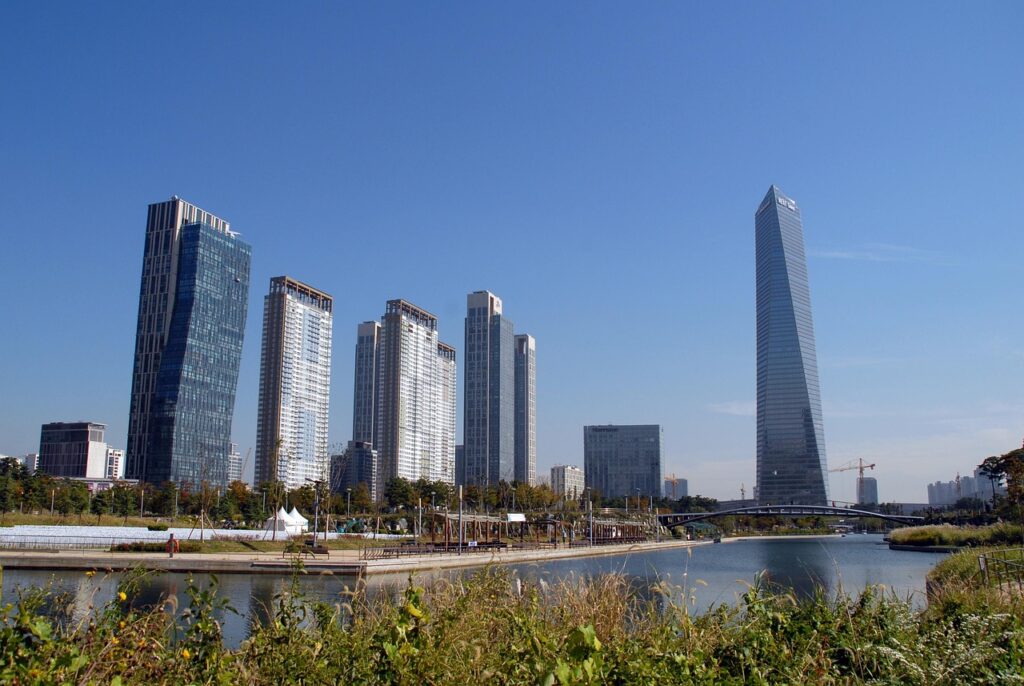
One of the most striking examples of modern Incheon is Songdo International Business District.
Songdo was developed on reclaimed land along the coast and was designed as a modern international business and residential district.
Wide roads, high-rise buildings, parks, convention facilities, universities, and advanced infrastructure have created a very different urban landscape from the old port area.
The contrast is remarkable.
In one part of Incheon, visitors can walk through a historic neighborhood filled with buildings from the late 19th and early 20th centuries.
In another part, they can see a futuristic skyline of glass towers.
This contrast is one of the defining characteristics of Incheon.
14. A City of Ports, Airports, and Connections
If Seoul represents the political and cultural heart of Korea, Incheon can be understood as one of Korea’s major gateways to the world.
Its identity has been shaped by movement.
Ships arrived at its port.
Foreign merchants established businesses.
Railways connected the city to Seoul.
People left Korea through its port and later through its airport.
Goods entered and left the country through Incheon.
Today, millions of travelers pass through the city on their way to other parts of Korea and the world.
Incheon has always been connected to somewhere else.
That is one of the most important things to understand about the city.
15. Incheon’s Islands and the Sea
Incheon is also much more than its urban areas.
The city includes numerous islands and extensive coastal areas.
Ganghwa Island (강화도) is particularly important historically.
Located at the mouth of the Han River and close to the western coast, Ganghwa has long been strategically important. It contains ancient fortifications, historic sites, and cultural heritage from different periods of Korean history.
Other islands and coastal areas offer a completely different atmosphere from downtown Incheon.
Visitors can find beaches, fishing villages, seafood restaurants, tidal flats, and quiet coastal landscapes.
This makes Incheon unusual among Korea’s major metropolitan cities.
You can experience a modern international city and a traditional island environment within the same metropolitan area.
16. Incheon Today
Modern Incheon is one of Korea’s largest cities.
It is home to a major international airport, one of Korea’s major ports, large industrial complexes, international business districts, universities, hospitals, cultural facilities, parks, and residential areas.
The city is also becoming increasingly important in industries such as bio, semiconductors, logistics, and advanced manufacturing.
At the same time, Incheon continues to preserve its older neighborhoods and historical sites.
The Open Port Area, Chinatown, Jayu Park, Incheon Landing Operation Memorial Hall, Ganghwa Island, and the old port are reminders of different chapters in the city’s history.
This combination of old and new is one of the most interesting things about visiting Incheon.