Three Different Places to Study, Read, and Concentrate
Anyone who spends time in Korea quickly notices that studying does not happen only at school or at home.
Students prepare for exams in quiet reading rooms. University students spend entire afternoons in libraries. Office workers preparing for professional qualifications study late at night in study cafés. Even during weekends and school vacations, places designed for concentration remain busy.
Three spaces are especially important in Korean study culture:
- the dokseosil (독서실), or private reading room;
- the doseogwan (도서관), or library;
- and the study café (스터디카페).
At first glance, all three may seem similar. They contain desks, chairs, lights, and people sitting quietly with books or laptops.
But they serve different purposes.
A library is a public or institutional place built around access to books, information, and study. A dokseosil is a paid private facility designed primarily for silent individual study. A study café is a newer commercial space that combines the atmosphere of a café with the rules and equipment of a study room.
Together, these places reveal an important aspect of Korean life: concentration itself has become something that can be organized, managed, and even purchased.
The Traditional Dokseosil
The word dokseosil literally means “reading room.”
However, the modern Korean dokseosil is usually not a place where people casually sit and read novels. It is primarily a place for serious study.
For decades, dokseosil have been used by:
- middle and high school students;
- university entrance exam candidates;
- university students;
- civil-service exam candidates;
- people preparing for professional licenses.
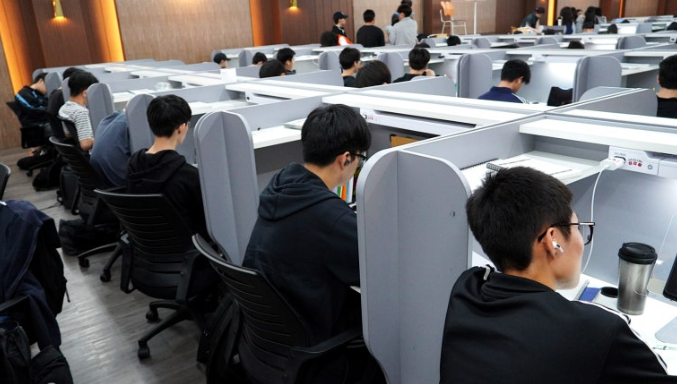
A traditional dokseosil is usually divided into rows of individual desks. Many desks have high partitions on the sides so that the student sees little more than the books directly in front of them.
The purpose is simple: remove distractions.
Talking is normally prohibited. Phone calls must be taken outside. Food may be restricted to designated areas. Movement is kept quiet, and some facilities have separate rooms for male and female users.
Students usually pay for a fixed period, such as a day, several weeks, or a month.
In the past, many dokseosil had a rather plain atmosphere. There might be fluorescent lighting, small cubicles, lockers, and little decoration. Comfort was less important than concentration.
The message of the space was clear:
You came here to study.
For students living in crowded homes, sharing rooms with siblings, or finding it difficult to concentrate near television and family activity, a dokseosil offered something valuable: uninterrupted silence.
Why Pay for a Place to Sit and Study?
To someone from another country, the idea of paying simply to sit at a desk may seem strange.
Why not study at home?
For many Koreans, the answer is discipline.
At home, there are many temptations. A student can lie down, turn on the television, open the refrigerator, play a game, or begin using a phone.
In a dokseosil, everyone around you is studying.
This creates social pressure to do the same.
Even when a student is tired, looking around and seeing twenty other people concentrating can make it difficult to stop.
The environment therefore performs part of the work of self-discipline.
Some parents also prefer their children to use a dokseosil because they know where the child is during the evening. Instead of studying alone in a café or staying at home, the student is in a supervised environment.
For older students and adults, paying a monthly fee can also create psychological commitment.
Once money has been spent, there is an additional reason to use the space regularly.
The Korean Public Library
The Korean word for library is doseogwan.
Unlike a dokseosil, a library is not primarily a commercial study business. It is a public, university, school, or institutional facility whose main purpose is to provide access to books, information, educational resources, and community services.
Public libraries can be found throughout Korean cities and towns.
Visitors may use them to:
- borrow books;
- read newspapers and magazines;
- access computers;
- use study rooms;
- attend lectures;
- participate in children’s programs;
- join reading groups;
- use digital resources.
Many libraries also provide large reading rooms filled with desks.
This is where the distinction between a Korean library and a dokseosil can sometimes become confusing for foreign visitors.
In Korea, people frequently use libraries not only to read library books but also to study from their own textbooks.
A student may enter a public library carrying mathematics workbooks, English vocabulary books, a laptop, and several highlighters, then sit for five hours without opening a single library book.
This is completely normal.
Libraries therefore function as both cultural institutions and important study spaces.
The Library as a Community Facility
Modern Korean libraries are becoming much more than rooms filled with shelves.
Newer facilities often include:
- children’s reading areas;
- multimedia rooms;
- laptop zones;
- cafés;
- lecture halls;
- exhibition spaces;
- meeting rooms;
- digital equipment;
- cultural programs.
Some libraries are architecturally impressive and are designed as public cultural destinations.
Local governments may organize writing classes, author talks, language programs, film screenings, and activities for families.
University libraries can be even more extensive, providing databases, research materials, group study rooms, printing facilities, and long opening hours.
In this sense, a library is fundamentally different from a dokseosil.
The dokseosil exists mainly to provide a quiet desk.
The library exists to provide access to knowledge and public educational resources, although it also serves as a place to study.
The Rise of the Study Café
During the 2010s, another type of study space became increasingly common in Korea: the study café.
A study café is not necessarily a real café in the traditional sense.
It may have coffee machines and drinks, but people do not go there primarily to chat with friends.
Instead, it combines the visual atmosphere of a modern café with the quiet rules of a study room.
Compared with the traditional dokseosil, study cafés often feel brighter, cleaner, and more comfortable.
They may include:
- open desks;
- private booths;
- laptop zones;
- silent rooms;
- group rooms;
- individual lighting;
- electrical outlets;
- high-speed Wi-Fi;
- lockers;
- printers;
- coffee machines;
- water dispensers.
Some are open 24 hours a day.
Many operate with very little staff.
A customer may enter using a touchscreen kiosk, choose the number of hours, pay by card or mobile payment, receive an access code, and select a seat.
When the reserved time ends, the system automatically records it.
This unmanned or semi-automated operation has become one of the defining features of Korean study cafés.
Why Study Cafés Became Popular
Study cafés became popular partly because they solved a problem with traditional dokseosil.
Dokseosil could be effective, but many felt old-fashioned and uncomfortable.
Students increasingly wanted a place that was quiet without feeling oppressive.
The study café offered a different atmosphere.
There might be warm lighting, wood-colored furniture, plants, comfortable chairs, and stylish interior design. The space could feel similar to a premium café while remaining much quieter.
For some users, this makes long study sessions easier.
A student might feel less trapped than in a narrow cubicle but still remain focused.
Study cafés are also flexible.
Instead of buying a full monthly membership, users can often purchase:
- two hours;
- five hours;
- ten hours;
- a daily pass;
- a package of multiple hours;
- or a monthly plan.
This is convenient for people whose schedules change frequently.
A university student can use one during examination week. An office worker can study for two hours after work. A job seeker can spend the entire day there.
The user chooses according to need.
A Café Where Talking Is Usually Not Welcome
The name “study café” can confuse foreign visitors.
In an ordinary café, conversation is expected.
In a study café, silence is usually expected.
Some facilities divide the interior into zones.
One area may be completely silent. Another may allow laptops. A separate room may be available for online lectures or phone calls. Group study rooms may permit conversation.
The rules vary by business, but one principle is common: do not disturb other people.
Eating strong-smelling food, speaking loudly, making phone calls at a desk, or repeatedly entering and leaving can irritate other users.
In this sense, study café etiquette is closer to library etiquette than ordinary café etiquette.
A person who walks into a study café expecting to drink coffee and talk with friends may quickly realize that the word “café” is mostly about the interior design and convenience, not socializing.
The Difference Between the Three
The easiest way to understand these spaces is to compare their main purposes.
Dokseosil
A dokseosil is primarily a paid quiet study facility.
It is usually highly structured and designed for long individual study sessions.
People often use it when preparing for important examinations.
Library
A library is primarily a public or institutional knowledge facility.
It provides books, databases, cultural programs, and reading spaces, while also functioning as a popular place for study.
Public libraries are usually free or inexpensive to use.
Study Café
A study café is primarily a commercial study space with flexible access and a modern atmosphere.
It combines privacy, technology, silence, and convenience.
The boundaries can overlap.
A modern dokseosil may look like a study café. A library may have café-style seating. A study café may contain private cubicles almost identical to those in a traditional dokseosil.
The differences are therefore becoming less rigid.
Who Uses These Spaces?
Teenagers are among the most visible users, but they are not the only ones.
Korean university students often use libraries and study cafés during examination periods.
Job seekers may spend months studying for company recruitment tests or professional certificates.
Civil-service candidates can spend years preparing for competitive examinations.
Office workers may study English, accounting, coding, or professional qualifications after work.
People preparing for real-estate, financial, legal, teaching, or technical certifications also make extensive use of these facilities.
As a result, entering a study café late at night does not necessarily mean finding only teenagers.
The person at the next desk may be a 17-year-old preparing for the Suneung.
Another may be a 25-year-old preparing for a corporate recruitment exam.
Another may be a 40-year-old employee preparing for a professional license.
Korean study culture extends well beyond childhood.
Study Spaces and Korea’s Exam Culture
The popularity of dokseosil and study cafés is closely related to Korea’s examination culture.
Important examinations influence many stages of life.
Students prepare for school exams and university admission.
University students prepare for employment.
Job seekers prepare for public-service examinations.
Workers study for qualifications and promotions.
This creates constant demand for environments where people can concentrate for long periods.
The physical design of the study space reflects this culture.
There are individual desks to prevent distraction.
There are lockers so users can leave heavy books overnight.
There are clocks everywhere.
Some facilities prohibit mobile phones in certain rooms.
Others use applications to track attendance and study time.
The study environment becomes part of the preparation strategy.
The underlying idea is that concentration should not depend entirely on willpower.
A well-designed environment can help create it.
The Growth of Managed Study Spaces
A more intensive version of the study café is the managed study room.
These businesses do more than provide desks.
They may monitor:
- arrival time;
- departure time;
- study schedules;
- break periods;
- phone use;
- daily targets.
Some send attendance information to parents.
Students may be required to submit a daily plan and later report whether they completed it.
In such facilities, customers are purchasing both a physical space and a system of supervision.
This approach is especially common among students preparing for major examinations.
For some users, it is extremely effective.
For others, it may feel restrictive.
Either way, it demonstrates how far Korea’s study-space industry has developed.
The product is no longer simply a chair and desk.
It can also include discipline, monitoring, and time management.
Studying in an Ordinary Café
Korea also has a strong culture of studying in regular cafés.
This is sometimes called cagong, short for café gongbu, meaning “studying in a café.”
University students and office workers often bring laptops and books to large coffee shops, order a drink, and remain for several hours.
Many Korean cafés provide electrical outlets, Wi-Fi, large tables, and comfortable seating, making this easy.
However, ordinary cafés have different expectations from libraries and study cafés.
People are allowed to speak.
Coffee machines make noise.
Customers come and go.
Music may be playing.
Some people prefer this background activity because complete silence makes them uncomfortable.
Others cannot concentrate and choose a study café instead.
This gives Korean students several options depending on personality:
complete silence in a dokseosil,
public study in a library,
structured comfort in a study café,
or moderate background noise in an ordinary café.
A Space for Concentration
Dokseosil, libraries, and study cafés may look like ordinary rooms filled with desks, but they reveal something larger about Korean society.
They show how seriously Koreans take the environment of learning.
When concentration is difficult at home, people go somewhere designed for concentration.
When an examination approaches, they may change not only what they study but also where they study.
The traditional dokseosil provided silence and isolation.
The library provided books and a public place for learning.
The study café added flexibility, technology, comfort, and stylish design.
Each belongs to a different stage in the evolution of Korean study culture.
And all three remain relevant.
Where Korea Goes to Study
At night, the lights of Korean schools gradually turn off.
But studying does not necessarily stop.
In a library, a university student is still reading.
In a dokseosil, a high school student is solving mathematics problems.
In a study café, an office worker is watching an online lecture for a professional examination.
They may be different ages and have different goals, but they share the same idea:
Sometimes, the place where you study is part of how you study.
For foreign visitors, Korea’s many study rooms can initially seem surprising. Why are there so many businesses devoted simply to sitting quietly?
The answer becomes clearer when viewed in the context of Korean education and employment culture.
Competition is strong, examinations matter, and many people continue studying well into adulthood.
In such a society, silence, a comfortable desk, reliable Wi-Fi, and several uninterrupted hours can have real value.
The Korean dokseosil, library, and study café are therefore not merely places with chairs and books.
They are spaces where ambition is given a desk, a lamp, and enough quiet to continue working.