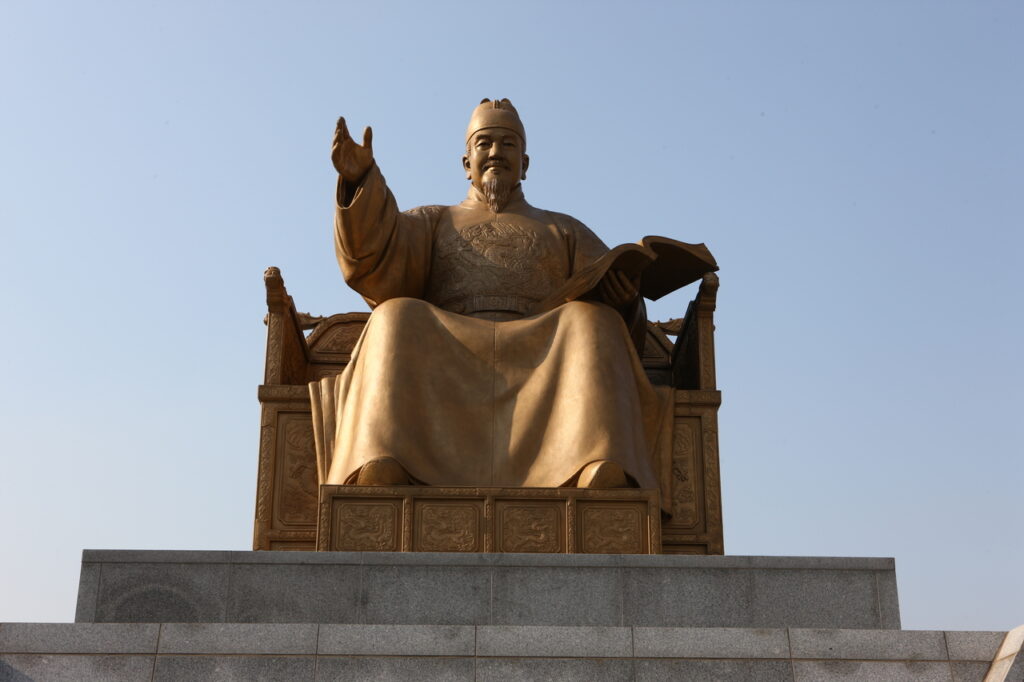

King Sejong the Great (세종대왕) is one of the most respected figures in Korean history. As the fourth king of the Joseon Dynasty, he ruled from 1418 to 1450 and made lasting contributions to Korean language, science, agriculture, music, and government.
He is best known for creating Hangeul (한글), the Korean writing system. However, his achievements went far beyond language. During his reign, scholars and officials worked to develop new technologies, improve farming, organize knowledge, and make government policies more effective.
Quick Facts About King Sejong
- Korean name: 세종대왕 (Sejong Daewang)
- Birth name: Yi Do (이도)
- Born: May 15, 1397
- Reign: 1418–1450
- Dynasty: Joseon Dynasty
- Best known for: Creating Hangeul
- Major interests: Science, agriculture, music, education, and government
- Royal tomb: Yeongneung (영릉), Yeoju, Gyeonggi Province
King Sejong was the third son of King Taejong and Queen Wongyeong. Although he was not the eldest son, he became crown prince and succeeded his father in 1418.
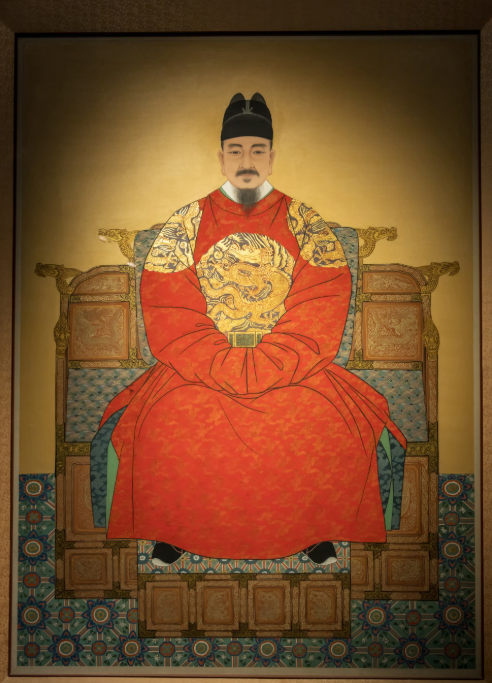
No portrait of Sejong painted from life survives. Court records show that an eojin (御眞), a royal portrait, was produced during his reign, but none has come down to us. So when the government introduced its “standard portrait” (표준영정) system in 1973, the Sejong the Great Memorial Society commissioned the painter Kim Ki-chang (Unbo, 1913–2001) to create one, and it was designated the official standard portrait that same year.
The painting is a full-length, front-facing portrait of the king seated on a dragon-carved throne. He wears the red gonryongpo robe embroidered with round gold dragon insignia (龍補) and the black winged ikseongwan cap. His hands are folded inside his sleeves, holding no object, and the background is left as a plain, warm beige.
This portrait became the face of Sejong as we know him today — on the 10,000-won banknote, on statues, and in textbooks.
Photo: Korea Heritage Service
1. A King Who Valued Learning
King Sejong believed that knowledge and learning were important for governing the country. During his reign, he supported scholars, encouraged research, and promoted practical ways to improve people’s lives. He was particularly interested in applying knowledge to real-world problems. Agriculture, astronomy, timekeeping, medicine, and music all received attention during his reign. His approach combined scholarly research with the needs of the state. Rather than focusing only on political matters, he encouraged work that could help officials govern more effectively and help people in their daily lives.
2. Jiphyeonjeon (집현전): A Place for Scholars
An institution called Jiphyeonjeon(집현전) existed before Sejong’s reign. In 1420, King Sejong expanded and reorganized it into a research institute inside the palace. It is often translated as the Hall of Worthies. Scholars there studied, researched, and worked on important royal projects. The scholars examined historical records, studied classical texts, and helped develop books and educational materials. Their work contributed to the intellectual environment of Sejong’s reign. Jiphyeonjeon is also closely associated with the history of Hangeul. The development and explanation of the new writing system involved scholarly work, although the precise roles of individual participants are not fully established in every detail. The institution reflects Sejong’s belief that careful research and scholarship could strengthen the country.
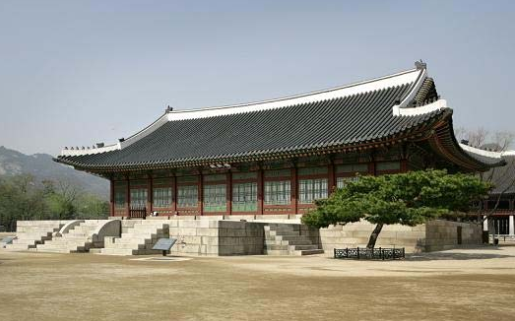
Photo: Korea Heritage Service
3. Hangeul: A Writing System for the Korean Language
King Sejong’s most famous achievement was the creation of Hangeul, originally called Hunminjeongeum (훈민정음). Before Hangeul, educated Koreans used Classical Chinese for many official and scholarly purposes. Korean people also used Chinese characters and other methods to represent Korean speech, but these methods could be difficult to learn and did not conveniently represent the Korean language. Sejong wanted people to have a writing system that was easier to learn and use.
When Was Hangeul Created?
The new writing system was created in 1443 and officially introduced in 1446 through a publication titled Hunminjeongeum. The accompanying explanation, commonly known as the Hunminjeongeum Haerye (훈민정음 해례본), described the principles behind the letters and how they worked. The original system contained 28 letters: 17 consonants and 11 vowels. Modern Korean uses 24 basic letters—14 consonants and 10 vowels—although additional combinations are used to write Korean.
How Was Hangeul Designed?
Hangeul was designed with a systematic approach to the sounds of Korean. The shapes of the basic consonants reflect aspects of the speech organs involved in pronunciation. The basic vowel symbols were developed around the traditional concepts of heaven, earth, and human beings. The letters are combined into syllable blocks. For example, the word 한글 is written as two syllable blocks: 한 and 글. This structure makes Hangeul visually distinctive and gives learners a clear way to understand how Korean syllables are written.
Why Was Hangeul Important?
Hangeul made it easier for people who did not know Chinese characters to learn to read and write Korean. Its introduction did not immediately replace Chinese characters in official writing, and widespread acceptance took time. Nevertheless, it provided a writing system specifically designed for the Korean language. Today, Hangeul is an important symbol of Korean culture and identity.
The Hunminjeongeum Haerye was inscribed on UNESCO’s Memory of the World Register in 1997. This recognition highlights the historical and scholarly importance of the document.
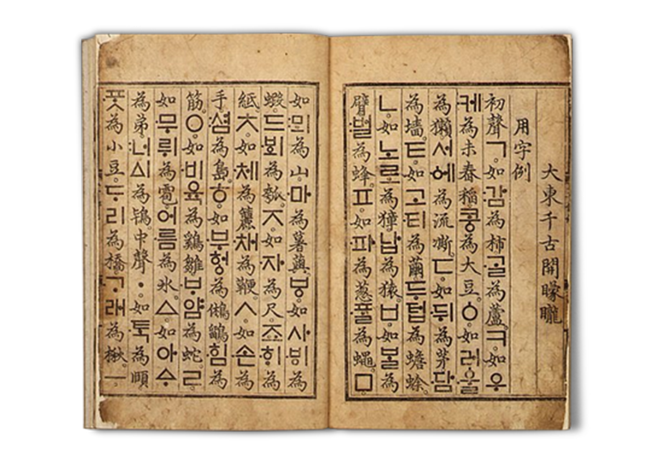
This book is a Chinese-character commentary on the newly created Hunminjeongeum, produced in 1446 (the 28th year of King Sejong) on the king’s orders, with the Jiphyeonjeon scholars — Jeong Inji foremost among them — taking the lead. Because it shares the name of the script itself, it is also called simply “Hunminjeongeum,” and since it includes the haerye (explanations and examples), it is also known as the Hunminjeongeum Haeryebon (“Hunminjeongeum with Explanations”) or the Hunminjeongeum original. It is a woodblock-printed edition in a single volume of 33 leaves, though the first two leaves are a portion restored around 1940.
Photo: Korea Heritage Service
Read Next Hangeul Day (한글날): Korea’s Celebration of Its Alphabet – Kimbap Life
4. Scientific Achievements During Sejong’s Reign
King Sejong’s reign was also notable for advances in science and technology. Scholars, officials, and skilled craftspeople worked on instruments that helped with timekeeping, astronomy, and weather observation.
Jagyeongnu (자격루): An Automated Water Clock
The Jagyeongnu was an automated water clock used to tell time. Its very name explains its purpose: jagyeok (自擊) means “self-striking,” and ru (漏) means “water clock” — a clock that strikes the hour by itself. Water-powered mechanisms triggered signals at designated times, helping officials and people in the capital keep track of the hours.
The clock works by measuring the rise and fall of water. Water poured into a large vessel at the top flows down through smaller vessels into tall receiving cylinders below. As the water level rises, a float and measuring rod trip a lever, which sends steel balls rolling into a series of hammers — and the bell, gong, and drum sound on their own, while wooden figures appear to raise signboards announcing the time.
Jang Yeong-sil produced the first such clock in 1434 (the 16th year of King Sejong), but it did not remain in use for long. The Jagyeongnu was rebuilt in 1536 (the 31st year of King Jungjong), and only part of that later clock survives today: three bronze pasuho (播水壺), the jars that supply the water, and two cylindrical bronze susubo (受水壺), the vessels that receive it. The striking mechanism itself is gone. Developed during Sejong’s reign, the clock demonstrates how mechanical technology could be used for public timekeeping and governm
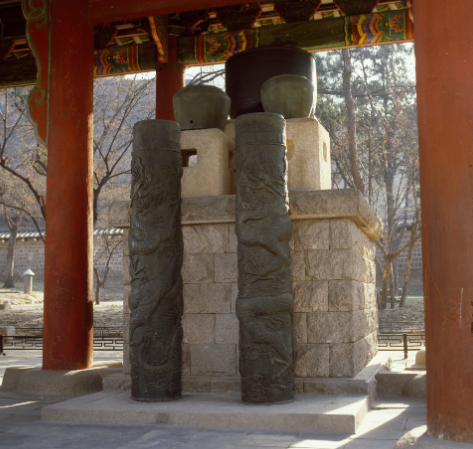
This photo shows what is left of the Jagyeongnu, the automated water clock rebuilt in 1536. It stands beneath a traditional pavilion at Changgyeonggung Palace, framed by red pillars and painted dancheong beams. Two tall bronze cylinders, cast with dragon-and-cloud reliefs, rise in front of a stepped stone pedestal; the bronze water jars that once fed them sit on top. Everything that made the clock strike — the float, the levers, the rolling steel balls and the hammers — is gone. What survives is the quiet part of the machine: the vessels that held the water.
Photo: Korea Heritage Service
Cheugugi (측우기): A Rain Gauge
Agriculture depended heavily on rainfall, so measuring precipitation was important to farmers and government officials. During King Sejong’s reign, the Cheugugi was developed as a standardized instrument for measuring rainfall — a bronze cylinder set on a stone pedestal to catch the rain, its depth read with a ruler. Historical records describe Crown Prince Hyang, who later became King Munjong, as playing an important role in its development. In 1441–1442, the government established a system for measuring and reporting rainfall, and gauges were sent out across the country. It was the world’s first nationwide rainfall observation network, roughly two centuries before Europe — an important step in the development of systematic weather observation.

The Geumyeong Cheugugi (금영 측우기) was installed at the Gongju Provincial Office — the Gamyeong of Chungcheong Province, also known by the name Geumyeong — during the Joseon dynasty. In around 1915 the Japanese meteorologist Wada Yuji (和田雄治, 1859–1918) took it out of the country; it was recovered from Japan in 1971 and has since been kept by the Korea Meteorological Administration in Seoul. Because the central government manufactured rain gauges and sent them out to every provincial office across the country, many must once have been made — but today only the Geumyeong Cheugugi is known to survive.
Although the Geumyeong Cheugugi was produced in 1837, its actual dimensions trace back to the rain-gauge system of King Sejong’s reign. With both its date of manufacture and its origins clearly documented, it is a relic that proves a scientific invention made for agriculture and its concrete implementation — and it holds great value from the perspective of world cultural history as well.
Photo: Korea Heritage Service
Angbu-ilgu (앙부일구): A Sundial
The Angbu-ilgu (앙부일구) is a sundial made in 1434 (the 16th year of King Sejong) by Jang Yeong-sil, Yi Cheon, Kim Jo and others. Its dial is concave like a cauldron, and because this “cauldron” gazes up at the sky, it was given this name. The concave face represents the round Earth, and even at a small size it effectively indicates both the hour lines and the seasonal lines.
The larger dial is 35.2 cm in diameter and 14 cm high, and was made in the late 17th century; the smaller is 24.3 cm in diameter and was made in the early 18th century. On the concave dial, seven vertical lines and thirteen horizontal lines are engraved — the vertical lines mark the hours and the horizontal lines mark the seasons. As the sun rises in the east and sets in the west, the shadow it casts falls across the hour lines, revealing the time. And because the sun’s altitude differs with each solar term, the differing length of the shadow on the seasonal lines reveals the twenty-four solar terms.
It is especially noteworthy that the Annals of King Sejong record that the twelve zodiac animals were drawn on the dial so that people who could not read could still tell the time. It is also highly significant that this sundial was placed not only within the palace but at Hyejeonggyo in Jongno and in front of Jongmyo — making it Korea’s first public clock.

This sundial has an elegant form — a small, concave cauldron shape set on four legs. The body was cast in bronze, coated in black lacquer, and the characters and lines inlaid in silver, making it no less than a work of art. A cross-shaped base beneath the legs keeps the instrument precisely level. It is the finest sundial of the Joseon dynasty and a relic of great value as scientific and cultural heritage.
Photo: Korea Heritage Service
Ganuidae (간의대): An Astronomical Observation Platform
Astronomical observation was important in traditional East Asian government because calendars, seasonal changes, and celestial events were connected to agriculture and state ceremonies. During Sejong’s reign, astronomical instruments and observation facilities were developed to improve the study of the sky and support calendar-making. These achievements show that science during the Joseon Dynasty was closely connected to practical needs.
5. Jang Yeong-sil: An Inventor in Sejong’s Court
Jang Yeong-sil (장영실) is one of the best-known inventors associated with King Sejong’s reign. Despite his low social status at birth, Jang gained recognition for his technical abilities and worked on scientific instruments under royal support. He is associated with the development of devices such as the Jagyeongnu and other instruments used for astronomical observation and timekeeping. The historical record does not always make it easy to assign every invention to a single person, but Jang’s name remains closely connected to the technological achievements of the period. His story is often remembered as an example of the importance of practical skill and technical knowledge in Sejong’s court.
6. Improving Agriculture and Medicine
King Sejong understood that the prosperity of Joseon depended heavily on agriculture. Better farming knowledge could help officials and farmers respond to local conditions and improve food production.
Nongsa Jikseol (농사직설)
Published in 1429 during the reign of King Sejong, Nongsa Jikseol (농사직설) was an important agricultural book in Korean history. Before its publication, farming knowledge often came from Chinese agricultural texts, which did not always reflect Korea’s local environment. To address this problem, the book collected farming techniques used by experienced Korean farmers. It emphasized practical methods suited to the country’s climate, soil, and agricultural conditions. By recording local knowledge, Nongsa Jikseol helped make farming information more relevant and useful to Korean farmers. The book also reflected the Joseon government’s efforts to improve agriculture and support the people’s livelihoods. It became an important reference for agricultural development and helped preserve traditional farming knowledge for future generations.
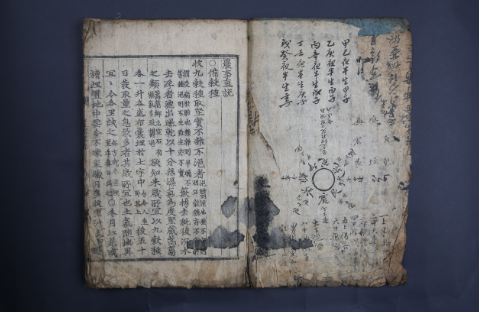
An old copy of Nongsa Jikseol featuring traditional Chinese characters written on aged paper. The surviving pages show signs of wear, discoloration, and damage, offering a glimpse into the physical history of this valuable historical document.
Photo: Korea Heritage Service
Hyangyak Jipseongbang (향약집성방)
Completed in 1433 during the reign of King Sejong, Hyangyak Jipseongbang (향약집성방) was an important medical compilation in the history of Korea. It brought together a wide range of knowledge about medicinal herbs, diseases, and medical treatments. One of the book’s main goals was to make medical knowledge more suitable for Korea’s own environment. It drew on existing medical texts and information about medicinal materials available locally, helping organize this knowledge into a useful reference for medical practitioners. The compilation reflected the Joseon government’s efforts to develop medicine by making better use of local resources and traditional knowledge. It also contributed to the preservation of Korean medical practices and the development of a medical tradition adapted to the country’s needs. Today, Hyangyak Jipseongbang remains an important historical record of how people in early Joseon Korea understood medicinal plants and organized medical knowledge.
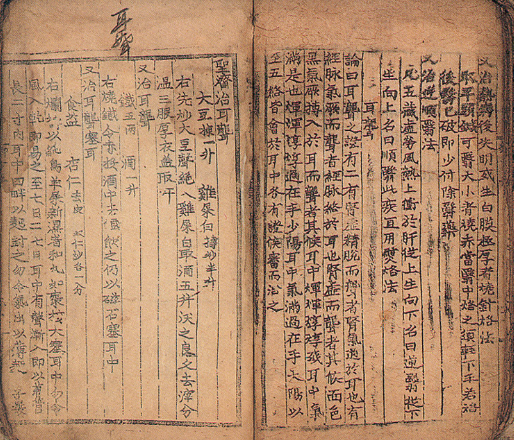
An open historical edition of Hyangyak Jipseongbang, displaying pages of traditional Chinese characters arranged in vertical columns. The aged paper and carefully structured text offer a glimpse into the format of medical books produced during Korea’s Joseon Dynasty.
Photo: Korea Heritage Service
Uibang Yuchwi (의방유취)
Completed in 1445 during the reign of King Sejong, Uibang Yuchwi (의방유취) was one of the largest medical encyclopedias produced in Korea during the Joseon Dynasty. It brought together medical knowledge from a wide range of existing texts, creating an extensive reference for the study and practice of medicine. The compilation was part of the Joseon government’s efforts to preserve valuable medical knowledge and make it easier for physicians and scholars to consult. By collecting and organizing information from numerous sources, the editors created a comprehensive resource that helped preserve earlier medical writings for future generations. The work was completed in 1445, but its large scale made publication a lengthy process. It was eventually printed in 1477 during the reign of King Seongjong. The encyclopedia originally consisted of 365 volumes, reflecting the remarkable scope of the project. Uibang Yuchwi remains an important historical work because it demonstrates the Joseon dynasty’s commitment to organizing medical knowledge and preserving the intellectual heritage of traditional Korean medicine.

An open volume of Uibang Yuchwi showing traditional Chinese characters arranged in vertical columns across two facing pages. The worn edges, aged paper, and damaged section on the right page reveal the physical marks left by time on this historical medical text.
Photo: Korea Heritage Service
7. Astronomy, Calendars, and Printing
Astronomy and calendar-making were important to the Joseon government. Calendars helped organize agricultural activities, official events, and seasonal observations. Chiljeongsan (칠정산), a major astronomical and calendrical work completed during Sejong’s reign, included calculations for understanding celestial movements and preparing calendars suited to the region.
Printing technology also supported scholarship and administration. Metal movable type, including the Gyeongja type of 1420 and the Gapinja type of 1434, helped produce books and official materials. Printing books required skilled workers, resources, and considerable planning. The ability to reproduce texts was valuable for preserving knowledge and distributing information among scholars and officials.
8. Reforming the Tax System
King Sejong also worked to improve the government’s tax system. Agricultural taxes were especially important because farming was central to the economy. However, harvests differed according to land quality, weather, and local conditions. A uniform system could place an unfair burden on some farmers.
In 1430, the government gathered public opinions about a proposed tax reform. The process revealed different views among regions and social groups. Rather than adopting a new system immediately, the government continued discussing and revising the proposal.
A revised system, known as gongbeop (공법), was developed through an extended process and moved toward implementation in 1444. It classified farmland by productivity and considered harvest conditions when determining tax obligations.
The reform illustrates Sejong’s interest in gathering information and considering different perspectives before making policy decisions. It also shows that even an ambitious reform could involve years of debate and adjustment.
9. Government, Law, and Public Administration
King Sejong’s reign included efforts to improve the operation of government and the organization of legal and administrative knowledge. Officials collected records, revised documents, and worked to make policies more consistent. These activities helped strengthen the administrative foundations of the Joseon Dynasty.
However, Joseon remained a hierarchical society in which social status strongly influenced people’s rights and opportunities. Sejong’s reforms did not remove these inequalities. His legacy is best understood by considering both the achievements of his reign and the social structures of the time.
10. Music and Royal Ceremonies
King Sejong was interested in music as well as science and scholarship. Music played an important role in royal ceremonies, state rituals, and cultural life.
With the help of musicians and scholars, including Park Yeon (박연), the court worked to organize musical theory, instruments, and performance practices.
Instruments such as the pyeonjong (편종), a set of tuned metal bells, and the pyeongyeong (편경), a set of tuned stone chimes, were used in ceremonial music.
Sejong’s court also developed Jeongganbo (정간보), a notation system that organized musical sounds in a grid-like format. It provided a way to record aspects of music more systematically.
Ceremonial compositions such as Botaepyeong (보태평) and Jeongdaeeop (정대업) became important parts of royal ancestral rites.
These projects show that Sejong’s cultural achievements extended beyond written language and scientific instruments.
11. Expanding and Defending the Northern Frontier
During Sejong’s reign, Joseon worked to strengthen its northern frontier. Military campaigns and settlement policies helped establish the Four Counties and Six Garrisons, known in Korean as Sagun Yukjin (사군육진). These developments expanded the state’s effective control in the north and helped establish a more secure border.
Joseon also carried out a military expedition to Tsushima in 1419, during Sejong’s early reign. The campaign took place in response to persistent maritime raiding and was part of the dynasty’s broader efforts to address security concerns.
These events formed part of the political and military context of the period. Sejong’s legacy therefore includes both cultural achievements and the practical challenges of governing and defending a kingdom.
12. The Personal Challenges of a King
Although Sejong’s reign is often remembered as a period of cultural and scientific achievement, his family life also involved serious difficulties. After stepping down, his father, King Taejong, remained in control of the military and stayed politically influential as retired king. Sejong’s in-laws were caught up in the political conflicts of this period. His father-in-law, Shim On (심온), was ordered to take poison in late 1418, shortly after Sejong became king. Taejong feared that the queen’s family could become too powerful. The case shows that even royal relatives were not safe from the dangers of court politics. Sejong also experienced personal and family losses during his reign. These events offer a more complete picture of the king. His achievements took place within a demanding political system, and his life was not free from conflict or grief.
13. King Sejong’s Death and Royal Tomb
King Sejong died in 1450 after ruling for 32 years. He was buried beside his wife, Queen Soheon, who had died in 1446. Their royal tomb is called Yeongneung (영릉) and is located in Yeoju, Gyeonggi Province. The tomb was originally established near the tomb of Sejong’s father, King Taejong. In 1469, during the reign of King Yejong, it was moved to its present location. Yeongneung is a joint tomb of King Sejong and Queen Soheon. It is part of the Royal Tombs of the Joseon Dynasty, which are recognized as a UNESCO World Heritage Site. Visitors can explore the royal tomb grounds.
14. Where to Learn More About King Sejong in Korea
If you are interested in Korean history, several places can help you explore King Sejong’s life and achievements.
Sejong Story (세종이야기), Seoul
Sejong Story is a free exhibition space dedicated to King Sejong, located underground beneath the King Sejong statue in Gwanghwamun Square in central Seoul. Exhibits introduce his life, Hangeul, scientific achievements, and cultural contributions. The Admiral Yi Sun-sin exhibition (충무공이야기) is right next door, so you can see both in one visit. It is a useful place to begin learning about the king while visiting central Seoul.
- Admission: Free
- Hours: 10:00–18:30 (last entry 18:00)
- Nearest station: Gwanghwamun Station (Line 5)
- Extended hours: 10:00–21:00 on Tuesdays, Wednesdays, Fridays, Saturdays, and Sundays through November 30 (last entry 20:30)
- Closed: Mondays. If Monday is a public holiday, it stays open and closes the next weekday instead.
Sources: Sejong Center – Sejong Story & Admiral Yi Sun-sin Story visitor information · Sejong Center (English) – The Story of King Sejong
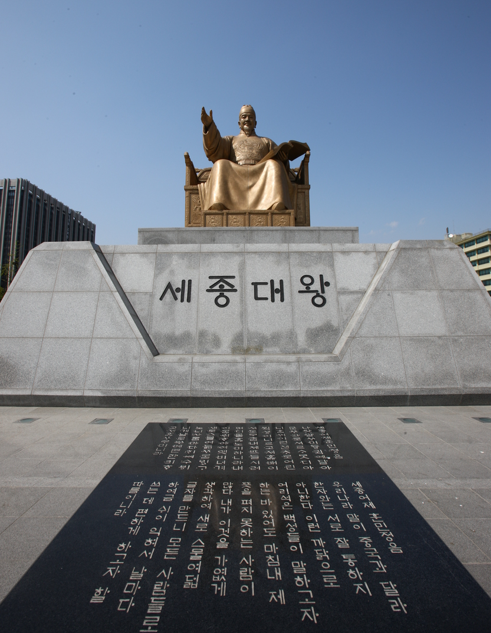
Photo: Korea Tourism Organization
Gyeongbokgung Palace (경복궁), Seoul
Gyeongbokgung was the main royal palace of the Joseon Dynasty. Sejong was crowned at Geunjeongjeon, the main throne hall. Jiphyeonjeon stood at Sujeongjeon (수정전), which still stands in the palace today. Sujeongjeon is west of Geunjeongjeon and just south of Gyeonghoeru Pavilion. It served as Jiphyeonjeon during Sejong’s reign, was destroyed during the Imjin War, and was rebuilt under King Gojong, when it received its current name. Walking through the palace grounds offers a glimpse into the political and ceremonial world in which King Sejong lived and ruled.
- Hours: They change by season. March–May and September–October, 09:00–18:00 (last entry 17:00). January–February and November–December, 09:00–17:00 (last entry 16:00). In June–August, it stays open later.
- Closed: Tuesdays
- Admission: Check the official page
Sources: Royal Palaces and Tombs Center – Opening Hours · Royal Palaces and Tombs Center – Admission Fees · Encyclopedia of Korean Culture – Sujeongjeon Hall at Gyeongbokgung
Yeongneung Royal Tomb (영릉), Yeoju
Yeongneung is the burial place of King Sejong and Queen Soheon, who lie together in one mound. It is the first Joseon royal tomb built this way. Located in Yeoju, the site offers a quieter setting for learning about the king’s life and the traditions of Joseon royal tombs.
- Address: 269-10 Yeongneung-ro, Sejongdaewang-myeon, Yeoju-si, Gyeonggi-do (경기 여주시 세종대왕면 영릉로 269-10)
- Getting there: Take the Gyeonggang Line to Sejong Daewangneung Station or Yeoju Station, then a local bus. From Sejong Daewangneung Station, take buses 950, 961-1, 955-1, or 962.
- Phone: 031-885-3123
- Hours and admission: Check the official page
Sources: Royal Palaces and Tombs Center – Directions to Yeongneung, Yeoju · Encyclopedia of Korean Culture – Yeongneung, Yeoju
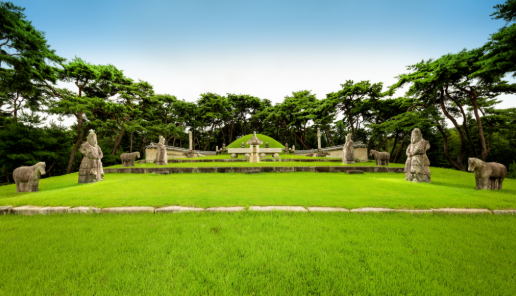
the burial place of King Sejong and Queen Soheon, who lie together in one mound.
Photo: Korea Heritage Service