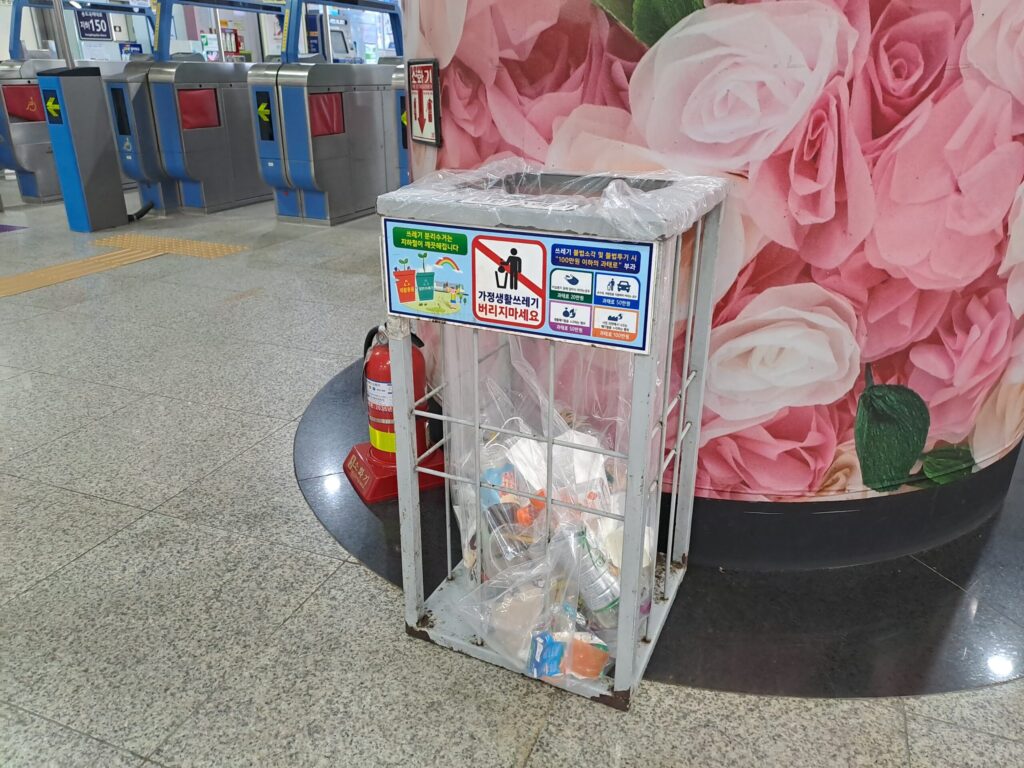

If you buy a coffee, eat a snack, or pick up a takeaway meal while walking around South Korea, you may notice something unexpected: public trash bins can be surprisingly difficult to find. In some countries, trash cans are placed along most streets. In Korea, however, you may walk for several blocks without seeing one. Even when you find a bin, it may be intended for specific types of waste, such as recyclable bottles or cans. This can be confusing for foreign visitors who simply want to throw away a coffee cup, food wrapper, or empty drink bottle. Understanding where to look for public trash bins, what you can put in them, and what to do when there is no bin nearby will make everyday life in Korea much easier.
Why Are Public Trash Bins Difficult to Find in Korea?
Public trash bins are available in Korea, but they are not installed on every street corner. You are more likely to find them in certain public areas, such as subway stations, bus terminals, parks, shopping areas, and other managed facilities.
Their availability and the types of waste they accept vary by location.
Korea also operates a waste-disposal system in which households generally pay for the disposal of ordinary waste through designated pay-as-you-throw garbage bags, known as 종량제봉투 (jongnyangje bongtu). Waste is separated into categories such as general waste, food waste, and recyclables.
Public trash bins are therefore not intended to replace the household waste-disposal system. You should not assume that a public bin is available for every kind of rubbish you produce.
Where Can You Find Public Trash Bins in Korea?
If you need to throw something away while walking around, try the following places.
1. Subway Stations
Subway stations are useful places to check, especially when you are traveling around Seoul or another major city. However, not every station has a trash bin in every area. Some bins may be located near station entrances, ticket gates, platforms, or other designated areas, depending on the station. Follow any signs indicating waste separation, and do not leave rubbish on a platform or near a ticket machine if you cannot find a bin.
2. Parks and Public Recreation Areas
Parks, riverside walking paths, and other public recreation areas may have waste bins in designated locations. Some facilities provide separate containers for general waste and recyclables. Others may have limited disposal facilities, so check the signs before throwing anything away. If you are having a picnic, it is a good idea to bring a small bag for your rubbish rather than relying on finding a nearby bin.
3. Bus Terminals and Major Transport Facilities
Large bus terminals and other transport facilities may provide waste-disposal stations, particularly in waiting areas. Look for designated bins inside the facility. Their availability may differ between indoor waiting areas, outdoor platforms, and individual transport stops. A small bus stop on an ordinary street may not have a trash bin at all.
4. Shopping Malls and Department Stores
Large shopping malls and department stores often have waste-disposal areas, particularly near food courts, dining areas, and shared seating spaces. If you have finished eating, look around the dining area for a designated waste station. These stations may separate general waste, paper, plastic, cans, and bottles. Follow the labels rather than putting everything into one container.
5. Cafés and Fast-Food Restaurants
If you buy a drink or meal to take away, you may be able to dispose of the packaging at the establishment where you purchased it. Some cafés and fast-food restaurants have designated waste stations for customers, while others have limited disposal facilities. Check the instructions before using a bin. If you are unsure whether customers may use it for takeaway packaging, ask a staff member. Do not assume that every café or convenience store will accept rubbish from items purchased elsewhere.
What Types of Waste Can You Put in Public Trash Bins?
The correct bin depends on the facility and its instructions. You may encounter the following Korean labels.
일반쓰레기 (ilban sseuregi) — General waste
This category is for waste that is not accepted as recyclable material or food waste under the applicable local rules.
재활용 (jaehwalyong) — Recycling
This indicates a recycling collection area. Depending on the facility, separate bins may be provided for different materials.
플라스틱 (peullaseutik) — Plastic
캔 (kaen) — Cans
병 (byeong) — Bottles
종이 (jong-i) — Paper
Not every public waste station has all these categories. Some provide only general waste and a limited number of recycling bins.
When separate bins are available, follow the labels and keep different materials apart.
How to Dispose of a Coffee Cup or Takeaway Drink
Coffee cups and takeaway drinks are among the most common sources of confusion for visitors.
If you have finished your drink, follow these steps when a suitable waste station is available.
- Empty the remaining liquid. Use a designated liquid-disposal area if one is provided.
- Check the cup and lid. Some facilities ask you to separate the lid, cup, and straw.
- Read the bin labels. Paper cups, plastic cups, and other packaging may be collected differently depending on the facility.
- Follow the local instructions. Do not assume that all cups belong in the same recycling bin.
A paper cup is not necessarily accepted in the same recycling stream as ordinary paper. Likewise, a plastic cup may have different disposal instructions from a plastic bottle.
If the facility does not explain how to dispose of a particular item, ask staff rather than guessing.
What Should You Do If There Is No Trash Bin?
This is one of the most useful things to know when visiting Korea. If you cannot find a public trash bin, keep your rubbish with you until you find an appropriate place to dispose of it. You can carry a small reusable bag or keep an extra bag in your backpack to hold empty wrappers, tissues, and drink containers temporarily. You can then look for a designated waste station at a subway station, shopping mall, park, or another public facility. Do not leave rubbish beside a pole, on a bench, near a vending machine, or next to an overflowing bin. Waste should be placed only in locations or facilities designated for collection. Korea’s Waste Control Act prohibits disposing of waste outside designated collection locations or in ways that do not follow the applicable rules.
Can You Put Household Garbage in a Public Trash Bin?
You should not treat public trash bins as a place to dispose of household garbage. Korean households generally use designated pay-as-you-throw bags for ordinary waste and follow local instructions for food waste and recycling. The exact disposal method can differ by municipality and housing type. For example, if you are staying in an apartment or a guesthouse, ask the host where residents should dispose of their rubbish. Do not put a bag of household garbage into a small street bin simply because it is nearby. Use the designated collection facilities and follow the local rules. This distinction is particularly important if you are staying in Korea for several weeks or months.
What About Food Waste?
Food waste is handled separately from ordinary rubbish in many Korean residential waste-disposal systems. However, a public trash bin is not automatically a food-waste bin. If you have leftover food from a takeaway meal, check whether the restaurant or food court provides a designated container for food waste. If no suitable container is available, do not leave the food beside an ordinary trash bin. The rules for food-waste disposal vary by local authority and facility. For residential disposal in particular, follow the instructions provided by your accommodation or local government.
How to Find Local Waste-Disposal Information
If you are staying in Korea for an extended period, the rules for disposing of household rubbish are worth learning. You can check the website of the local district office or city government for information about general waste, food waste, recycling, and designated collection locations. For example, Seoul provides an official guide to waste disposal for residents and foreign visitors:
Seoul Metropolitan Government — Waste Disposal Guide
If you live in Incheon, you can also consult the city’s official English-language guide:
Incheon Metropolitan City — Residential Waste Disposal
These guides explain household waste-disposal procedures. Remember that the precise requirements may differ between cities and districts.
What Foreign Visitors Should Remember
Public trash bins in Korea can be less common than visitors expect, and the bins you find may have specific purposes.
When you are out sightseeing, shopping, or eating, keep these points in mind:
- Look for waste stations in subway stations, parks, shopping malls, and other managed public facilities.
- Check the labels before disposing of recyclable items.
- Empty leftover drinks where a suitable disposal facility is provided.
- Do not assume that a café or convenience store will accept rubbish from outside.
- If there is no suitable bin, carry your rubbish until you find one.
- For household garbage, follow the disposal instructions provided by your accommodation or local government.
Once you understand this system, managing everyday rubbish in Korea becomes much easier. The most useful habit is simple: find a designated place for your waste rather than expecting a trash bin to be available on every street.