
If you need to do laundry in South Korea, you have several options. You can wash your clothes at home or at your accommodation, use a self-service coin laundry, or take certain clothes to a professional laundry and dry-cleaning shop.
Unlike in some countries where laundromats are a regular part of everyday life, many Koreans do most of their laundry at home. Korean homes generally have washing machines, and modern Korean washing machines offer a wide range of washing and drying functions.
So when do Koreans use a coin laundry or a professional laundry shop?
The answer depends on what you need to wash.
For ordinary clothes, home washing is usually the easiest option. Coin laundries are particularly useful for large items, large amounts of laundry, or when you need a powerful dryer. Professional laundry shops are commonly used for suits, coats, delicate clothing, and items that require special care.
Understanding these three options will make doing laundry in Korea much easier.
Three Ways to Do Laundry in Korea
There are three common choices.
Wash at home or at your accommodation
Best for everyday clothes such as T-shirts, underwear, socks, pajamas, towels, and casual clothing.
Self-service coin laundry (셀프빨래방 / 코인빨래방)
Best for large loads, blankets, bedding, bulky clothing, and situations where you need a large dryer.
Professional laundry or dry-cleaning shop (세탁소)
Best for suits, coats, delicate clothing, formal wear, and clothing that requires professional cleaning or pressing. You do not necessarily need to use a coin laundry just because you are staying in Korea. If your accommodation has a washing machine, using it is usually the simplest and cheapest option.
Washing Clothes at Home in Korea
Korean households commonly have their own washing machines. Modern Korean washing machines are generally well equipped, with programs for different fabrics and washing conditions. Many models have functions for delicate clothing, bedding, baby clothes, quick washing, steam, high-temperature washing, and other specialized cycles. Some newer models also combine washing and drying in the same appliance. For everyday laundry, therefore, many Koreans simply use the washing machine at home.
This is particularly common for:
- T-shirts
- Underwear
- Socks
- Pajamas
- Towels
- Casual shirts
- Everyday pants
- Bedding that fits in the washing machine
If you are staying in an apartment, officetel, guesthouse, or long-term accommodation, check whether a washing machine is provided before looking for a laundromat. For a short stay, this can be especially convenient because you may not need to carry several weeks’ worth of clothes.
Why Use a Coin Laundry in Korea?
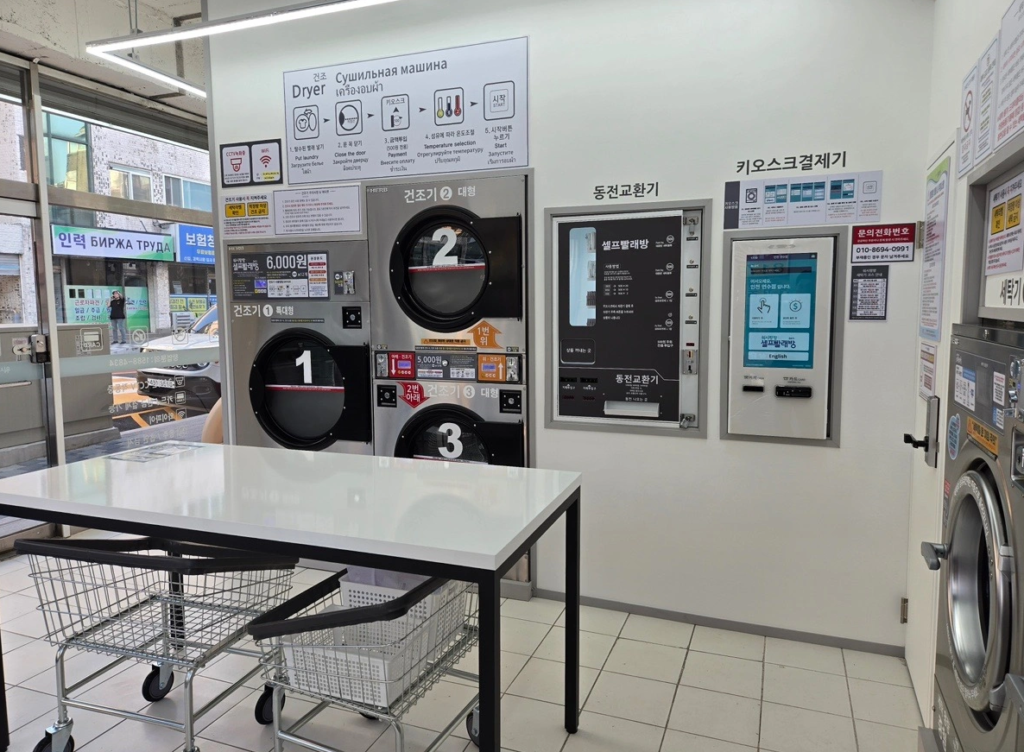
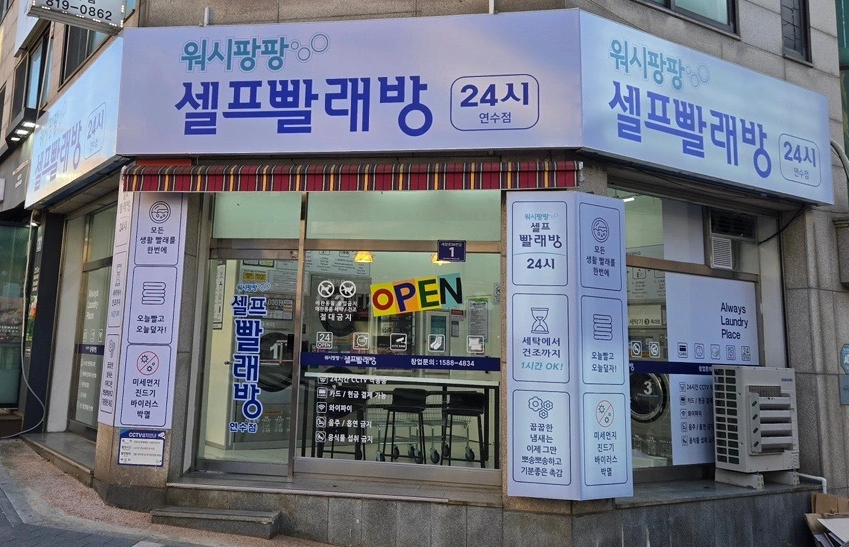
A Korean coin laundry is called 셀프빨래방 (selpeu-ppallaebang) or 코인빨래방 (koin-ppallaebang). It is a self-service laundry where you operate the washing machines and dryers yourself. The biggest advantage is not necessarily the washing itself. It is the large machines and large dryers. For example, a normal apartment washing machine may not be large enough for a thick winter blanket. A coin laundry usually has much larger machines designed for bedding and bulky items.
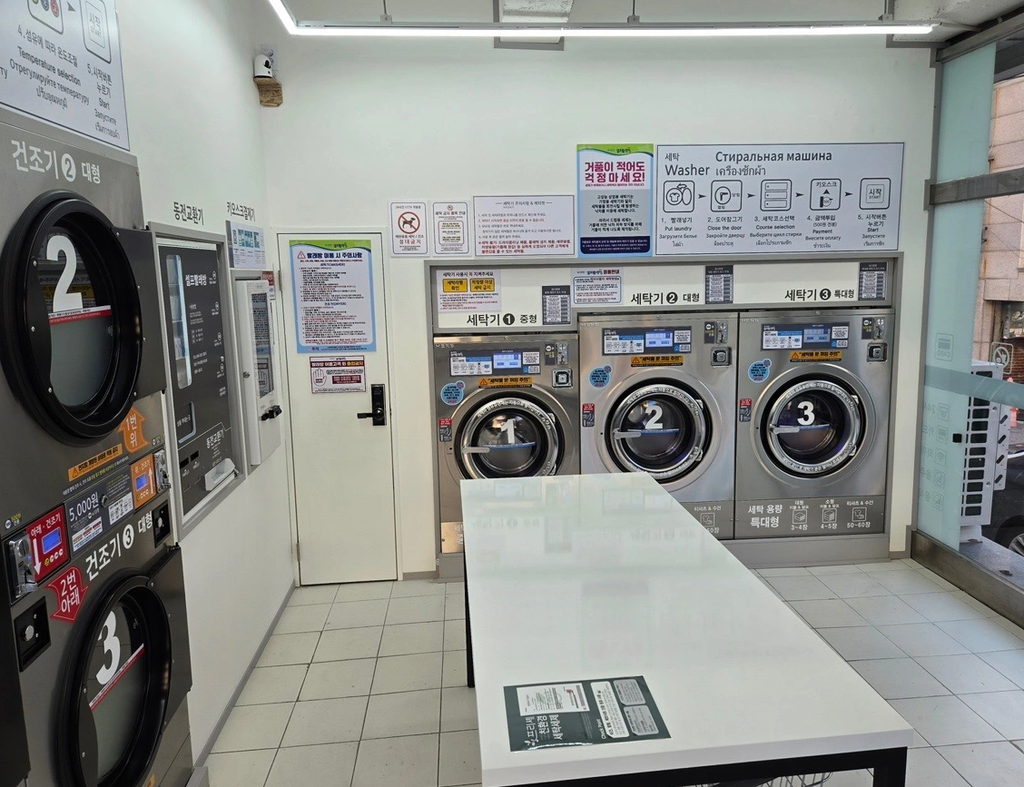
Coin laundries are particularly useful for:
- Blankets and comforters
- Large bedding
- Sleeping bags
- Thick winter clothing
- Large amounts of laundry
- Clothes that need quick drying
- Laundry when your accommodation has no washing machine
- Laundry when you do not have access to a dryer
They are also useful during Korea’s hot and humid summer or during the rainy season, when air-drying clothes can take a long time.
How Much Does a Korean Coin Laundry Cost?
Prices vary depending on the location, machine size, and washing program.
As a general guide, a standard washing cycle at a self-service laundromat may cost around ₩4,000–₩6,000, while a dryer may cost another ₩3,500–₩5,000 or more, depending on the drying time and machine.
A complete wash-and-dry cycle often costs roughly ₩8,000–₩12,000.
Large machines for blankets and other bulky items cost more.
These are only approximate prices. Always check the price displayed on the machine or payment kiosk before starting the cycle.
Some laundromats also offer additional options such as hot-water washing, extra rinsing, antibacterial washing, or longer drying.
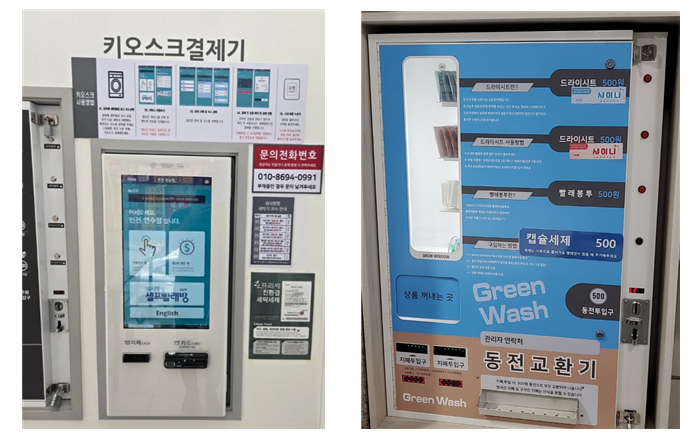
Do You Need Coins?
Despite the name “coin laundry,” you may not actually need coins. Many modern Korean self-service laundromats use a central payment kiosk, card payment, or other electronic payment methods. Some locations still use coins, and payment methods vary from one store to another. Do not assume that every laundromat works the same way. Check the payment instructions before putting your clothes into the machine.
Is Detergent Provided?
This also depends on the laundromat. Many modern self-service laundromats automatically add detergent and fabric softener when you start the washing cycle. Other stores may require you to add detergent yourself or purchase it from a vending machine.
Look for:
세제 (seje) — detergent
섬유유연제 (seomyu-yuyeonje) — fabric softener
If you are unsure, check the machine instructions before adding anything. Adding extra detergent to a machine that already automatically dispenses detergent can result in too much soap and may make rinsing difficult.
How to Use a Coin Laundry in Korea
The exact procedure varies by store, but the basic process is usually straightforward.
1. Choose the right washing machine
Look at the capacity of the machines. Small machines are suitable for ordinary clothes, while large machines are designed for blankets, bedding, and bulky items. Do not overfill the machine. Clothes need enough space to move around in the drum for proper washing.
2. Check the instructions
Before paying, check:
- Washing price
- Machine capacity
- Washing temperature
- Whether detergent is automatic
- Payment method
- Washing time
- Dryer instructions
Some machines have English instructions, but many use Korean.
Useful words include:
세탁 (setak) — washing
건조 (geonjo) — drying
세제 (seje) — detergent
표준 (pyojun) — standard
강력 (gangnyeok) — strong/intensive
온수 (onsu) — hot water
냉수 (naengsu) — cold water
시작 (sijak) — start
정지 (jeongji) — stop
3. Put your clothes in the machine
Check your pockets before putting clothes into the washer. Separate items according to the washing instructions on the clothing labels, especially if you are washing delicate or expensive clothing. Do not put clothes that require professional dry cleaning into a regular washing machine.
4. Select the washing program and pay
Choose the appropriate program and pay using the method available at that store. Once the machine starts, the washing cycle usually takes around 30–40 minutes, although this varies by machine and program.
5. Move the clothes to the dryer
After washing, move your clothes to a dryer if you want to dry them there. Check the clothing labels first. Some fabrics can shrink or become damaged at high temperatures. For ordinary cotton clothing, a standard drying cycle may be suitable. Delicate clothing may need to be air-dried instead.
6. Check whether the clothes are completely dry
Large or thick items may require additional drying time.
This is particularly true for:
- Blankets
- Thick towels
- Padded clothing
- Heavy cotton items
Instead of automatically paying for a very long cycle, check the clothes near the end of the cycle and add more drying time if necessary.
What Is a Korean Laundry Shop?
A professional laundry shop is called 세탁소 (setakso). Unlike a self-service laundromat, you hand your clothes to a staff member, and the shop cleans them for you. You may also see 드라이클리닝 (dry cleaning) written on signs or service menus. A Korean 세탁소 is not necessarily limited to dry cleaning. Depending on the shop, it may offer washing, dry cleaning, stain removal, ironing, pressing, shoe cleaning, and repairs. Many neighborhood laundry shops are small local businesses, while franchise chains are also common.
What Do Koreans Take to a Professional Laundry?
Professional laundry shops are commonly used for clothing that people do not want to wash themselves.
Typical examples include:
- Suits
- Suit jackets and trousers
- Wool coats
- Formal clothing
- Delicate sweaters
- Certain dresses
- Padded winter clothing
- Clothing with difficult stains
- Expensive or special-care clothing
People also use professional laundry shops when an item needs ironing or pressing to maintain its shape.
For example, if you have a business suit that needs to look neat for a meeting, taking it to a local 세탁소 is usually more practical than trying to wash and iron it yourself.
Is a Korean Laundry Shop Expensive?
For many ordinary clothing items, professional laundry service in Korea is not necessarily very expensive. Prices vary by region, store, material, size, and the condition of the clothing. As a rough guide, a shirt may cost several thousand won, while jackets, coats, and other larger or more complicated items cost more. A suit jacket may cost around ₩5,000–₩10,000 or more, while coats and padded winter clothing can cost ₩10,000–₩30,000 or more, depending on the garment. Special materials, difficult stains, luxury clothing, leather, fur, or other items requiring special treatment may cost considerably more. Always ask about the price before leaving expensive clothing at a laundry shop.
How to Find a Laundry in Korea
The easiest way to find a self-service laundromat is to search a Korean map service. On Naver Map (네이버 지도) or KakaoMap (카카오맵), try these search terms:
셀프빨래방 — self-service laundromat
코인빨래방 — coin laundromat
빨래방 — laundromat
세탁소 — laundry shop
드라이클리닝 — dry cleaning
Search results can vary depending on the area, so checking the individual store listing for opening hours and reviews is useful. Many self-service laundromats operate without staff, and some are open 24 hours, but this is not true of every location.
One More Option: Laundry Pickup and Delivery
Korea also has laundry services that pick up your clothes and return them after cleaning. These services are particularly useful for people who live in Korea but do not have time to visit a laundry shop. Depending on the service, you can request pickup through an app or website, place the laundry outside your door, and receive it back after cleaning. This can be more expensive than washing clothes yourself, but it can be convenient for people staying in Korea for a longer period.
Which Laundry Method Should You Use?
Korea gives you more than one way to deal with laundry. For everyday clothing, washing at home is usually the most convenient and economical choice, because most Korean homes are equipped with modern washing machines. For blankets, bedding, large loads, or clothes that need a powerful dryer, a self-service coin laundry (셀프빨래방) can be a better option. For suits, coats, delicate clothing, formal wear, or items that require professional cleaning, use a professional laundry shop (세탁소). The important point is that a coin laundry is not the standard way Koreans do all their laundry. It is one part of Korea’s broader laundry system, alongside well-equipped home washing machines and neighborhood professional laundry shops. Once you know which option is appropriate for your clothes, doing laundry in Korea is usually much easier than it first appears.