
Understanding Seats for Older Passengers, Pregnant Women, and Passengers with Disabilities
When visitors first ride a subway in Korea, they often notice that not all seats look the same.
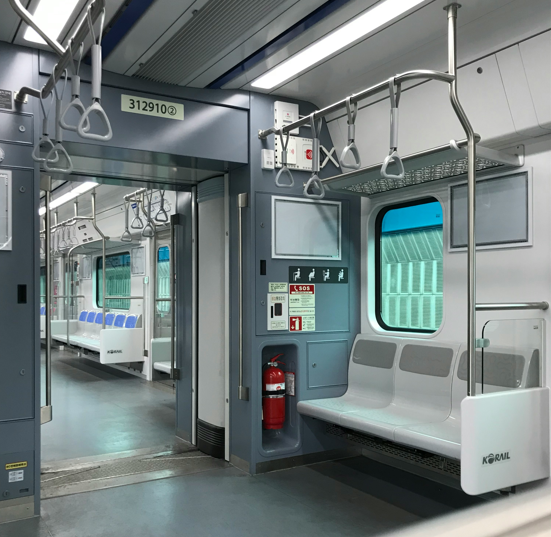
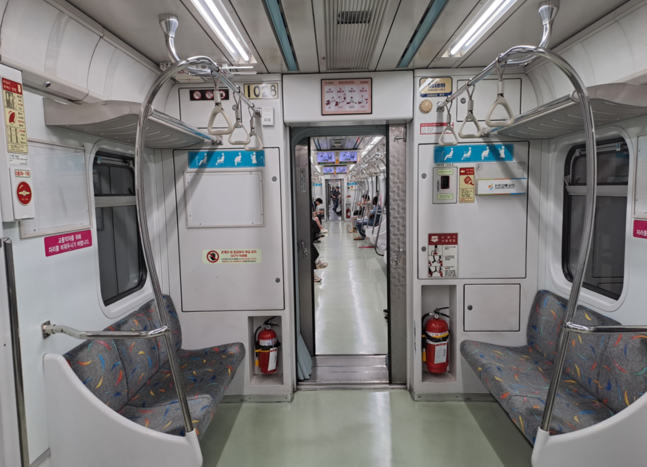
Near the ends of a subway car, there are usually seats marked with pictures of older people, pregnant women, passengers using crutches, or adults carrying small children. Near the middle of the car, bright pink seats are reserved for pregnant passengers. Close to some doors, there may also be an open area marked with a wheelchair symbol.
These seats and spaces are more than colorful decorations. They represent an important social agreement: people who may have greater difficulty standing or moving safely should be given priority.
To understand Korean subway etiquette, the most useful question is not simply, “Am I allowed to sit here?” A better question is, “Is there someone nearby who needs this seat more than I do?”
Priority Seats Are Not Only for Older People
In everyday Korean, priority seats are often called noyakjaseok (노약자석). The word is commonly understood as meaning “seats for older or physically weak people.”
However, this everyday expression can be misleading because the seats are intended for a much wider range of passengers.
A more inclusive official term is gyotong yakja baeryeoseok (교통약자 배려석), meaning “priority seats for people with limited mobility.” Under Korea’s Act on Promotion of Transportation Convenience for Mobility Disadvantaged Persons, this group includes people with disabilities, older people, pregnant women, adults traveling with infants, children, and others who experience difficulty while moving through everyday life.
Therefore, these seats are not exclusively for senior citizens. They may also be needed by:
- a passenger with a disability;
- someone recovering from an operation;
- a person with an injured leg or back;
- a pregnant passenger;
- an adult holding a baby;
- a young child who cannot balance safely;
- or someone with a medical condition that is not immediately visible.
One of the most important points is that physical difficulty cannot always be judged by appearance. A young passenger may look healthy but have chronic pain, balance problems, a heart condition, or another invisible disability. Someone may have undergone surgery recently without wearing a cast or using crutches.
For this reason, passengers should avoid staring at someone in a priority seat or demanding an explanation. The purpose of priority seating is to help vulnerable passengers, not to encourage everyone in the subway car to investigate one another’s health.
The Bright Pink Seats for Pregnant Passengers
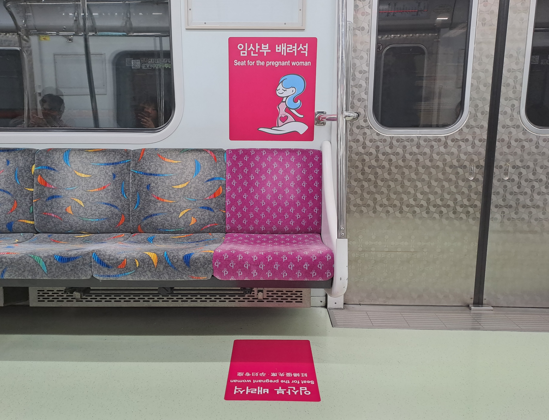
The most visually distinctive seats on many Korean subway trains are the pregnancy priority seats, known in Korean as imsanbu baeryeoseok (임산부 배려석).
These seats are generally pink and are accompanied by a pregnancy symbol. The surrounding wall, floor, or window may also have pink markings so that the seats can be recognized from a distance.
Seoul operates these seats separately from the general priority seats located near the ends of subway cars. According to the Seoul Metropolitan Government’s published information, Lines 1 through 8 generally have two pregnancy priority seats in each subway car, positioned at the two ends of a central bench. Seoul’s Line 9 and light-rail services also operate designated pregnancy seats, although the number and arrangement can differ according to the train design.
The separate seats are especially important because pregnancy is not always visible.
During the early stages of pregnancy, a passenger’s body may not look noticeably different. Nevertheless, standing for a long period or maintaining balance on a crowded, moving train may be difficult. A pregnant passenger may also feel uncomfortable asking a stranger directly to give up a seat.
The pink design attempts to solve this problem by making the purpose of the seat clear before anyone has to ask.
Some pregnant passengers also carry a small pink badge or tag on a handbag. Korea’s Ministry of Health and Welfare introduced and distributed pregnancy emblems partly to help other passengers recognize pregnant women, including those in the early stages of pregnancy.
However, the badge should be understood as a helpful signal, not as a certificate that a passenger must display. A woman without a badge may still be pregnant, and no passenger has the right to demand proof.
Should the Pink Seat Be Left Empty?
This is one of the most frequently debated questions about subway etiquette in Korea.
“Can a person who is not pregnant sit there when no pregnant passenger is visible?”
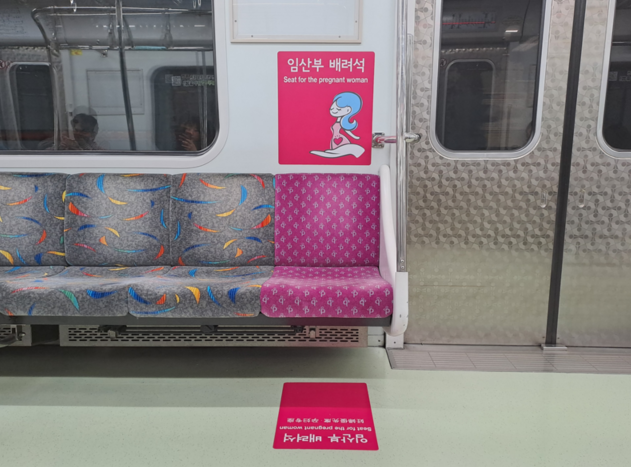
In Seoul, the official public campaign encourages passengers to leave pregnancy priority seats empty so that a pregnant passenger can use one immediately. The city promotes a “keep the seat empty” culture through signs, announcements, videos, and other public messages.
The reasoning is simple. A pregnant passenger, particularly someone in early pregnancy, may not be recognizable. She may also feel embarrassed or unsafe asking a seated passenger to move.
At the same time, the pregnancy priority seat is generally operated through voluntary public courtesy rather than through a system of legal punishment. In a 2025 response to a public inquiry, the Seoul Metropolitan Government explained that the seats are not legally enforced and depend on the voluntary consideration of passengers. It nevertheless reaffirmed its policy of encouraging people to leave them available for pregnant passengers.
For foreign visitors, the least confusing approach is to avoid using a pink seat unless it is genuinely necessary.
This is particularly advisable during rush hour. A person sitting in the pregnancy seat while looking at a phone or sleeping may fail to notice a pregnant passenger nearby. Even when the train appears quiet, someone who needs the seat could enter at the next station.
A passenger who does sit there should remain attentive and give up the seat immediately when a pregnant passenger approaches.
There is no need to ask loudly, “Are you pregnant?” It is much more respectful simply to stand and say:
“Please take this seat.”
In Korean, a natural phrase is:
여기 앉으세요.
Yeogi anjeuseyo.
“Please sit here.”
When the passenger declines, it is best not to insist repeatedly. Offering a seat is considerate, but respecting the other person’s decision is also a form of consideration.
Priority Seats and Wheelchair Spaces Are Different
The expression “disabled seating” can refer to two different things on a Korean subway.
The first is an ordinary priority seat that may be used by a passenger with a disability. A person does not need to use a wheelchair to have a disability. Passengers with visual impairments, internal medical conditions, neurological conditions, balance difficulties, chronic pain, or limited stamina may all need to sit.
The second is a wheelchair space.
A wheelchair space is usually an open area rather than a conventional seat. It is commonly located near a subway door and marked with a wheelchair symbol. The absence of a chair is intentional: the space allows a passenger to remain in a wheelchair while traveling.
To another passenger, it may look like convenient room for standing, placing a suitcase, parking a stroller, or storing a shopping cart. However, the area must remain accessible.
When a wheelchair user enters the train, other passengers should move away promptly and remove any luggage blocking the space. A wheelchair cannot be maneuvered through a crowded subway car as easily as a small bag can be moved. The passenger may also need space to turn, position the chair safely, or prepare to leave at the next station.
Passengers should never hold, push, or move someone’s wheelchair without permission. A wheelchair is part of the user’s personal space and mobility. The appropriate response is to ask whether assistance is needed and follow the person’s instructions.
In Seoul, wheelchair users can request boarding or alighting support through a subway customer center or station safety office. Seoul Metro personnel can then assist the passenger in entering or leaving the train.
Do Not Decide Who Is “Qualified” by Appearance
Many disagreements surrounding priority seats begin when one passenger tries to decide whether another passenger looks sufficiently old, pregnant, injured, or disabled.
This is rarely a reliable judgment.
A young person may have an invisible disability. A pregnant woman may not yet have a visible belly. An older passenger may prefer to remain standing. A passenger carrying a baby may be more at risk of falling than someone much older. A person who appears healthy may have been advised by a doctor not to stand for extended periods.
For these reasons, it is better to offer assistance than to interrogate people.
It is also inappropriate to photograph someone in a priority seat and post the image online in order to criticize or embarrass that person. A photograph cannot reveal a private medical condition, and public shaming can cause serious harm to someone who may have a legitimate reason to sit.
A passenger who needs the seat should not feel obligated to explain an entire medical history. When necessary, a brief statement is enough:
“I’m sorry, but I have a medical condition and need to remain seated.”
The passenger does not owe strangers the name of the condition, a diagnosis, or documentary proof.
The Best Way to Offer Your Seat
Giving up a seat does not require a dramatic announcement.
First, make eye contact if appropriate. Then stand, gesture gently toward the seat, and offer it in a quiet voice.
Avoid saying something such as, “You look very old,” or, “You look like you are pregnant.” Even when the intention is kind, comments about age, weight, pregnancy, or disability can be embarrassing.
A simple sentence is better:
“Would you like to sit here?”
In Korean, you can say:
여기 앉으실래요?
Yeogi anjeusillaeyo?
“Would you like to sit here?”
Sometimes the person will refuse. They may be getting off at the next stop, feel more comfortable standing, or believe another passenger needs the seat more. In that situation, accept the answer politely.
Good manners are not only about giving something to another person. They also include allowing that person to choose.
Practical Etiquette for International Visitors
When using a Korean subway, first look at both the color of the seat and the symbols around it. Designs can differ depending on the city, subway operator, train model, and line.
When ordinary seats are available, choose one of those before using a priority seat. There is little reason to occupy a designated seat when an unrestricted seat is empty nearby.
Try not to block wheelchair spaces or the paths leading to subway doors with large luggage. When a wheelchair user, a passenger with a stroller, or someone using a walking aid needs to pass, create enough room before the doors open.
Do not ask a pregnant passenger to show a badge, and do not ask a passenger with a disability to show identification. Subway passengers are not responsible for examining or approving one another’s medical circumstances.
Most importantly, occasionally look up from your phone. Priority seating works only when passengers notice what is happening around them.
What These Seats Reveal About Korean Society
Korean subways are frequently praised for their extensive networks, frequent trains, clear signs, and efficient transportation. However, the quality of public transportation cannot be measured by speed alone.
A successful transportation system must also be usable by someone who moves slowly, has difficulty standing, cannot easily maintain balance, or needs additional space.
Priority seats, pregnancy seats, and wheelchair spaces make this principle visible inside the subway car. They show that public transportation is a shared environment and that equal access sometimes requires different treatment according to need.
Of course, the system is not perfect. People sometimes occupy designated seats without paying attention. Arguments arise over who should sit and who should stand. Some passengers become so focused on enforcing etiquette that they forget to respect privacy and dignity.
The existence of a sign does not automatically create a considerate culture. That culture must be recreated every day through the behavior of individual passengers.
Each designated seat quietly asks several questions:
“Do I genuinely need this seat?”
“Is someone near me having greater difficulty?”
“Can I accept a little inconvenience so that another person can travel safely?”
The answers are not always visible, and the correct response is not always identical. Nevertheless, awareness is the essential first step.