
What Is Banchan?
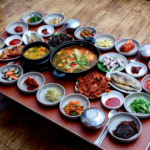
Banchan (반찬) means “side dishes” in Korean. A Korean meal is typically built around four components: rice, soup or stew (guk / jjigae), a main dish, and kimchi — plus several small side dishes. Those side dishes are called banchan, and they are one of the most distinctive features of Korean food culture.
A common misunderstanding is that banchan are appetizers. In many Western meals, small dishes served before the main course are eaten first and then removed. Banchan work differently: they are part of the whole meal and stay on the table from beginning to end.
For example, when a restaurant serves kimchi jjigae with rice and several banchan, diners do not finish the banchan first and then begin the stew. They move back and forth — a spoonful of stew, a bite of kimchi, a piece of rolled omelet, a spoonful of rice, more stew. Banchan are woven into the meal, not an opening act.
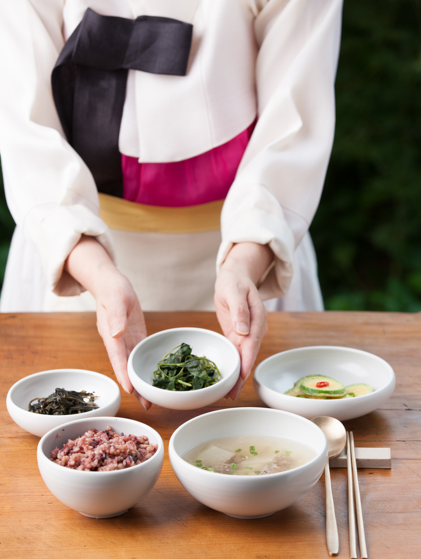
Common banchan include:
- Kimchi (김치) – fermented Napa cabbage
- Kongnamul muchim (콩나물무침) – blanched soybean sprouts with sesame oil
- Sigeumchi namul (시금치나물) – blanched spinach with sesame seasoning
- Eomuk bokkeum (어묵볶음) – stir-fried fish cake slices with vegetables
- Gyeran mari (계란말이) – pan-fried rolled egg
- Dubu jorim (두부조림) – soy-braised tofu
- Myeolchi bokkeum (멸치볶음) – crispy stir-fried anchovies
- Jangajji (장아찌) – assorted pickled vegetables
- Guun kim (구운 김) – roasted dried seaweed sheets
- Oi muchim (오이무침) – seasoned cucumber side dish
- Gamja jorim (감자조림) – soy-braised potatoes
- Ganjang gyeran jang (간장달걀장) – eggs braised in soy sauce
- Mu muchim (무무침) – seasoned Korean radish
- Yeongeun jorim (연근조림) – soy-braised lotus root
- Maneul jjong muchim (마늘쫑무침) – seasoned garlic stems
- Aehobak bokkeum (애호박볶음) – stir-fried zucchini
- Beoseot bokkeum (버섯볶음) – stir-fried mushrooms
- Jeon (전) – Korean savory pancake
- Mareun ojingeo (마른오징어) – dried seasoned squid
- Janmyeolchi (잔멸치) – tiny stir-fried anchovies
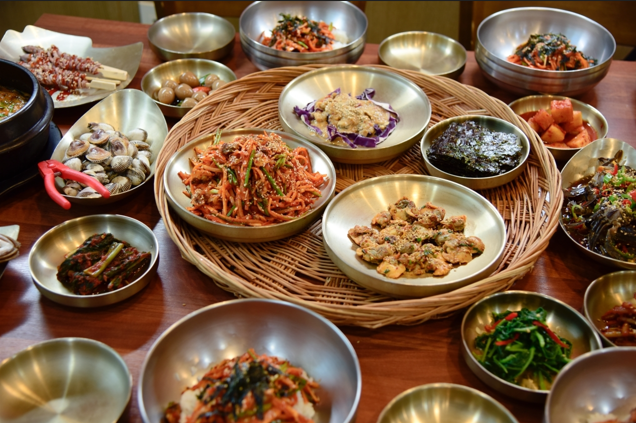
Banchan can be made from vegetables, tofu, eggs, seafood, meat, grains, roots, seaweed, beans, or fermented ingredients. Some are eaten fresh. Some are stored for several days. Some are preserved for weeks or months. Some are made quickly before a meal. Others are prepared in large batches and kept in the refrigerator.
This flexibility is one reason banchan are so important.
They allow a Korean meal to be simple and varied at the same time.
Banchan exist mainly to balance the meal. Korean main dishes often have strong flavors: kimchi is sour, salty, spicy, and fermented; jjigae can be intense; grilled meat is rich and fatty; soy-braised dishes are salty. Banchan offset these — a mild rolled omelet balances a spicy stew, pickled radish refreshes a rich grilled-meat meal, and fresh cucumber cuts through a salty soup.
The variety is almost endless.
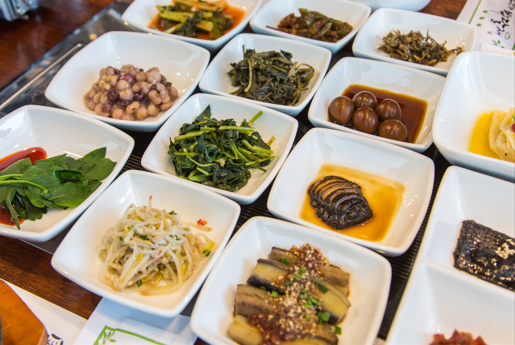
Banchan at Home
Banchan are central to Korean home meals. Most households keep several in the refrigerator and serve them at mealtime in small dishes with rice and soup.
Typical home refrigerator staples:
- Kimchi (김치)
- Eomuk bokkeum (어묵볶음) – stir-fried fish cake slices with vegetables
- Myeolchi bokkeum (멸치볶음) – crispy stir-fried anchovies
- Dubu jorim (두부조림) – soy-braised tofu
- Namul (나물) – assorted seasoned vegetables
- Maneul jangajji (마늘장아찌) – garlic pickled in soy sauce
- Ganjang gyeran jang (간장달걀장) – eggs braised in soy sauce
- Oi muchim (오이무침) – seasoned cucumber side dish
- Gamja jorim (감자조림) – soy-braised potatoes
- Jangjorim (장조림) – soy-braised beef (distinct from dubu jorim)
With rice and soup, these prepared banchan turn into a full meal in minutes. Not every dish has to be cooked fresh each time — banchan are made ahead and used across several meals. This is why storage containers are so important in Korean kitchens: food is cooked, stored, opened, served, and returned to the refrigerator on a daily cycle.
Banchan Shops
Banchan shops (banchan gage, 반찬 가) are stores that sell prepared side dishes by portion. They are popular with busy families, office workers, elderly people, students, and single-person households who buy banchan instead of making everything at home.
Typical shop offerings:
- Kimchi (김치)
- Namul (나물) – assorted seasoned vegetables
- Eomuk bokkeum (어묵볶음) – stir-fried fish cake slices with vegetables
- Dubu jorim (두부조림) – soy-braised tofu
- Myeolchi (멸치) – dried anchovies
- Jangjorim (장조림) – soy-braised beef
- Gyeran mari (계란말이) – pan-fried rolled egg
- Jeon (전) – Korean savory pancake
- Guk (국) – Korean soup
- Jjigae (찌개) – Korean stew
- Yangnyeom gogi (양념고기) – marinated meat
- Jangajji (장아찌) – assorted pickled vegetables
Where else to buy banchan: Traditional markets (전통시장) sell freshly made banchan from market stalls — a long-established way to buy side dishes. These days, however, many people also order banchan online and have it delivered home, and supermarkets (마트) and neighborhood banchan specialty shops carry a wide ready-made selection too. With so many channels, buying banchan has never been easier.
Banchan shops show how home food culture has adapted: in the past, more side dishes were made at home; today, many people buy some or all of them.
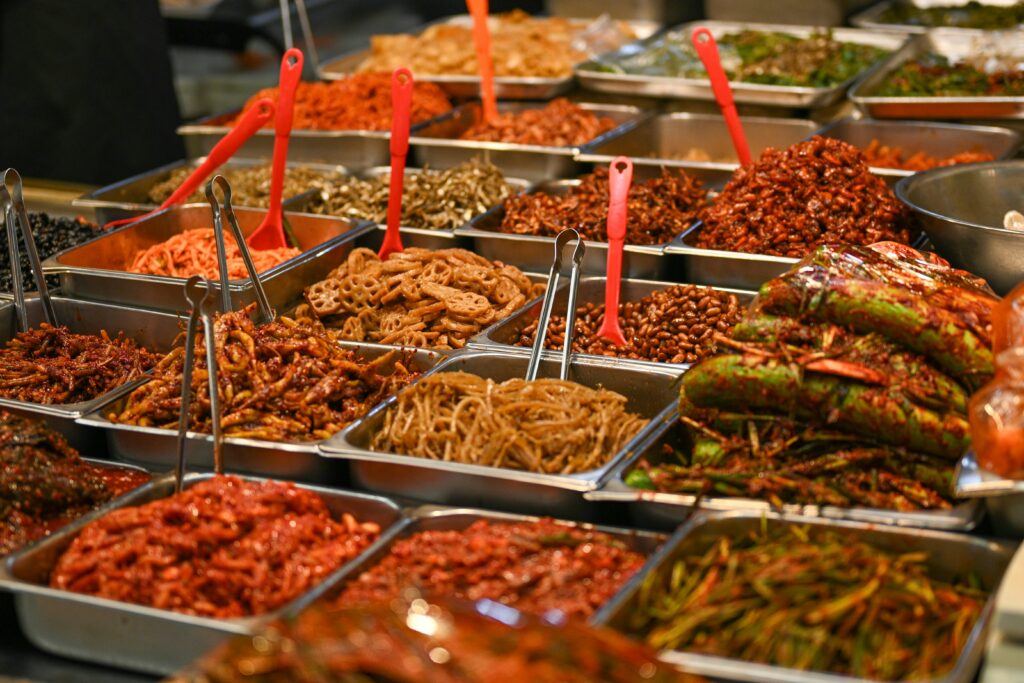
Photo: Korea Tourism Organization
Banchan at Restaurants: Refill Culture
In many Korean restaurants, basic banchan can be refilled free of charge — a custom many foreign visitors find surprising. If you finish the kimchi, bean sprouts, lettuce, or pickled radish, you can often ask for more at no extra cost. Ask politely, take only what you will eat, and do not waste food.
/banchan-refills-in-korean-restaurants/
Sharing and Table Manners
Banchan are shared dishes, so table manners matter. In casual restaurants, people may take banchan directly with their chopsticks; in more formal settings, or when serving utensils are provided, use them.
Good manners:
- Do not dig through a shared dish.
- Take a reasonable amount.
- Do not put food back after touching it.
- Use serving chopsticks or spoons if available.
- Do not move a shared banchan dish too far from other diners.
- Be aware of the group; do not take the last piece without noticing others.
These rules are not always strictly enforced in casual settings, but awareness matters — a Korean table is shared space.