
Seoul is often described as a 600-year-old city because it became the capital of the Joseon Dynasty (조선) in 1394 and remained the political center of Korea for more than five centuries.
Yet Seoul’s history stretches back much further. The area around present-day Seoul (서울) has been an important center of political power for more than 2,000 years. It was once the early capital of Baekje (백제), one of Korea’s ancient kingdoms. During the Goryeo Dynasty (고려), it was known as Namgyeong (남경), or the Southern Capital. In 1394, it became Hanyang (한양), the capital of Joseon.
Since then, Seoul has passed through royal rule, modernization, Japanese colonial rule, liberation, war, rapid economic growth, and globalization. Today, it is home to more than nine million people and is one of the most recognizable cities in Asia.
So how did Seoul become the city it is today?
Seoul Before Joseon (조선): Why This Place Became Important
Before examining the rise of modern Seoul, it is important to understand the geography that gave this area its long-standing importance.
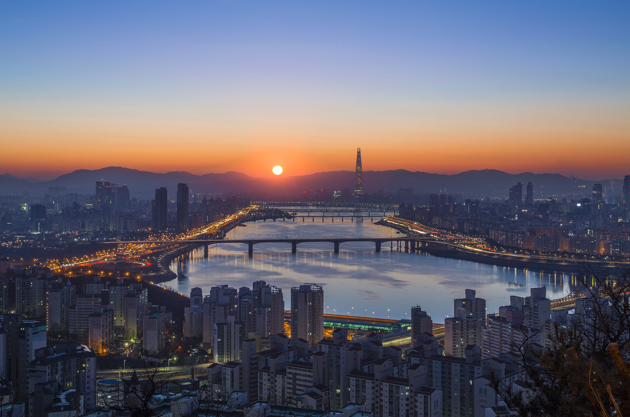
Seoul lies along the Han River (한강), one of the major rivers of the Korean Peninsula. Mountains surround much of its historic center, while the river runs through the city from east to west. This setting offered several advantages. The river provided water and fertile land, while also serving as an important transportation route connecting different parts of the peninsula. The surrounding mountains provided natural protection, and the area’s central location made it strategically valuable.
For these reasons, the Seoul region became important long before it became the capital of Joseon.
1. Baekje’s First Capital: Wiryeseong (위례성)
Seoul’s story begins more than 2,000 years ago. According to traditional historical records, Onjo (온조), one of the founders of Baekje, established the kingdom in 18 B.C. and made the area around what is now southeastern Seoul its early center. This settlement is generally associated with Wiryeseong (위례성).
Baekje was one of the Three Kingdoms of Korea, alongside Goguryeo (고구려) and Silla (신라). During its early period, the Han River basin was at the center of political and military competition. Two important archaeological sites from this period can still be visited in Seoul: Pungnap Fortress (풍납토성) and Mongchon Fortress (몽촌토성).
Pungnap Fortress is a large earthen fortification believed to have formed part of the early Baekje capital. Mongchon Fortress was another important defensive site in the same area. Today, these places are surrounded by modern apartments, roads, and sports facilities, yet beneath the surface they preserve evidence of a much older Seoul.
Baekje later moved its capital south to Gongju (공주) and then to Buyeo (부여). Even so, the Han River basin remained strategically important.
2. The Three Kingdoms and the Han River
The Seoul area did not remain under Baekje’s control forever. During the Three Kingdoms period, Goguryeo expanded southward and took control of the Han River region. Later, Silla gained control as it gradually unified much of the Korean Peninsula.
This competition was no accident. The Han River basin was valuable because of its location. Whoever controlled the region could use the river as a transportation route and gain access to the central part of the peninsula. For that reason, the Seoul area changed hands several times in ancient Korean history.
Long before it became a capital, Seoul was already important because of where it stood.
3. Namgyeong (남경): Goryeo’s Southern Capital
After the Three Kingdoms period, the political center of Korea shifted again. In 918, Wang Geon (왕건) founded the Goryeo Dynasty, which ruled for nearly five centuries. Goryeo’s main capital was Gaegyeong (개경), in present-day Kaesong (개성).
Although Seoul was not the primary capital, its strategic importance continued. In 1067, during the reign of King Munjong (문종), the Seoul area was officially designated Namgyeong (남경), meaning the Southern Capital. It became one of Goryeo’s key secondary capitals.
The government developed facilities there, and some even discussed making it a more important political center. Geography once again played a major role. According to pungsu (풍수), the traditional Korean system for interpreting the relationship between land, mountains, water, and human life, the area’s landscape was considered highly favorable. The Han River and the surrounding mountains created a setting thought to be suitable for a capital.
In other words, the idea that this was an ideal location for Korea’s political center existed well before the Joseon Dynasty.
4. Hanyang (한양): The Capital of Joseon
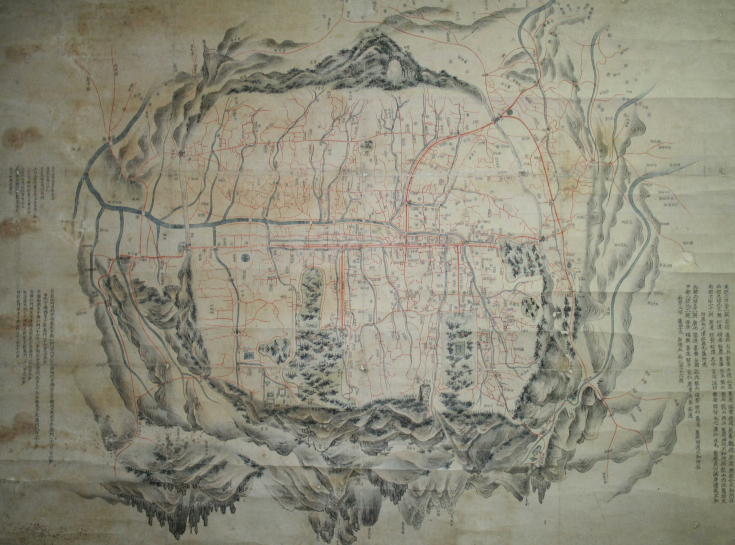
The decisive turning point came in 1394. In 1392, Yi Seong-gye (이성계) founded the Joseon Dynasty. As the new dynasty established itself, it needed a new capital. Two years later, the capital was moved to Hanyang (한양), in the area of present-day Seoul.
This decision shaped the city for the next five centuries. King Taejo (태조) and his officials carefully planned the new capital, and one of the most influential figures in that process was Jeong Do-jeon (정도전), a scholar-official who helped design its political and spatial structure.
The royal palace, government offices, roads, markets, religious institutions, and defensive walls were arranged according to the political and philosophical principles of the Joseon state. Gyeongbokgung Palace (경복궁) was completed in 1395. Nearby stood Jongmyo (종묘), the royal ancestral shrine, and Sajik (사직), where rituals were performed for the gods of land and grain.
Together, these places represented the foundations of the new kingdom.
5. The Fortress Around Hanyang (한양)
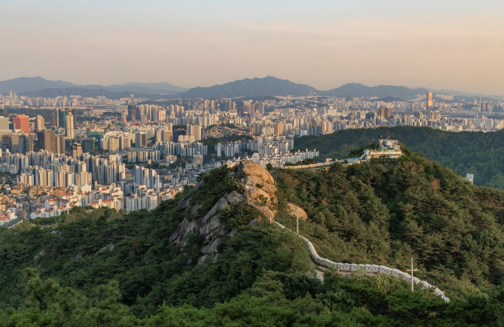
Hanyang was also a fortified city. The Seoul City Wall (한양도성) was built along the surrounding mountains, following the natural landscape. Stretching roughly 18 kilometers, it connected four major mountains: Bukaksan (북악산), Naksan (낙산), Namsan (남산), and Inwangsan (인왕산).
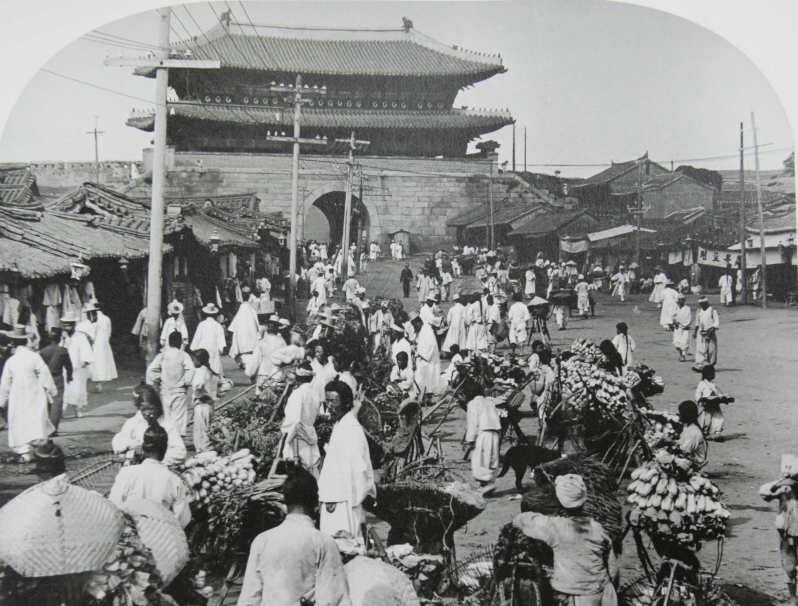
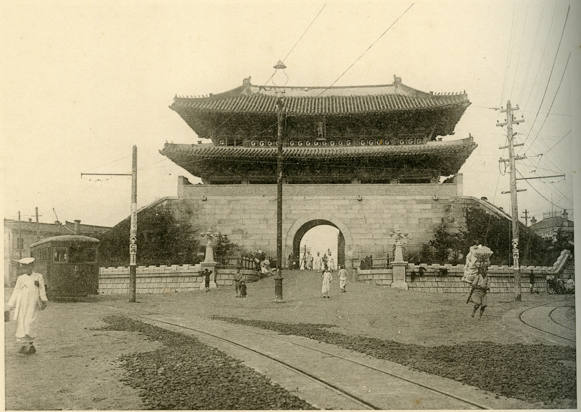
The city had four major gates. Sungnyemun (숭례문), commonly called Namdaemun (남대문), stood to the south. Heunginjimun (흥인지문), commonly called Dongdaemun (동대문), stood to the east. Sukjeongmun (숙정문) marked the north, while Donuimun (돈의문) stood to the west.
Some of these gates still stand today, while others have disappeared. Even now, walking through central Seoul, it is still possible to recognize parts of the basic structure of the old capital.
6. The Seoul That People Lived In
Joseon-era Seoul was very different from the city we know today. People traveled mainly on foot, on horseback, or in sedan chairs. Houses were usually built with traditional materials, and many streets were narrow and irregular.
Yet Hanyang was not simply a royal city of palaces and officials. It was also home to merchants, craftsmen, servants, laborers, and ordinary families. Markets were central to everyday life, supplying rice, vegetables, fish, meat, clothing, household goods, and other necessities.
The capital was a center of politics, education, culture, and commerce. In short, Hanyang was a living city where hundreds of thousands of people worked, traded, raised families, and went about their daily lives.
7. From Joseon to Modern Seoul
For centuries, the basic structure of Hanyang remained relatively stable. Then, in the late nineteenth century, Korea began to change rapidly.
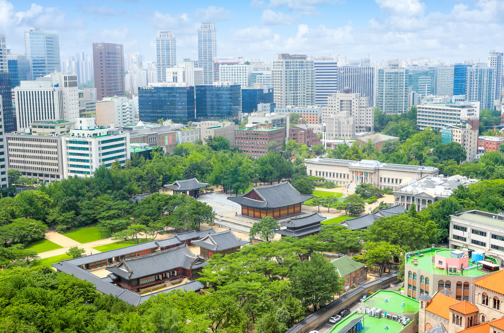
The country established diplomatic relations with foreign powers and began adopting new technologies and institutions. Electricity, telephones, modern transportation, schools, hospitals, and Western-style buildings gradually appeared in Seoul. Traditional Korean buildings stood beside newer Western structures, and old streets were crossed by modern transit systems.
Areas around Deoksugung Palace (덕수궁) and Jeongdong (정동) became especially important during this period of modernization. This was the beginning of Seoul’s transition from a traditional royal capital into a modern city.
8. Gyeongseong (경성) Under Japanese Colonial Rule
In 1910, Korea was annexed by Japan. During the colonial period, Seoul was officially called Gyeongseong (경성). The city underwent major physical changes as streetcars, modern infrastructure, water systems, electricity, and new government buildings altered its appearance.
But these changes took place under colonial rule. Many traditional buildings and parts of the old capital were destroyed or altered. Parts of Gyeongbokgung (경복궁) were demolished, and the Japanese Government-General building was constructed in front of the palace.
For Koreans, modernization under colonial rule carried a complicated meaning. It introduced new infrastructure and technology, but it also came with political oppression and the destruction of important cultural heritage.
Seoul was also a major center of the independence movement. On March 1, 1919, Koreans publicly declared their independence from Japanese rule. The March 1st Movement (3·1운동) quickly spread across the country and became one of the most important events in Korea’s struggle for independence.
9. Liberation, War, and a City in Ruins
Korea was liberated from Japanese colonial rule in 1945, and the city was officially renamed Seoul (서울), using the native Korean word historically associated with a capital city. In 1948, the Republic of Korea (대한민국) was established, with Seoul as its capital.
But the new country soon faced war. The Korean War (한국전쟁) began in 1950, and because Seoul lay close to the front line, control of the city changed hands several times. Large parts of the city were destroyed, and many residents were forced to flee.
When the war ended in 1953, Seoul faced the enormous task of rebuilding. At the same time, it experienced a major influx of people from other parts of Korea who came in search of safety, work, education, and a better future. This movement of people became one of the driving forces behind Seoul’s extraordinary growth.
10. The Miracle on the Han River
From the 1960s onward, South Korea underwent rapid industrialization and economic growth, and Seoul expanded at an extraordinary pace. Factories, offices, roads, schools, apartment complexes, and commercial districts spread across the city. The population rose dramatically as people moved from rural areas to the capital.
In 1974, the first line of the Seoul Subway (서울 지하철) opened, creating a new way for millions of residents to move through the rapidly growing city. The Han River (한강) also became increasingly important to urban development. Large-scale development projects transformed the riverbanks, especially the areas south of the river, helping create the modern landscape of Gangnam (강남).
Today, Gangnam is one of Seoul’s best-known districts, associated with business, shopping, technology, entertainment, and nightlife. The dramatic economic transformation of South Korea during this period is often called the Miracle on the Han River, and Seoul stood at its center.
11. The 1988 Seoul Olympics
Another major turning point came in 1988, when Seoul hosted the Summer Olympics. The Games introduced the city to millions of people around the world and prompted major investment in transportation, sports facilities, roads, and urban infrastructure.
For many international visitors, the 1988 Olympics provided their first image of modern Seoul. The event also symbolized something larger. Only a few decades earlier, Seoul had been a war-damaged city struggling to rebuild. By 1988, it had emerged as a rapidly developing international metropolis.
12. From Economic Powerhouse to Hallyu (한류) City
Seoul’s transformation continued after the Olympics. During the 1990s and 2000s, the city became a major center of information technology, finance, business, entertainment, and culture. Areas such as Teheran-ro (테헤란로) came to symbolize Korea’s growing technology industry.
Then another transformation began. Korean dramas, K-pop, films, food, beauty products, and fashion started attracting audiences around the world. This global popularity became known as Hallyu (한류), or the Korean Wave.
For many international visitors today, Seoul is the place where Hallyu can be experienced most directly. They visit filming locations from Korean dramas, attend K-pop performances, try Korean food, shop for beauty products, and explore neighborhoods they have seen online. Seoul today is therefore more than the political and economic center of Korea; it has also become one of the world’s major cultural cities.
13. Seoul Today
Today, Seoul is home to more than nine million people and stands as one of the largest and most dynamic cities in Asia. It is filled with modern buildings, advanced technology, shopping districts, universities, parks, museums, restaurants, and entertainment venues. Yet what makes Seoul especially remarkable is not only its modern energy, but also the way its long history remains visible in everyday life.
The old city has not disappeared. You can still walk along the Seoul City Wall (한양도성), visit Gyeongbokgung Palace (경복궁) and see the mountains that shaped the old capital, explore Bukchon (북촌), where traditional hanok (한옥) houses remain in the middle of a modern city, and visit historic markets such as Namdaemun Market (남대문시장). At the same time, only a few subway stops away, you can find enormous shopping malls, modern office towers, and some of the busiest streets in Asia. This contrast is one of the defining qualities of Seoul.
Seoul’s history is not the story of a city that erased its past and replaced it with something entirely new. Rather, it is a city built in layers. Beneath the modern city lie traces of Baekje’s ancient fortresses. Around the old city center remain the palace grounds and city walls of Joseon. Elsewhere are buildings and streets shaped by modernization and Japanese colonial rule, neighborhoods marked by the destruction and rebuilding that followed the Korean War, and districts that emerged during South Korea’s period of rapid economic development.
In Seoul, it is possible to visit a 600-year-old palace in the morning, eat lunch at a traditional market, cross the Han River by subway in the afternoon, and watch the skyline from a modern skyscraper at night. That is what makes Seoul’s history so compelling.
Seoul is not simply a city with a long past. It is a city where that past is still present. More than 2,000 years of history are still part of Seoul today.