

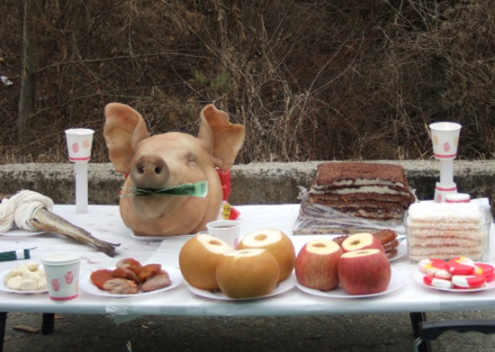
A pig’s head on a ritual table may seem surprising to visitors unfamiliar with Korean customs. In Korea, it can be part of a blessing for a new business, offered with hopes for success and good fortune. The pig is an animal of striking contrasts: it has been treated as a sacred offering and a bringer of prosperity, yet is also teased in sayings as greedy or lazy. The Pig is the last of the twelve Korean zodiac animals. Its sign is hae (해, 亥). In traditional beliefs, it is associated with fortune, abundance, and protection. Stories from Korea’s ancient kingdoms also give the pig a remarkable role: it helps kings find a capital or an heir.
Quick Facts About the Pig Zodiac
- Korean name: 돼지 (dwaeji)
- Zodiac sign: 해 (亥, hae)
- Position: Twelfth of the twelve zodiac animals
- Traditional hours: 9–11 p.m., called haesi (해시, 亥時)
- Direction: North-northwest
- Lunar month: The tenth lunar month
- Main associations: Fortune, abundance, sacrifice, protection, and contradictory ideas about greed and laziness
- Birth Years: 1947 · 1959 · 1971 · 1983 · 1995 · 2007 · 2019 · 2031

Photo: National Folk Museum of Korea
The Pig in the Zodiac Cycle
The Pig year returns every twelve years. Within the longer 60-year cycle, it combines with the five elements to form five different Pig years.
| Pig year | Korean name |
|---|---|
| Wood Pig | 을해 (乙亥, eulhae) |
| Fire Pig | 정해 (丁亥, jeonghae) |
| Earth Pig | 기해 (己亥, gihae) |
| Metal Pig | 신해 (辛亥, sinhae) |
| Water Pig | 계해 (癸亥, gyehae) |
The Pig also belongs to the traditional system used to describe time and direction. Its two-hour period is from 9 to 11 in the evening, and its direction is north-northwest. In some folk beliefs, the Pig was understood as a guardian of this direction.
A Sacred Offering and a Sign of Good Fortune
Pigs have long been raised for their meat and fat, but they also held an important place in Korean ceremonies. Historical accounts and traditions describe pigs being raised or selected as offerings to local gods and other spiritual beings. This practice reaches back at least to the Three Kingdoms period and has continued in different forms.
The pig’s role as an offering gave it a sacred quality. People believed it could carry their wishes to the gods, and so the animal came to be associated with good fortune and happiness. A pig’s head may be placed on a ritual table at a new business opening, where people make wishes for prosperity.
The pig also appears in stories about Korea’s ancient kingdoms. In one account, King Yuri of Goguryeo follows a pig to Guknaewinaam, a place surrounded by mountains and rivers that he chooses as a new capital. In another, a ceremonial pig leads King Sansang to a young woman who later gives birth to an heir. In these stories, the pig’s unexpected movements help shape the future of a kingdom.
Pigs, Dreams, and Everyday Good Luck
In Korean folk belief, dreaming of a pig is often considered a lucky sign, especially one connected with money or prosperity. The pig became a familiar symbol of abundance, and families sometimes displayed pictures of pigs as protective charms. The first Pig Day of the lunar year, Sanghaeil (상해일, 上亥日), was also considered an auspicious day to begin business. These customs reflect a long-standing hope that the pig could bring wealth and happiness into the home.
The Pig’s Contradictory Image
Despite its auspicious associations, the pig has another side in Korean expressions and folktales. It may be portrayed as greedy, dirty, lazy, or foolish. People sometimes use ttungdwaeji (뚱돼지, “fat pig”) to tease someone who is overweight, or kkotdwaeji (꽃돼지, “flower pig”) as a more affectionate, playful expression. These ideas sit uneasily beside the pig’s role as a sacred offering and bringer of fortune. The animal could symbolize wealth and blessing in a ritual, while appearing as a greedy or foolish character in a story. That contradiction is part of the pig’s cultural history: its meaning changes with the setting.
What the Pig Represents in Korean Culture
The Pig brings together sacrifice, prosperity, and protection, along with less flattering ideas about greed and laziness. It is a zodiac guardian and an auspicious dream, but also a familiar figure in jokes and folktales. For readers discovering the Korean zodiac, the Pig shows how one animal can carry several meanings at once. In Korea’s stories and customs, it could help a king find a capital, carry people’s wishes to the gods, or stand for the hope of good fortune in everyday life.
Read Next
Dream Interpretation in Korean Culture: Lucky and Unlucky Dreams –

