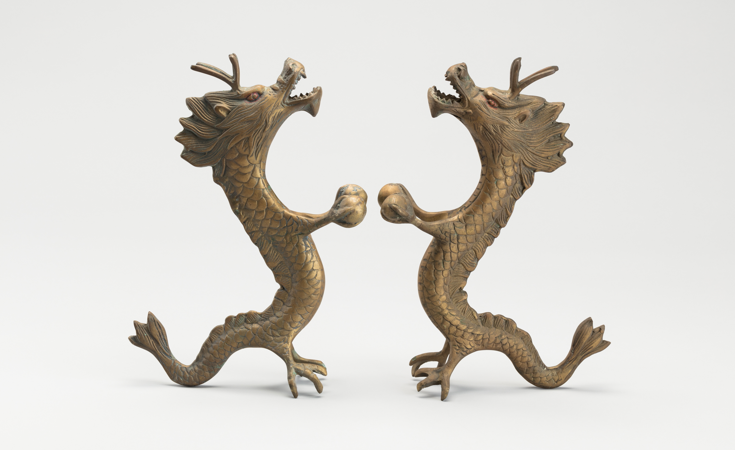

The dragon is the fifth animal in the Korean zodiac—and the only imaginary creature in the twelve-animal cycle. Known as yong (용), it is traditionally associated with power, good fortune, protection, and the ability to rise above difficulties. The dragon appears throughout Korean legends, folk beliefs, art, and place names. It could represent a guardian of the country, a ruler of water and rain, or the authority of a king. These are cultural symbols and traditional beliefs, not predictions about everyone born in a Dragon year.
Quick Facts About the Dragon
- Korean name: 용 (yong)
- Zodiac sign: Jin (진, 辰)
- Position: Fifth of the twelve zodiac animals
- Traditional time: 7 a.m. to 9 a.m.
- Traditional associations: Power, water, rain, protection, authority, and good fortune
- Birth Years: 1940 · 1952 · 1964 · 1976 · 1988 · 2000 · 2012 · 2024

Photo: National Folk Museum of Korea
A Dragon That Protects the Country
Korean stories sometimes describe dragons as guardians of the country. One famous example is King Munmu of Silla. According to tradition, he wished to become a sea dragon after his death so he could protect Silla from foreign invaders. His underwater tomb, known as the Tomb of King Munmu, is in the East Sea near Gyeongju. This story shows how the dragon could symbolize more than supernatural power. It could also represent loyalty and a desire to protect the community.
The Dragon, Water, and Rain
In Korean folk belief, the dragon was closely connected with water. People associated it with clouds, rain, rivers, and the sea. Since farming depended on rainfall, the dragon became an important figure in hopes for a good harvest. Dragons also appeared as protective beings in Buddhist art and as symbols of royal authority. The dragon’s imagined body combines features of several animals. This helped make it a creature that could move between the sea, the land, and the sky. Its legendary goal was to rise through the clouds and ascend to heaven.
Dragon Years and Traditional Personality Readings
Traditional zodiac readings often describe people born in a Dragon year as energetic, brave, sensitive, and trustworthy. Some readings also portray them as strong-willed, quick to become excited, and clear about what they like or dislike. These descriptions belong to folk tradition. They are not a reliable way to judge an individual’s character.
Dragon Compatibility in Zodiac Folklore
In one traditional compatibility system, the Dragon, Rat, and Monkey form a harmonious group called samhap (삼합). Their symbolic combination brings together the Dragon’s strength, the Rat’s cleverness, and the Monkey’s agility. Some folk interpretations describe the Dragon and Pig as a conflicting pair, with a story that the Dragon dislikes the Pig’s nose. These ideas are part of zodiac folklore; they are not rules for choosing a partner or predicting a relationship.
Yongduam, Jeju’s Dragon Head Rock
Dragon imagery also appears in Korean place names. Yongduam (용두암), or Dragon Head Rock, is a coastal rock formation in Jeju City. Wind and waves have shaped the stone so that it resembles a dragon’s head looking out from the sea. Local legends tell different stories about how the dragon became part of the rock.

From stories of a dragon protecting Silla to images connected with rain, royalty, and Jeju’s coastline, the dragon has held many meanings in Korea. As the only imaginary animal in the zodiac, it represents the power of imagination—and the hope of rising toward something greater.
Read Next
Dream Interpretation in Korean Culture: Lucky and Unlucky Dreams –

