

A dog watching beneath a tree may look like a simple scene from everyday life. In Korean art, however, it could also carry a protective meaning: the dog stood guard over the home, keeping watch for thieves and warding off misfortune.The Dog is the eleventh of the twelve Korean zodiac animals. Its sign is sul (술, 戌), and it is traditionally associated with loyalty, vigilance, and protection. Dogs were familiar companions and working animals, but they also held a place in folk beliefs as guardians between the human world and the spirit world.
Quick Facts About the Dog Zodiac
- Korean name: 개 (gae)
- Zodiac sign: 술 (戌, sul)
- Position: Eleventh of the twelve zodiac animals
- Traditional hours: 7–9 p.m., called sulsi (술시, 戌時)
- Direction: West-northwest
- Lunar month: The ninth lunar month
- Main associations: Loyalty, vigilance, protection, bravery, and the boundary between this world and the next
- Birth Years: 1946 · 1958 · 1970 · 1982 · 1994 · 2006 · 2018 · 2030
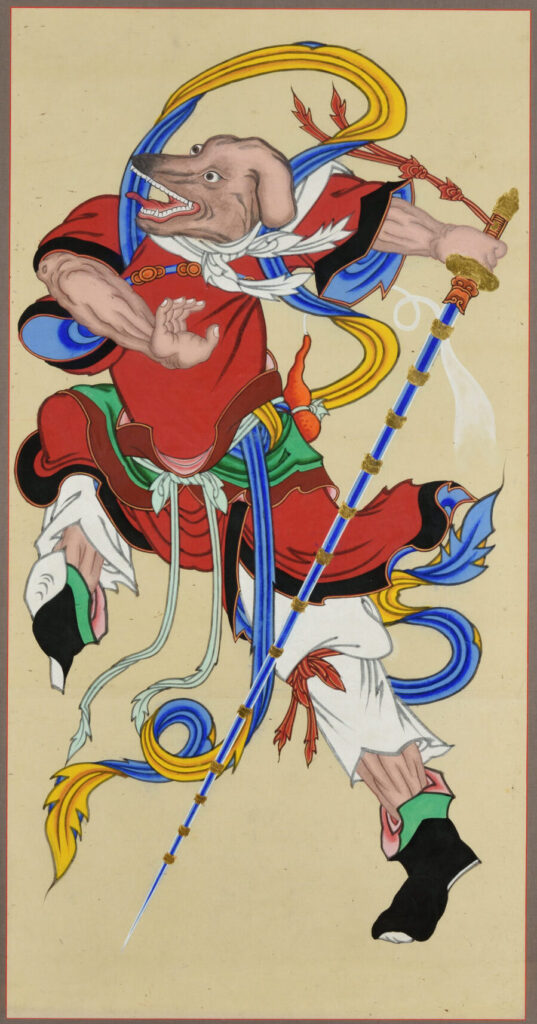
Photo: National Folk Museum of Korea
The Dog in the Zodiac Cycle
The Dog year returns every twelve years. Within the longer 60-year cycle, it combines with the five elements to form five different Dog years.
| Dog year | Korean name |
|---|---|
| Wood Dog | 갑술 (甲戌, gapsul) |
| Fire Dog | 병술 (丙戌, byeongsul) |
| Earth Dog | 무술 (戊戌, musul) |
| Metal Dog | 경술 (庚戌, gyeongsul) |
| Water Dog | 임술 (壬戌, imsul) |
The Dog also belongs to the traditional system used to describe time and direction. Its two-hour period is from 7 to 9 in the evening, and its direction is west-northwest. Folk beliefs sometimes cast the Dog as a guardian spirit that drove away evil from the hours and direction associated with its sign.
A Loyal Companion and Guardian
Dogs have lived alongside people for a long time, serving as companions, hunting partners, and guards. Their sharp hearing and sense of smell made them useful watchdogs, while their attachment to their owners made them powerful symbols of loyalty. Korean folktales and legends often tell of dogs that protect their owners, sometimes sacrificing their own lives. Monuments and tombs commemorating loyal dogs can be found in Korea. In these stories, a dog’s devotion is more than affection: it is a promise kept even in the face of danger. That loyalty also shaped the dog’s protective role in folk belief. Dogs were thought to guard not only the physical home but also the people within it, helping to repel disease, goblins, and ghosts.
The Dog as a Messenger Between Worlds
In Korean shamanic stories, a white dog could guide the dead back from the otherworld to the world of the living. This gave the animal a role beyond guarding the household: it could cross a boundary that people could not. The dog’s place between worlds helps explain why it could be regarded as both an ordinary companion and a spiritually powerful creature. Its alertness made it a natural guardian, while its presence in stories of the dead made it a guide through unseen realms.
The Dog Beneath the Tree
Traditional paintings sometimes show a dog beneath a tree. The image could suggest a watchful dog protecting a home. Part of the symbolism comes from associations among Chinese characters. The zodiac character for Dog, 戌 (sul), was linked in folk interpretation with characters meaning “guard” and “tree.” The tree beneath which the dog sits could therefore reinforce its role as a sentry. A picture of a dog under a tree was believed to help protect a household from theft. The motif appears in works by painters such as Yi Am, whose paintings include dogs and puppies, and Kim Du-ryang, who depicted a dog scratching itself. In these paintings, dogs are not just decorative subjects; their posture and setting can suggest watchfulness, family life, or protection.
The Contrasting Image of the Dog
Dogs held an affectionate place in Korean life, but the language surrounding them could also be harsh. Korean expressions using gae (개), the word for “dog,” have often described people or things as low, crude, or poor in quality. Many Korean sayings refer to dogs, reflecting how familiar the animal was in everyday speech. This contrast appears in social attitudes as well. Dogs could be praised as bright, loyal, and righteous, yet also treated as dirty or lowly animals and left outside the home. Their cultural image was not simply one of devotion. It carried both admiration and contempt. The contrast is important when reading older stories and customs. A dog might be a hero who saves its owner in one tale, and a symbol of vulgarity in an everyday expression. Both images formed part of the animal’s cultural history.
What the Dog Represents in Korean Culture
The Dog brings together loyalty, protection, and social contradiction. It is a devoted companion, an alert guardian, and in some stories a guide between the worlds of the living and the dead. At the same time, the language and customs surrounding dogs reveal how an animal could be loved and relied upon while still being treated as lowly. Through the Dog, Korean stories and artworks explore what it means to protect someone, remain faithful, and recognize danger. Its place in the zodiac reflects not only a familiar animal’s character, but also the complicated ways people have understood and treated it.
Read Next
Dream Interpretation in Korean Culture: Lucky and Unlucky Dreams –

