

The horse is the seventh animal in the Korean zodiac. Known as mal (말), it is traditionally associated with energy, vitality, speed, and endurance. Horses were once important in Korean life—as transportation, working animals, and companions in war and travel. They also appear in legends, tomb art, and folk customs.
Quick Facts About the Horse
- Korean name: 말 (mal)
- Zodiac sign: O (오, 午)
- Position: Seventh of the twelve zodiac animals
- Traditional time: 11 a.m. to 1 p.m.
- Traditional direction: South
- Traditional month: The fifth month of the lunar calendar
- Traditional associations: Energy, vitality, speed, and endurance
- Birth Years: 1942 · 1954 · 1966 · 1978 · 1990 · 2002 · 2014 · 2026
The Horse sign appears in five combinations within the 60-year calendar cycle: Metal Horse (경오, 庚午), Water Horse (임오, 壬午), Wood Horse (갑오, 甲午), Fire Horse (병오, 丙午), and Earth Horse (무오, 戊午).

Photo: National Folk Museum of Korea
Horses in Korean History and Daily Life
For centuries, horses helped people travel, carry goods, hunt, and fight in wars. They were also used in farming and in the government’s communication system. Because horses were valuable and powerful, they became closely connected with Korean life and culture. Horses also appear in Korean foundation legends. In stories about figures such as Jumong, Bak Hyeokgeose, and Geumwa, a horse appears as an auspicious sign connected with the birth or arrival of an important ruler. These stories reflect the horse’s sacred and symbolic status in early Korean history.
Horses and the Journey to the Afterlife
Horse-shaped objects and horse imagery have been found in tombs from ancient Korea. Some have been interpreted as symbolic mounts that could carry the deceased into the afterlife. In this sense, the horse was imagined as a guide between this world and the next.
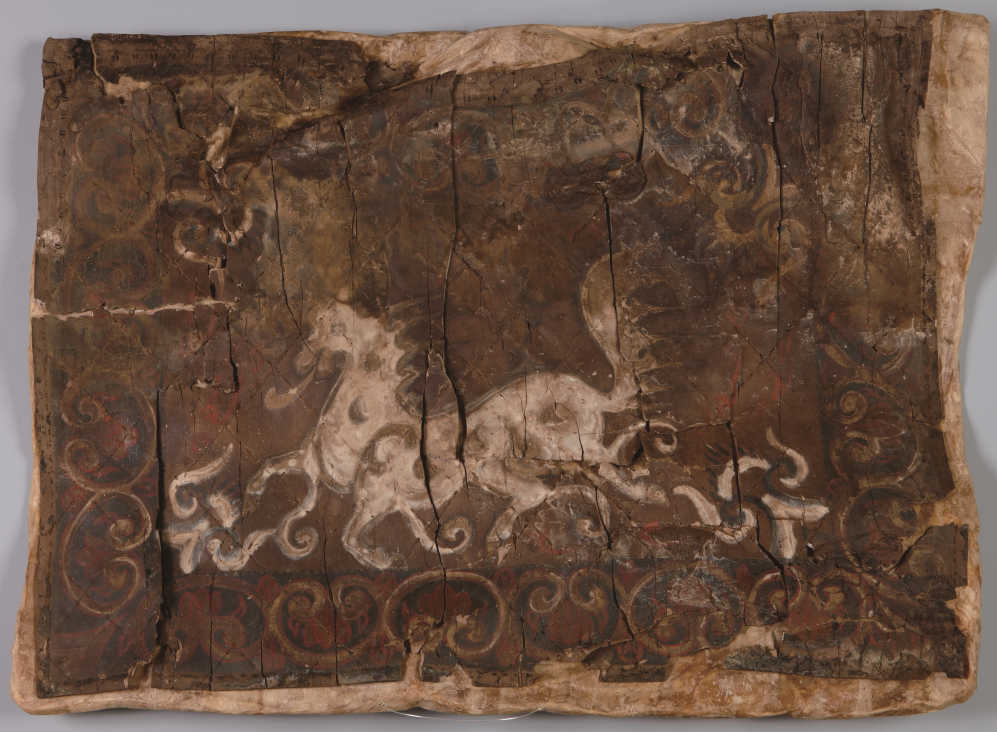
Pictures that include birds and animals are called yeongmohwa in Korean. This picture is one of them, which was excavated in 1973 from the Cheonmachong Tomb located in Ancient Tombs of Hwangnam-dong, Gyeongju. This picture of a white flying horse was drawn on the mudguard flap (75cm X 53cm / 6 mm) made of birch bark that hangs down from the saddle, which was produced during the 5∼6 century Silla Era. This flap for mudguard was made of the layers of birch bark hemstitched with leather. In the center there is a white horse flying into the sky ornamented with patterns of bindweeds on all sides, which is mostly colored in brown, red, white, and black. Looking at the flying white horse further in detail, the tail is turned upward, each of the four legs has projected ring-shaped hook, and the lips have the tongue darted out. We get some holy spirit from the White Horse flying with the mission of carrying the dead people to the heaven. This picture seems to have followed the same pattern of the mural paintings that can be found in ancient tombs of the Goguryeo Era, and it is considered as the most valuable and unique one that represents Silla paintings.
Photo: Korea Heritage Service
The famous Cheonmado (천마도), or “Painting of the Heavenly Horse,” was found in a Silla tomb in Gyeongju. Images of horses also appeared on pottery, figurines, tomb murals, and other objects. A horse-and-rider figure, reflecting the horse’s role in travel and burial customs.
Horse Customs and Folk Beliefs
Horses appeared in some seasonal customs and local rituals. The National Folk Museum of Korea records ceremonies held on certain days in the first and tenth lunar months to honor the horse deity. In some regions, people also placed horse statues or images in shrines, where the horse could serve as a village guardian or help protect against misfortune. Traditional horse games included gyeokgu (격구), a form of mounted sport similar to polo. These customs show that horses were more than practical animals: they also held a place in local celebrations and beliefs.
Horses in Korea Today
Horses are no longer a common part of everyday transportation or farm work in Korea. Today, they are most visible at racetracks, riding centers, tourist areas, and places with a strong horse culture, such as Jeju Island. The horse also remains a familiar symbol of speed, strength, and forward movement. The horse’s meaning has changed over time, but its image still carries the energy and vitality that made it important in Korean history and folklore. As the seventh animal of the zodiac, it represents movement, stamina, and the drive to keep going.
Read Next
Dream Interpretation in Korean Culture: Lucky and Unlucky Dreams –

