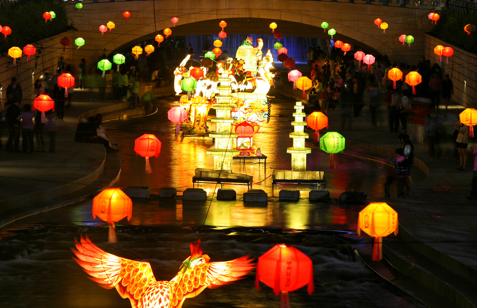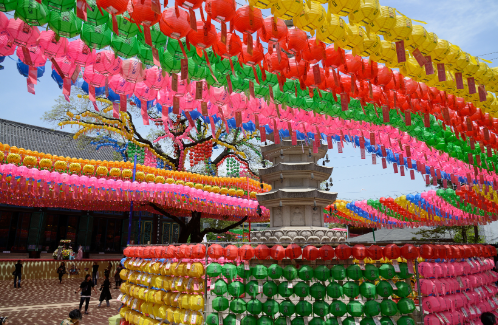

Buddha’s Birthday (부처님오신날) is one of Korea’s most beautiful holidays. On this day, temples across the country fill with the scent of incense, and city streets glow with thousands of paper lanterns shaped like lotus flowers. It is the day Koreans celebrate the birth of the historical Buddha, Siddhartha Gautama, and one of the best times of the year to experience Korean temple culture.
What Does “Buddha’s Birthday” Mean?
In Korean, the holiday is called Bucheonim Osinnal (부처님오신날), which simply means “the day the Buddha came.” It is also known as Seokga Tansil (석가탄신일), “the birthday of Shakyamuni,” the name Koreans use for the historical Buddha, and as Chopail (초파일), a name that comes from the date it falls on.
The Buddha was born as Prince Siddhartha Gautama in the 6th century BCE. After years of searching, he reached enlightenment and became the Buddha, meaning “the awakened one.” His teachings spread across Asia, and in Korea, Buddhism became one of the country’s great spiritual traditions. For Koreans, Buddha’s Birthday is a day of light, gratitude, and quiet reflection.
When Is Buddha’s Birthday?
Buddha’s Birthday follows the lunar calendar, so the date changes every year. It always falls on the 8th day of the 4th lunar month, which usually lands in May on the solar calendar.
The holiday became a national public holiday in 1975, and today it is one of the few religious holidays on Korea’s official calendar. On the day itself, many offices and schools close, and families often visit temples together.
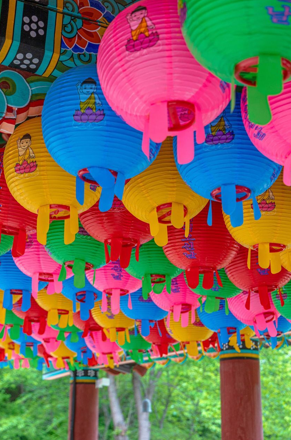
The Story of the Buddha’s Birth
The story of the Buddha’s birth is told across the Buddhist world. According to tradition, Queen Maya, the mother of Prince Siddhartha, gave birth in Lumbini Garden, in what is now Nepal. As the baby was born, it is said that he took seven steps, and at each step a lotus flower bloomed beneath his feet. Pointing one hand to the sky and one hand to the ground, he declared, “In the heavens above and the earth below, I alone am the world-honored one.”
This is why the lotus is the symbol of the holiday. The lotus grows from muddy water yet blooms clean and beautiful — a perfect image of the Buddha’s teaching that wisdom can rise from the ordinary world. On Buddha’s Birthday, the lotus appears everywhere: on lanterns, on temple banners, and in the decorations that fill the streets.
What Koreans Do During Buddha’s Birthday
Buddha’s Birthday customs center on temples, lanterns, and light. The details vary by region and from year to year, but most celebrations include the ones below.
Yeondeunghoe (연등회): The Lotus Lantern Festival
The most famous event is Yeondeunghoe, the Lotus Lantern Festival. With roots going back to the Silla Kingdom’s Palgwanhoe (팔관회) ceremonies, Yeondeunghoe has a history of more than a thousand years. In 2020 it was inscribed on UNESCO’s list of Intangible Cultural Heritage of Humanity, and in Korea it is a National Intangible Cultural Heritage (No. 122).
Yeondeunghoe is organized by the Bongchuk Committee (봉축위원회) of the Jogye Order together with the Yeondeunghoe Preservation Committee. The most famous celebration takes place in Seoul, where the grand lantern parade winds from Dongdaemun through the Jongno streets to Jogyesa Temple. But Yeondeunghoe is not a Seoul-only event — local Buddhist communities across the country hold their own lantern festivals, from the Busan Yeondeunghoe at Song Sang-hyeon Plaza to celebrations in Gwangju, Suwon, and other cities. The dates change every year, so it’s best to check the official schedule of the festival you plan to visit.
During the festival, the streets fill with tens of thousands of paper lanterns, and the highlight is the grand lantern parade (연등행렬), usually held on Saturday evening. Participants carry lanterns shaped like lotus flowers, dragons, fish, and even cartoon characters, and the whole city glows as the lanterns pass through the night.
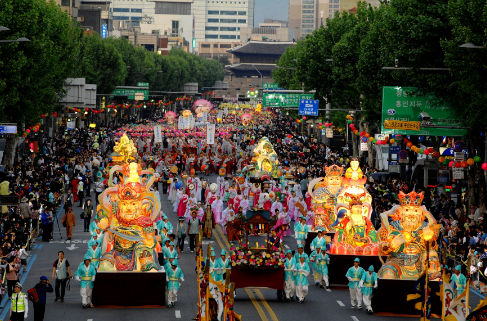
Photo: Korea Heritage Service
Bongchuk Beopyyosik (봉축법요식): The Commemorative Ceremony
On the day of Buddha’s Birthday itself, temples hold a commemorative ceremony called bongchuk beopyyosik (봉축법요식). At Jogyesa Temple in Seoul, the ceremony is attended by Buddhist leaders and often by national figures. A central part of the rite is the bathing of the baby Buddha (욕불): a small statue of the infant Buddha is placed in a flower-decorated basin, and visitors pour sweet tea over it as a gesture of purification and respect.
Lanterns and Temple Customs
Beyond the festival, families observe the day with quieter customs at their local temples:
- Gwandeung (관등놀이) — hanging a lantern at the temple, a wish for good fortune for the family
- Tapdori (탑돌이) — walking clockwise around the pagoda, a simple act of meditation
- Bangsang (방생) — releasing captive animals, such as birds or fish, as an act of mercy
- Incense and prayer — offering incense and bowing before the Buddha
Many temples also hold cultural programs for the public, and it is common for Koreans, Buddhist or not, to visit a temple on this day to enjoy the lanterns and the calm atmosphere.
Buddha’s Birthday Food: Temple Food (사찰음식)
Buddha’s Birthday is not tied to a single dish the way Seollal is tied to tteokguk. Instead, the day is associated with temple food (사찰음식), Korea’s traditional vegetarian cuisine. Rooted in the Buddhist principle of not taking life (불살생), temple food excludes meat, fish, and the “five pungent vegetables” (오신채) — garlic, onions, leeks, chives, and wild garlic — which are thought to stir the passions. What remains is a simple seasonal cuisine built on mountain greens and vegetables: namul (seasoned greens), tofu dishes, temple-made sauces, and pan-fried jeon and buchae. Temple food is not just a diet — it is considered a form of practice, a way of eating with mindfulness and respect for all living things. On Buddha’s Birthday, temples offer these meals to visitors, and many families eat a light vegetarian meal at home to mark the day.
A Celebration of Light
Buddha’s Birthday is Korea’s celebration of light. It is a day when the country slows down and the night is filled with light — a rare moment of calm. Whether you join the lantern parade in Seoul, climb to a mountain temple, or simply share a bowl of namul and rice, the holiday is a chance to pause, reflect, and let a little light into the year.