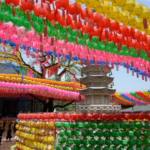

Chuseok (추석) is one of Korea’s two biggest holidays, together with Seollal (설날), the Lunar New Year. It is a harvest festival celebrated under the biggest full moon of autumn, when rice and fruit are newly gathered. At its heart are the same ideas found in harvest festivals everywhere: harvest, gratitude, and a large family meal.
During Chuseok, millions of Koreans travel back to their hometowns. Families gather at the home of the eldest relatives, hold a morning memorial service for their ancestors, share a large holiday meal, and visit ancestral graves together. Highways, train stations, and airports become crowded, and many offices and shops close for the holiday.
The usually busy capital feels quieter, tourist sites hold special holiday programs, and food shops fill their shelves with holiday rice cakes and gift sets.
What Does “Chuseok” Mean?
The word Chuseok comes from Chinese characters meaning “autumn evening” (秋夕) — or, more fully, “the night when the autumn moonlight is at its finest.” It describes a holiday spent under an exceptionally bright moon. The day is also known by its older native Korean name, Hangawi (한가위).
Chuseok falls on the 15th day of the 8th month of the lunar calendar, the night of the full harvest moon. In Korea, the day is also called Nonggong Gamsail (농공감사일) — a day of thanksgiving for the year’s farm work. Chuseok is the point at which the year’s farming is completed and its fruits are seen and shared, and at the same time a moment to wish for an abundant harvest in the year ahead.
The full moon is central to this meaning. In farming society, the full moon was deeply honored as a symbol of a rich harvest and abundance. A full moon looks like a grain just before harvest — plump and completely filled out. This is why Chuseok is often called the holiday of the moon (달의 명절).
In farming society, this was the time when the year’s crops were finally ready. Families thanked their ancestors for the harvest and shared the new rice, fruit, and wine with family and neighbors.
Because of this, Chuseok is not only a day off. It is the holiday that connects food, family, and gratitude in Korean culture. Many Korean holiday foods, including songpyeon, exist mainly because of Chuseok.
When Is Chuseok?
Chuseok follows the lunar calendar, so the date changes every year. It falls on the 15th day of the 8th lunar month, which usually lands in September or early October on the solar calendar. To find the exact date for any year, check a lunar calendar or an official holiday schedule.
In Korea, Chuseok is a three-day holiday: the day before, the day itself, and the day after.
- The day before Chuseok: the main travel day, when the great hometown migration begins
- Chuseok day: family rites and the holiday meal
- The day after Chuseok: the return trip begins
Travel is a big part of the holiday. Train tickets and flights for Chuseok are usually booked out weeks in advance, and highways are famously congested on the first and last days.
What Koreans Do During Chuseok
Chuseok customs center on family and ancestors. The details vary by family and region, but most celebrations include the ones below.
Charye (차례): The Ancestral Memorial Service
On Chuseok morning, many families hold charye, a memorial service for their ancestors. A table is set with carefully arranged holiday foods, including newly harvested rice, fruit, songpyeon, and savory pancakes. Family members bow together to honor their ancestors before sitting down to share the meal.
The arrangement of the charye table follows set rules, and every family does it a little differently. What stays the same is the idea: the year’s first harvest is offered to the ancestors first, and then the family eats together.
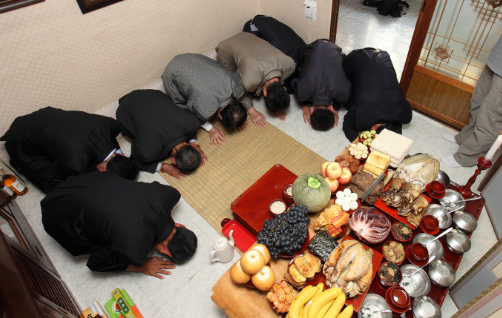
Photo: Korea Heritage Service
Seongmyo (성묘) and Beolcho (벌초): Visiting Ancestral Graves
After the morning service, families often travel to the graves of their ancestors. This custom is called seongmyo. Families clear the grass around the grave — a task called beolcho — and offer simple foods while paying respects.
For many Koreans, this is the most meaningful part of the holiday. Chuseok is often the one time a year when the whole family, including relatives who live far apart, gathers in one place.
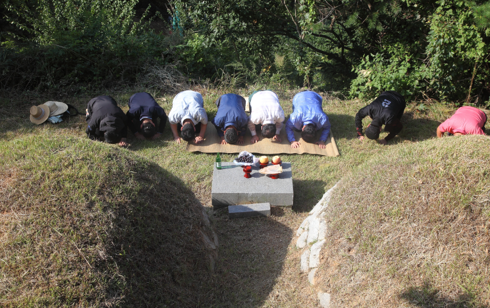
Photo: Korea Heritage Service
Games and the Harvest Moon
In the evening, families may play folk games together. The most famous is ganggangsullae (강강술래), a large circle dance performed under the full moon, in which dancers hold hands and sing while turning in a circle. Many Chuseok festivals and folk village events include performances of this dance.
Chuseok Food: What’s on the Holiday Table
Food is the heart of Chuseok. The holiday table is made with the year’s new harvest, and several dishes are strongly associated with the holiday.
Songpyeon (송편): Half-Moon Rice Cakes
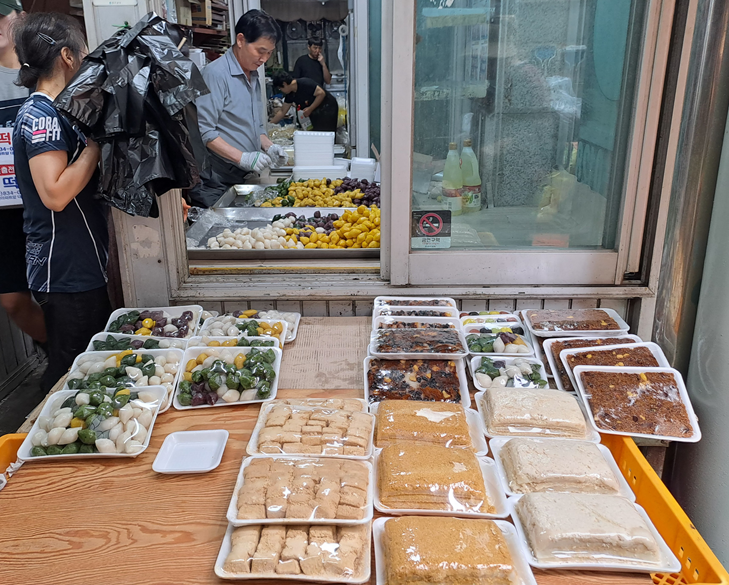
Songpyeon is the most famous Chuseok food. These are small rice cakes shaped like a half-moon, filled with ingredients such as sesame, honey, beans, or chestnuts, and steamed over pine needles, which gives them a subtle pine fragrance.
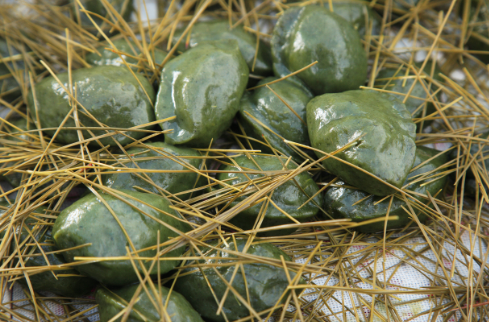
Photo: Korea Heritage Service
Making songpyeon is a family activity. The night before Chuseok, family members gather to shape the dough by hand, and children join in. There is a well-known saying that a person who shapes beautiful songpyeon will have good luck — or a beautiful child.
Toran-guk (토란국): Taro Soup
Toran-guk is a soup made with taro, a root vegetable harvested around Chuseok. The soup is a classic dish on the charye table in many regions, often cooked with beef broth and perilla powder.
Because taro is one of the season’s first new crops, serving toran-guk at Chuseok expresses the same idea as the holiday itself: offering the year’s first harvest with gratitude.
Jeon (전) and Bindaetteok (빈대떡): Savory Pancakes
Jeon are pan-fried pancakes made with ingredients coated in batter and egg. Vegetables, fish, and mushrooms are all used. On the Chuseok table, jeon made with newly harvested vegetables are common, and mung bean pancakes called bindaetteok are a classic holiday food in Seoul.
Hangwa (한과) and First Fruits: Korean Sweets and New Harvest
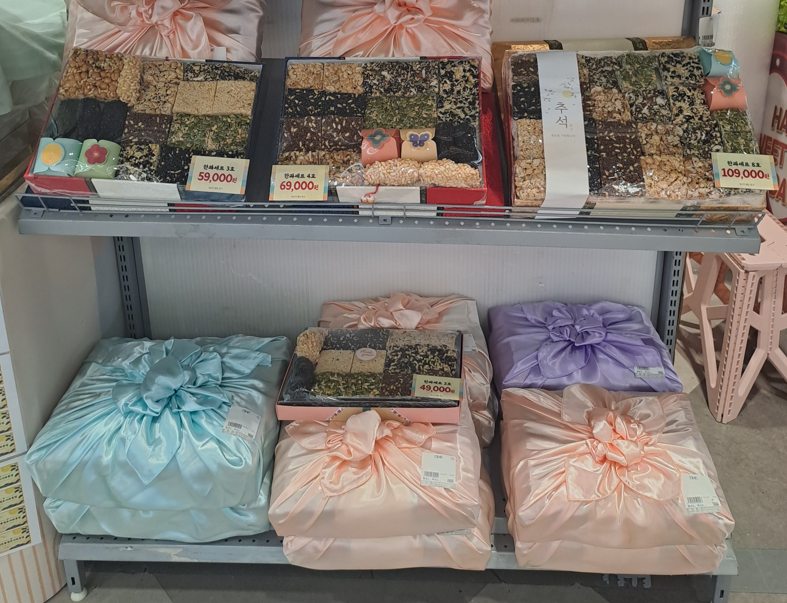
The holiday table also features hangwa, Korean sweets made from grain flour, honey, and rice, along with the season’s first fruit, such as Korean pears, apples, and jujubes. Newly harvested rice and freshly brewed rice wine may also be offered. Fruit is one of the most common Chuseok gifts.
Chuseok Gift Sets
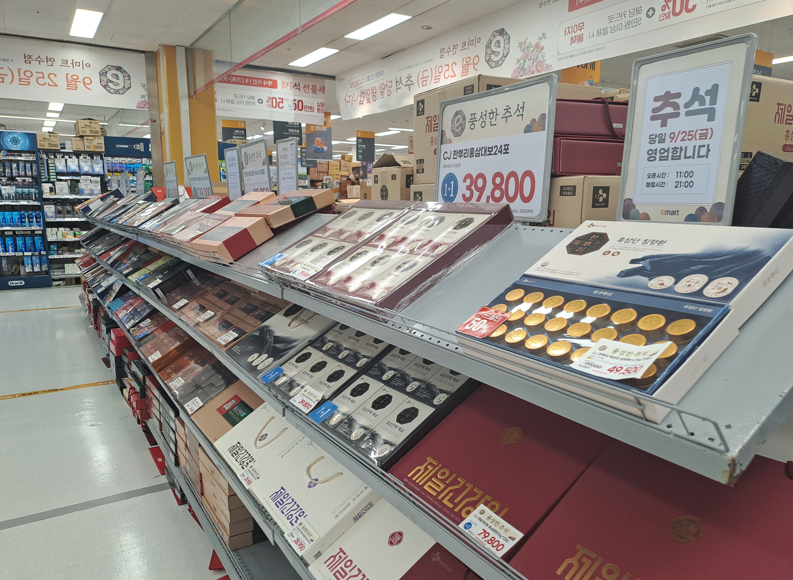
A modern Chuseok custom is the holiday gift set. Before Chuseok, department stores and convenience stores fill up with boxed gifts to give to parents, relatives, teachers, and coworkers. Popular gifts include fruit boxes, cooking oil, and health supplements. For many Koreans, choosing and wrapping these gifts is as much a part of the holiday as the meal itself.
A Holiday Under the Full Moon
Chuseok is the holiday when Korea slows down and turns toward home. Families shape songpyeon together the night before, share the year’s new harvest the next morning, and end the day under a full moon. It is a custom Korean families have carried on for centuries — a harvest festival that connects food, family, and gratitude in a single day.