
Korea is famous for service that goes further than most countries expect. A restaurant refills your side dishes before you ask. A shop assistant walks you to the door instead of pointing at it. And two minutes down almost any residential street, there is a shop with the lights on, the shelves stocked, and nobody inside at all.
Both things are true at the same time, and that contrast is the interesting part. An unmanned shop is a store with no staff: you take what you want, pay for it yourself, and leave. They sell ice cream, snacks, stationery, flowers, pet supplies, and plenty of other everyday goods, and in Korea they are not a novelty — they are simply part of how the neighborhood works. Here is why they spread, and how to use one without standing in the doorway wondering what to do.
1. Why a country this attentive to customers has stores with nobody in them
The answer is not technology. It is arithmetic.
Wages are the cost that decides everything for a small shop. Korea’s minimum wage for 2026 is 10,320 won an hour, confirmed by the Ministry of Employment and Labor — and it has more than doubled since the early 2010s. For a shop selling a 500-won ice cream bar, a part-time cashier costs more per month than some of these stores earn in profit. Once the wage bill outweighs the till, taking the person out of the shop stops being a gimmick and becomes the only way the numbers work.
The shops that survive are the ones selling something standard. An unmanned shop can only sell goods that need no explanation, no recommendation, and no age check. Packaged ice cream works. A loose vegetable that needs advice on how to cook it, or a bottle of soju that needs an ID, does not. That single rule explains most of what you will and will not find on these shelves.
Low running costs pulled in owners who were not retailers. Because these shops need no staff and start for far less than a conventional business, they attracted retirees, office workers wanting a second income, and younger owners with limited capital — people who would otherwise never have opened a shop at all.
So the unmanned shop is not a rejection of Korean service culture. It is what happens when a product is standard enough that service was never the thing being sold.
2. The door is usually just open
In most unmanned shops there is nothing to figure out. The door is open, and many of them have no lock at all. You walk in during operating hours and you are already a customer.
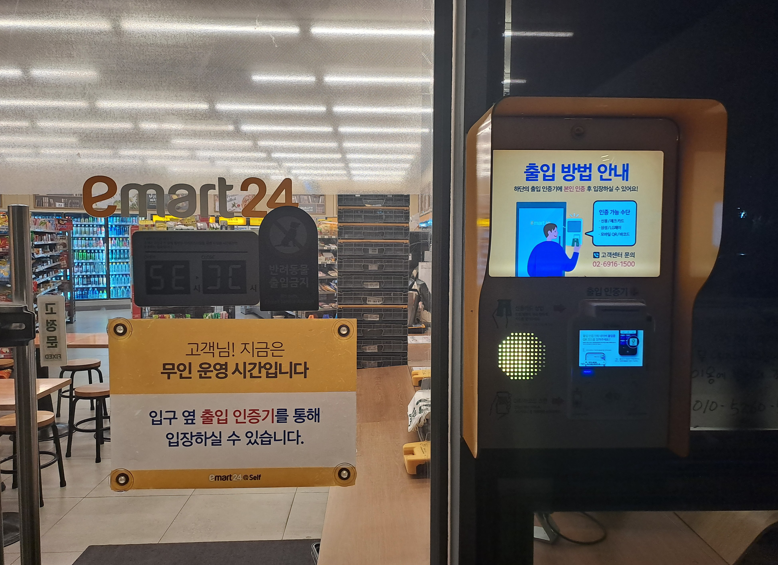
One common exception is worth knowing. At unmanned convenience stores and at some shops that stay open late into the night, the door is kept locked so that only registered visitors come in. In that case you tap a card on the reader, or enter your phone number on the keypad, and it opens.
If a door is locked and nothing on the sign explains it, look for a phone number. Storefronts almost always print one.
3. They all run on the same idea — only the goods change
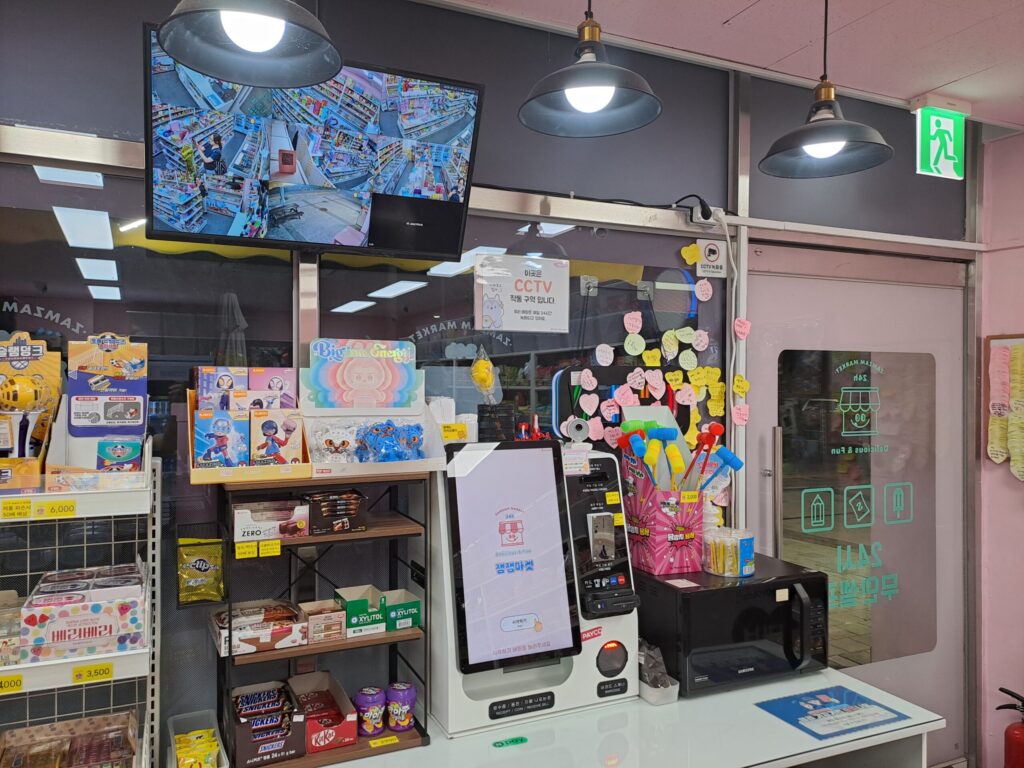
The format barely changes from shop to shop. There is a shelf or a freezer, a payment machine, and a door. What changes is what sits on the shelf.
The most common is the ice cream discount store, which is on nearly every residential street: a small room, chest freezers along the wall, and packaged ice cream priced lower than at the convenience store. You take what you want, pay at the machine by the door, and leave.
The same setup covers snacks and drinks, usually cheaper than the convenience store, and stationery and small household goods such as pens, batteries, and phone cables. Around university areas you will also find “zero” shops stocking only low-sugar and high-protein food — zero-sugar drinks, low-sugar snacks, protein bars — which sell at a bit above convenience store prices and have grown quickly with the diet-conscious crowd in their 20s and 30s.
Beyond that, the line keeps moving: meal kits in a chilled cabinet, flowers bought in a hurry on the way to a birthday dinner, pet supplies, and in residential areas, rice cake, vegetable, and butcher counters where you bag what you need and pay by card or account transfer.
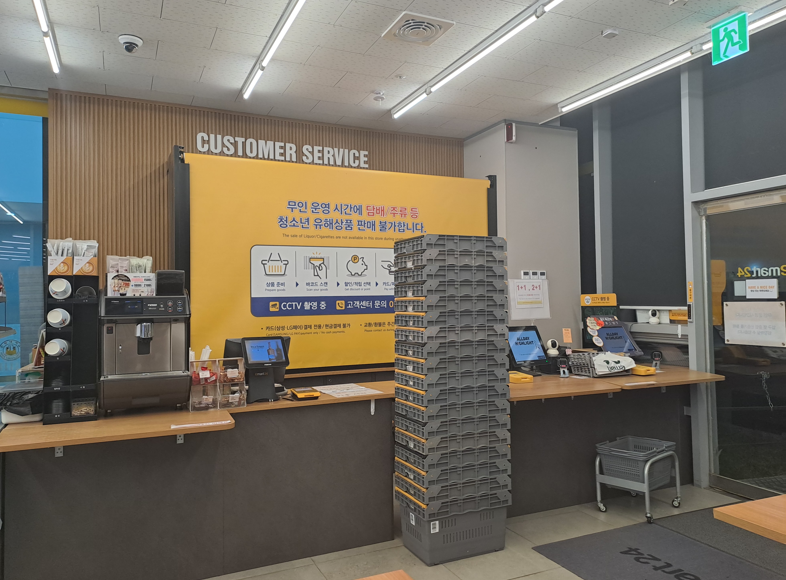
4. You pay for it yourself — four ways, and one catches people out
Payment is the only part that needs a moment of attention, because there are four systems and they don’t look alike.
4-1. A kiosk. A screen at the entrance or in the middle of the room. Choose the item, confirm, pay by card, take the receipt. Standard at larger shops and cafés.
4-2. A self-checkout terminal. A screen with a barcode scanner attached — the same machine you see in supermarkets. Scan each item, then pay by card.
4-3. A card reader on the wall or the counter. No screen to operate at all. You tap or insert your card, the amount is charged, done. It’s the cheapest setup to install, so it’s what most small shops use.
4-4. Bank transfer (gyejwaiche 계좌이체). This is the one that catches people out. An account number is printed on the wall, and you’re expected to send the exact amount from a banking app. The owner checks the transfer later, sometimes against the camera footage. If you don’t have a Korean bank account, this can be a real problem.
Bring a card. Card and mobile payment work almost everywhere, and cash is unreliable — some machines take it, many don’t, and the slot is often out of order. If there’s no card terminal and only an account number on the wall, that shop is not set up for you; call the number on the sign rather than walking out with unpaid goods.
If you do pay by bank transfer, write your name and the item in the memo. It makes the owner’s check easy and keeps you from being mistaken for a thief.
5. What to do when you get stuck
This is the part nobody prepares you for, and it is the moment foreign visitors usually give up and leave.
If the screen is Korean-only. Look for a small globe or flag icon near the top of the screen — most kiosks built for public use have a language toggle. If there isn’t one, point your phone’s camera at the screen and use a translation app’s live camera mode. It works surprisingly well on kiosk text, and it is usually faster than trying to read the buttons yourself.
If the machine won’t take your card. A foreign card occasionally fails on a small terminal. Try a tap instead of an insert, then a different card. If it still refuses, the shop simply isn’t equipped for foreign cards — leave the item on the counter and go to the next one. There is almost always another within a block.
If something goes wrong after you have paid. A machine swallows your money, the receipt doesn’t print, or the item looks expired. Take a photo of the screen and the item before you leave the shop, then use the manager’s phone number. Seoul began requiring unmanned shops to post a manager’s number where customers can see it, and most storefronts already have one on the sign or beside the kiosk.
If you are simply lost. Many kiosks have a small “help” or intercom button. Pressing it connects you to a remote manager who can see the camera feed and often talk you through the screen. Nobody is standing at the counter, but somebody is usually reachable.
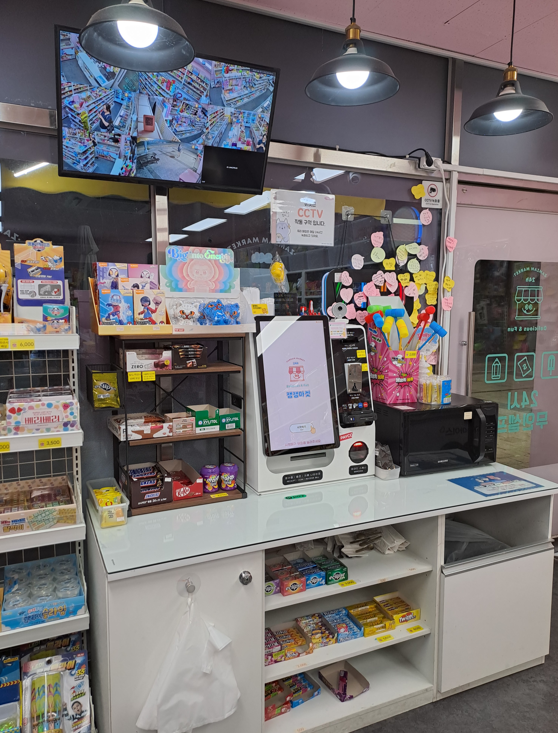
6. There’s a camera above the door — and still, the whole thing runs on trust
An unmanned shop has no employee, so the camera above the entrance is the only witness there is. Finish the payment before you leave, and keep the receipt until you’re outside. In a staffed shop a mistake is a conversation. In an unmanned one it becomes a photograph of you walking out.
And yet the arrangement is simple: you pay without anyone watching you, and the shop trusts that you will. In Korea that trust holds far more often than it fails, which is why there’s an unmanned shop on almost every street.