

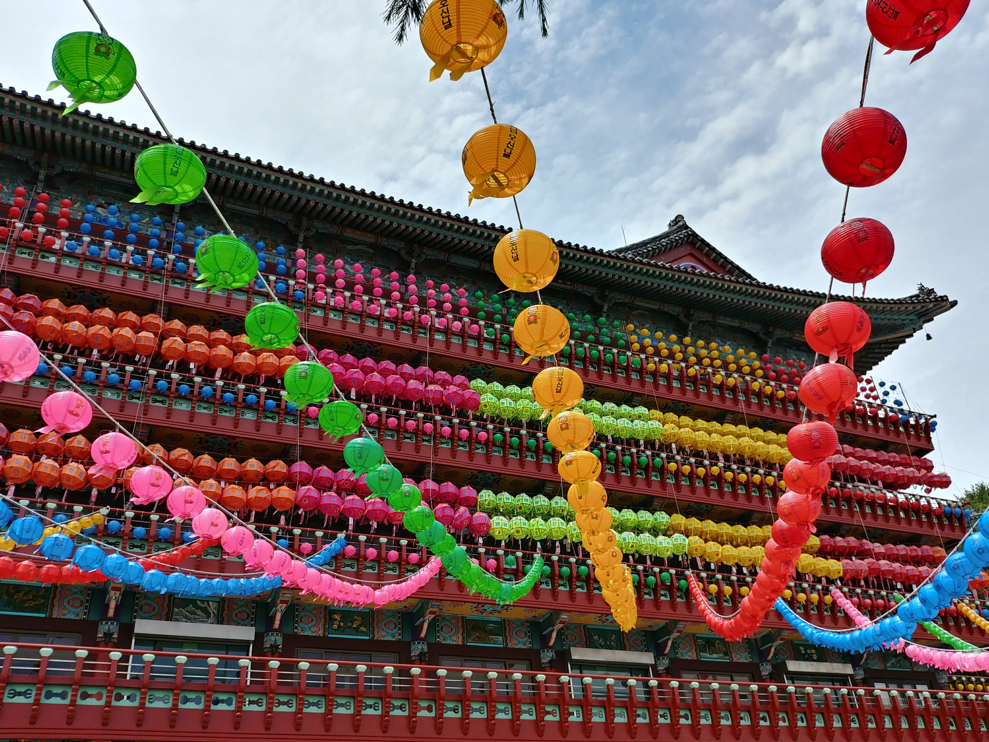
Around Buddha’s Birthday, tens of thousands of colorful lanterns fill Samgwangsa Temple in Busan. They stretch across courtyards, hang above stairways, and form glowing tunnels along the slopes of Baegyangsan Mountain. After dark, the display turns the temple grounds into a canopy of light. The lanterns draw local families, photographers, and international visitors. Some come for the evening scenery, while others light a lantern or offer a prayer for someone they care about. Understanding this meaning adds another layer to the view.
Quick Facts About Samgwangsa
- Korean name: 삼광사 (Samgwangsa)
- Location: Busanjin-gu, Busan, on the slopes of Baegyangsan Mountain
- Buddhist tradition: The Cheontae Order of Korean Buddhism
- Best known for: Its large lantern display around Buddha’s Birthday
- Lantern season: Spring, with dates changing each year
- Admission: Free
- Address: 77 Choeupcheon-ro 43beon-gil, Busanjin-gu, Busan
- Visiting: The temple is open year-round; the large lantern display is seasonal.
A Buddhist Temple Above the City
Samgwangsa developed from a Buddhist community established in Busan in 1969. The community later built and expanded the temple on Baegyangsan’s slopes. Today, it is a major temple of the Cheontae Order, with large worship halls and spaces for religious gatherings. Prayer continues throughout the year. Visitors may see worshippers quietly entering the halls or walking around the temple’s pagoda, even when no major event is taking place.
What Makes the Lantern Display Special?
At Samgwangsa, the lanterns cover a large area of the temple grounds. Closely spaced rows stretch overhead, while lantern-covered stairways lead visitors between different levels. From higher public viewpoints, the individual lights come together as a broad field of color. The display changes as you move through it. Under the lanterns, you can see their shapes and details. From above, the rows create patterns across the courtyards and around the buildings. Past festivals have also included large illuminated figures such as dragons, elephants, and zodiac animals. These give visitors smaller details to discover among the many hanging lanterns, although the designs can change from year to year.
What Do the Lanterns Mean?
In Korean Buddhism, lighting a lantern expresses the wish to bring wisdom into darkness. The light symbolizes Buddha’s teachings illuminating the mind and helping people move beyond ignorance and suffering.
Lanterns can also carry personal hopes—for health, peace, family, or the wider community. Some have prayer tags attached beneath them, reminding visitors that the display contains individual wishes as well as thousands of lights. UNESCO Intangible Cultural Heritage
Many lanterns are shaped like lotus flowers. In Buddhism, the lotus symbolizes purity because it grows from muddy water while its flower remains clean. This gives the flower-shaped lanterns a meaning beyond their color and appearance.
Korea’s broader lantern-lighting tradition, Yeondeunghoe (연등회), was inscribed on UNESCO’s Representative List of the Intangible Cultural Heritage of Humanity in 2020. The inscription recognizes the living tradition of making, lighting, and sharing lanterns across Korea.
When Can You See the Lanterns?
The large display is arranged around Buddha’s Birthday, celebrated on the eighth day of the fourth lunar month. Its date on the Western calendar changes each year, so the festival does not always fall on the same dates. Check the announced festival period and lighting hours before planning a trip specifically for the lanterns. The temple remains open throughout the year, but the full seasonal display is tied to this celebration. If your schedule allows, arrive in the late afternoon and stay into the evening. Daylight makes it easier to see the lantern colors and temple buildings; after the lights come on, the same paths take on a different appearance.
What Else Can You See?
The lanterns are the main attraction during the festival, but the temple buildings are worth looking at too.
Daeungbojeon Hall
Daeungbojeon (대웅보전) is a main worship hall. Its painted wooden details and tiled roof provide a setting for the hanging lanterns. Follow the entrance signs and give worshippers space when looking inside.
The Large Stone Pagoda
The temple’s Daebotap (대보탑) rises approximately 30 meters. It enshrines Buddhist relics, and visitors may see worshippers walking around it while praying. Its height makes it an easy landmark to recognize among the temple buildings.
How to Get to Samgwangsa
A convenient route starts at Seomyeon Station, an interchange for Busan Metro Lines 1 and 2.
From Exit 9, head toward Young Kwang Bookstore and find the bus stop opposite it. Take Village Bus Busanjin-gu 15 to Samgwangsa. City buses 44, 54, 63, 81, and 133 also stop near the temple entrance, followed by a walk uphill.
Search 삼광사 in a Korean map app to check the route from your accommodation. During the festival, allow additional time for the approach and your return journey.
Visiting During the Lantern Festival
You do not need to be Buddhist to enjoy the lantern display. Walk through the visitor areas, look at the different lantern designs, and pause where the view opens across the grounds. Keep stairways clear when taking photographs, speak quietly near prayer halls, and follow signs about entering buildings. If you notice wishes attached beneath the lanterns, treat them as personal offerings and leave them undisturbed.
Read Next
Temple Stay in Korea (템플스테이): How to Book & What to Expect

