
In Korea, you are almost never more than a few minutes from a convenience store. They sit at the corner of residential blocks, at the bottom of office towers, inside subway stations, beside bus stops, and next to hospital entrances. At two in the morning, when everything else in the neighborhood is dark, they are the lit rectangle on the street.
For a visitor, that is convenient. But for Koreans, the convenience store is not a backup plan. It is part of how daily life actually works — a kitchen, a pantry, an office, a post office, and a place to sit for twenty minutes.
This guide explains what a Korean convenience store is, how it differs from the ones you already know, what is worth buying, and how to use one like a local.
What “Pyeonuijeom” Means
The Korean word is 편의점 (pyeonuijeom). It comes from Chinese characters meaning “convenience shop” — 편의 (convenience) plus 점 (shop). The name is exactly what it sounds like, but the daily role it plays is much bigger than the name suggests.
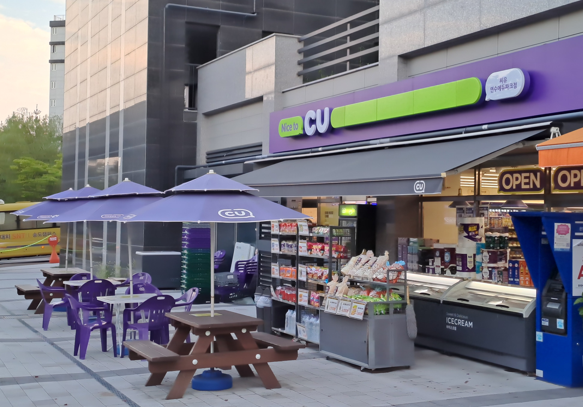
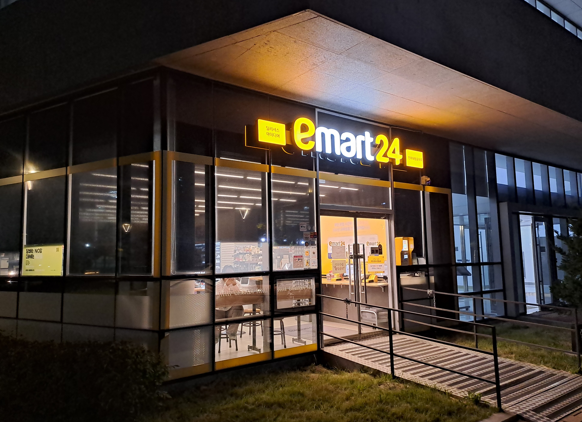
There are five chains you will notice, though four of them dominate. GS25, with its blue and green signage, is the largest by store count and is operated by GS Retail. CU, in green and purple, is a close second and the most aggressive expander of the group; it is run by BGF Retail. Emart24, which uses yellow and black, belongs to the same group behind the big Emart marts. 7-Eleven keeps its familiar green, orange, and red identity, but in a distinctly Korean form. Ministop has a smaller footprint, yet it is still around.
It helps to learn the signs quickly, because the differences between them show up in what they carry. GS25 tends to lead with fresh food and desserts, CU leans hardest into character collaborations and limited editions, and Emart24 has been building out sandwiches and bakery items. None of that matters much if you only need water and a bag of chips — but if you are choosing where to eat, the chain you walk into will shape the meal.
GS25 had about 18,100 stores at the end of 2024, and CU has been expanding hard to close the gap. Together the top two chains account for the large majority of the market.
One Store for Every 900 People
Korea does not just have a lot of convenience stores. It has more per person than any other country in the world.
According to data from Korea’s Ministry of Trade, Industry and Energy, the four major chains together operated 53,266 stores at the end of 2025. In a country of roughly 52 million people, that works out to about one store for every 900 residents. For comparison, Japan has approximately one convenience store per 2,300 people, and the United States about one per 2,500.
The number is worth reading twice, because of what sits behind it: the count actually fell from 54,852 stores in 2024 to 53,266 in 2025 — the first real contraction after decades of relentless growth. The market is approaching saturation, and the chains know it. That is why they are no longer fighting only over locations. They are fighting over what a convenience store can be.
Why They Are Everywhere
The density is not an accident of retail strategy. It answers a specific set of needs in Korean daily life.
Small homes. Many Korean apartments are compact, and so are their kitchens. Not every household has room to store a week of groceries — or a second refrigerator.
Single-person households. Korea has one of the highest shares of one-person households in the world, and those households buy food in single servings rather than in bulk. A store that sells one portion at a time fits their life exactly.
Long working hours. When people finish work late, the store is still open and the food is already made.
Dense, walkable cities. Korean cities are built upward and have strong transit, so a store on the ground floor of one building can serve thousands of people on foot.
Late-night and early-morning hours. Between the time restaurants close and the time they open, something has to feed the country. That gap is enormous, and the convenience store occupies all of it.
The store did not replace the supermarket. It took over the hours and the quantities that supermarkets were never designed for: one portion, right now, on the way home.
The Hot Water Machine and the Ramyeon Shelf
The most important piece of equipment in a Korean convenience store is not the register. It is the hot water dispenser.
Next to it, you will usually find a small standing counter with an instant noodle shelf nearby. You buy a cup of ramyeon, take it to the dispenser, fill it, wait three or four minutes, and eat it right there. Most stores keep chopsticks and lids within reach, and larger branches often have proper seating.
This is not a novelty in Korea. It is a normal way to eat lunch, dinner, or a late-night meal — and for travelers it is the cheapest hot meal in the country.
A few practical notes:
- Cup ramyeon (컵라면) is the easy version. Bag ramyeon (봉지라면) is cheaper, but normally needs a store with bowls or a cooking station.
- Hot water is free, and you are not strictly required to have bought the noodles there — though buying something is the norm.
- Many stores also keep a microwave near the dispenser. That is for dosirak and other prepared food, not for noodles.
- Look for stores with seating near universities, residential areas, and highway rest stops. Branches inside stations and office basements often have none.
What to Buy: The Food That Lives There
Convenience store food in Korea is not an emergency option. It is a category of its own, with seasonal releases, chef collaborations, and character-branded products that get discussed online the way new restaurant menus do.
Dosirak (도시락) are boxed meals: rice, a main dish, and several small side dishes packed in one tray. They are heated in the store microwave and cost a fraction of a restaurant meal. This is what office workers eat when they do not want to go out.
Triangle kimbap (삼각김밥) is the icon. It is a triangular rice ball wrapped in seaweed, and the plastic wrap is engineered to be pulled apart in two stages so the seaweed stays crisp until the moment you eat it. Common fillings include tuna mayonnaise, kimchi, bulgogi, and spam.
Kimbap (김밥): Types, Ingredients, How to Eat It, and Where to Find It in Korea – Kimbap Life
Kimbap and sandwiches sit alongside them, and the sandwiches have become noticeably more ambitious in recent years — some chains now sell them as a serious lunch rather than a snack.
Snacks run from the familiar to the deeply Korean: honey butter chips, shrimp crackers, dried squid, and small packs of roasted seaweed.
Ice cream occupies a year-round shelf in Korea, not a summer one, and the selection is far wider than in most countries — from cheap fruity bars to premium cones that come and go with the season.
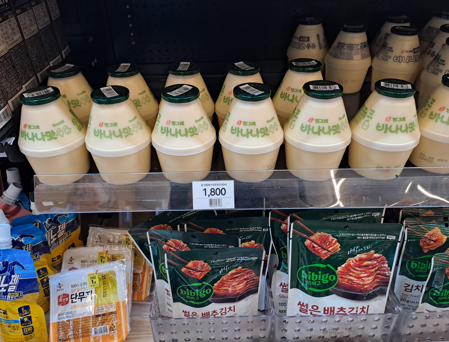
Drinks deserve their own paragraph. Look for banana milk (바나나맛 우유), a sweet yellow-bottle drink sold in Korea for decades and now popular enough abroad to be treated as a souvenir in its own right. Beside it you will find chocolate milk, yogurt drinks, barley tea, and a wall of iced coffee.
1+1 and 2+1: How the Promotions Work
Korean convenience stores run some of the most aggressive promotions in retail anywhere, and they are printed directly on the price tag.
- 1+1 means buy one, get one free.
- 2+1 means buy two, get one free.
- 행사 (haengsa) means “promotion” and marks the products currently on offer.
- 덤 or a +1 tag is the same idea applied to a specific item.
There is no membership card, no coupon to find, and no minimum spend. You take two of a 1+1 item to the counter and pay for one. Staff will often prompt you if you pick up a single promoted item. This is also why the same product can cost noticeably less at a convenience store than at a supermarket: the store is running a promotion, not cutting a base price.
If you are traveling on a budget, the promotion shelf is where your money goes furthest.
What Else You Can Do at the Counter
The counter does much more than sell things. For a lot of Koreans, the convenience store is the last local branch of every other service that has been withdrawing from neighborhoods.
- Recharge a T-money card — the transit card used on subways, buses, and taxis. Most stores also sell the card itself. This is the single most useful thing a visitor can do here.
- Send a parcel — most chains accept prepaid parcel drop-off through their in-store terminals, and some staff will pack it for you. A great deal of ordinary Korean shipping happens this way rather than at a post office.
- Use an ATM — common in larger branches. As traditional bank branches have disappeared from residential areas, store ATMs have filled the gap.
- Pay utility bills — still a normal errand at the counter.
- Buy an umbrella, a phone charger, a toothbrush, a face mask, or a pair of socks — the “just in case” shelf is remarkably complete, which is why nobody panics when it starts raining.
- Claim a tax refund — some tourist-heavy branches, especially in Myeong-dong and at Incheon Airport, run tax refund kiosks.
- Get hot water, a microwave, and sometimes a table — and use the restroom in many branches.
Two Words Koreans Invented for This
The clearest sign that convenience stores are part of Korea’s daily logic is that the language moved to accommodate them.
편세권 (pyeonsegwon) — “convenience store zone.” It is modeled on 역세권 (yeoksegwon), the long-standing term for a desirable residential area near a subway station. The fact that the walking distance to the nearest convenience store became a genuine factor in choosing an apartment tells you how deeply this infrastructure is woven into ordinary life.
슬세권 (seulsegwon) — “slipper zone,” a neighborhood you can navigate in slippers. At the center of that slipper-friendly radius is, almost always, the convenience store. Meals, over-the-counter medicine, parcel pickup, and bill payment all sit within a few minutes’ walk.
A Day in the Life of a Convenience Store
Walk into the same Korean convenience store at different hours and you will see different rooms.
Morning — a coffee stop. Office workers take an iced Americano from the fridge or the machine and leave within a minute.
Lunch — a canteen. The microwave line moves steadily, and the tables fill with dosirak and noodles.
Afternoon — an office. Students study at the tables, and freelancers work on laptops. Not every store has seating, and some quietly restrict it during peak hours.
Evening — a pantry. People stop on the way home for one or two items, not a week of shopping.
Late night — a living room. People finishing late shifts eat standing up, couples share ice cream on the walk home, and taxi drivers stop for a hot drink.
The store never becomes a restaurant or a café. It stays neutral, open to everyone, and open all night. That is the point.
The Trend Lab
Korean convenience stores are also where the country’s consumer trends surface first — before department stores, before online shops.
Character collaborations. BGF Retail, which operates CU, reports that its character collaboration products grew from roughly 50 items in 2021 to more than 370 in 2025 — a sevenfold increase, with related sales doubling every year. Milk, snacks, and bread now routinely ship with cartoon and IP branding aimed at younger shoppers.
Apps. Each major chain runs its own app, and they have evolved from coupon dispensers into practical shopping tools with real-time inventory checks and advance ordering. A survey of 1,000 convenience store users by the consumer data platform Opensurvey found installation rates of 55.3% for GS25’s app, 47.5% for CU’s, and around 12–13% each for 7-Eleven and Emart24 — all rising year on year.
Concept stores. As the domestic market saturates, chains are turning individual stores into destinations with floor space one and a half to two times the standard size. CU’s “Ramyun Library” in Hongdae stocks more than 230 varieties of instant noodles and has become a stop for international visitors. Emart24’s “K-food Lab” near Myeong-dong Station groups Korean desserts and food products with tax refund kiosks for foreign shoppers. BGF Retail runs a “Snack Library” at Incheon International Airport. Emart24 has also opened an all-in-one store in Seongsu-dong combining cosmetics, clothing, and character goods, and other concepts include sports stores with lockers and changing rooms.
The takeaway for a visitor: a convenience store in a tourist district may be worth a deliberate visit, not just a pit stop.
More Than a Shop: The Neighborhood Safety Net
The role does not stop at commerce, and this is the part foreign visitors rarely hear about.
Because they are open 24 hours and staffed, convenience stores function as an informal part of community safety. CU has operated a missing person prevention system with the Korean National Police Agency since 2017, supporting police reports and family reunification for lost children, dementia patients, and people with intellectual disabilities. GS25 runs its own emergency patient rescue system. Store ATMs have absorbed much of the banking access lost as physical bank branches closed.
None of this is advertised as a feature. It is simply what a building that never closes, in the middle of a neighborhood, ends up doing.
What Changes Through the Year
Korean convenience stores follow the calendar closely, and the shelves move with it.
Summer brings ice cups — a cup of ice you buy and fill with your own drink — along with cold noodles, iced desserts, and lighter dosirak.
Winter brings hot canned drinks, fish-shaped bread baked in small in-store machines, hand warmers, and heavier stew-type meals.
Before Chuseok and Seollal, the front of the store fills with boxed gift sets: cooking oil, canned goods, health drinks, and fruit. Convenience stores became the fast, cheap way to buy holiday gifts, and the displays are impossible to miss.
Exam seasons bring their own promotional waves, with snacks and drinks marketed to students and their parents.
Visit Korea twice in different seasons and the convenience store will look like a different store.
The Korean Model Is Going Abroad
The system is now being exported — not as a way to stock Korean products on foreign shelves, but as a transplant of store design, operating systems, and the underlying culture.
International locations operated by Korean chains passed 1,500 as of 2025. In countries such as Mongolia and Vietnam, Korean-style convenience stores have become gathering spots where young locals go specifically to experience Korean culture. GS25 has stores in Hanoi; collaborations with global brands now launch in Seoul and roll outward.
Given that the domestic market is contracting, that outward push is not a side project. It is the growth strategy.
Common Mistakes Foreign Visitors Make
Assuming it is a snack shop. It sells meals, and in many neighborhoods it is where dinner comes from.
Missing the promotions. The 1+1 and 2+1 tags are the biggest savings in the store, and they are easy to overlook if you cannot read Korean.
Not using the hot water. Travelers walk past the dispenser without realizing it is the cheapest hot meal available in the country.
Forgetting you can recharge transit here. Many visitors walk to a subway station to top up a T-money card when the store on the corner does it in ten seconds.
Expecting seating. Many branches have no tables at all, especially in busy commercial and station areas.
Being surprised by single-item fruit prices. Fruit sold in singles and small packs is convenient, not cheap.
Assuming all branches are identical. Two stores from the same chain can carry very different food depending on whether they serve a residential block, an office district, or a transit hub.
Queuing separately for each item. Bring everything to the counter at once.
Useful Korean Phrases
편의점 (pyeonuijeom) — convenience store 삼각김밥 (samgak gimbap) — triangle kimbap 도시락 (dosirak) — boxed meal 컵라면 (keop ramyeon) — cup noodles 뜨거운 물 (tteugeoun mul) — hot water 전자레인지 (jeonja-reinji) — microwave 일 플러스 일 (il plus il) — 1+1, buy one get one free 이 플러스 일 (i plus il) — 2+1 행사 (haengsa) — promotion 교통카드 충전 (gyotong kadeu chungjeon) — transit card recharge 택배 (taekbae) — parcel delivery 카드 되나요? (kadeu doenayo?) — Do you take card? 봉투 주세요 (bongtu juseyo) — Please give me a bag 데워 주세요 (dewo juseyo) — Please heat this up 이거 주세요 (igeo juseyo) — This one, please
You do not need full sentences. Pointing at an item and saying 이거 주세요 is enough for almost any purchase.
Frequently Asked Questions
Are Korean convenience stores open 24 hours? Most are, though some branches inside office buildings, schools, and stations keep limited hours. Signage and the chain’s app usually show opening times.
Can I recharge a T-money card at any convenience store? At nearly all of them — GS25, CU, and 7-Eleven included. Hand the card and cash to the cashier and say 충전해 주세요 (chungjeonhae juseyo). You can also buy the card itself at most branches.
What is the cheapest meal I can get there? Cup ramyeon eaten at the store, using the free hot water. Add a triangle kimbap for a complete, very cheap meal.
What does 1+1 mean? Buy one, get one free. Take two of the marked item to the counter and you pay for one. No membership or coupon is required.
Can foreigners send parcels from a convenience store? Yes. Prepaid parcel drop-off is available at most chains, with in-store terminals to register the shipment. Bring the item already packed.
Do convenience stores sell alcohol? Many do, and they sell it later into the night than other shops. Beer, soju, and makgeolli are common, along with glasses and simple anju snacks.
Why the Convenience Store Matters
Korea is often described through its big moments: the food, the history, the technology, the speed. The convenience store is where all of that becomes ordinary.
It is open when nothing else is. It sells one portion to one person. It heats your food, holds your parcel, recharges your card, and lets you sit for a while without asking you to leave. It is cheap, it is everywhere, and nobody minds whether you are a regular.
It is also, quietly, part of how the country takes care of itself — a place to report a lost child, to find an ATM when the bank branch is gone, to buy an umbrella when the sky opens.
For a visitor, it is the fastest way to understand how Korea actually lives day to day. Before the palaces, before the restaurants, spend one evening in a convenience store. Watch who comes in, and at what hour.
You will learn more about daily life in twenty minutes than most guidebooks will tell you in a chapter.