

On the wooded slopes of Geumjeongsan Mountain in northern Busan, Beomeosa Temple brings together stone gateways, painted wooden halls, and more than 1,300 years of Buddhist history. Visitors come to explore its buildings, walk through the surrounding forest, and spend time in a place where monks continue to study and practice. Beomeosa’s name also carries an unusual story: a golden fish descending from heaven into a mountain spring.
Quick Facts About Beomeosa Temple
- Korean name: 범어사 (Beomeosa)
- Location: Geumjeong-gu, Busan, on Geumjeongsan Mountain
- What it is: A Buddhist temple and active monastery
- Founded: Traditionally dated to 678, during the Silla period
- Founder: The Buddhist monk Uisang
- Main sights: Jogyemun Gate, Daeungjeon Hall, and the Three-Story Stone Pagoda
- Admission: Free
- Listed visiting hours: 8 a.m.–5 p.m., year-round
The temple’s general visitor hours are separate from the schedules of religious services and Templestay programs.
A Temple With More Than 1,300 Years of History
Beomeosa traces its founding to 678, when the monk Uisang established it during the reign of Silla’s King Munmu. It began as a temple associated with Hwaeom Buddhism and later became an important center of Seon (선), the Korean Buddhist tradition that emphasizes meditation. Religious study and practice continue here today. beomeo.kr
The temple has been rebuilt and repaired over the centuries. It suffered extensive destruction during the Japanese invasions of the late sixteenth century, followed by rebuilding during the Joseon period. The buildings visitors see today reflect these later chapters in its history.
The Golden Fish Behind the Name
According to the temple’s founding legend, a golden fish descended from Brahma’s heaven on five-colored clouds and entered a golden well on Geumjeongsan Mountain. The well was said never to dry up, even during drought. The mountain’s name refers to this “golden well,” while Beomeosa is explained as the “Temple of the Golden Fish from Brahma Heaven.” Knowing the story gives the name a meaning that is easy to miss when reading it only in English.
What to See at Beomeosa
Jogyemun: The One-Pillar Gate
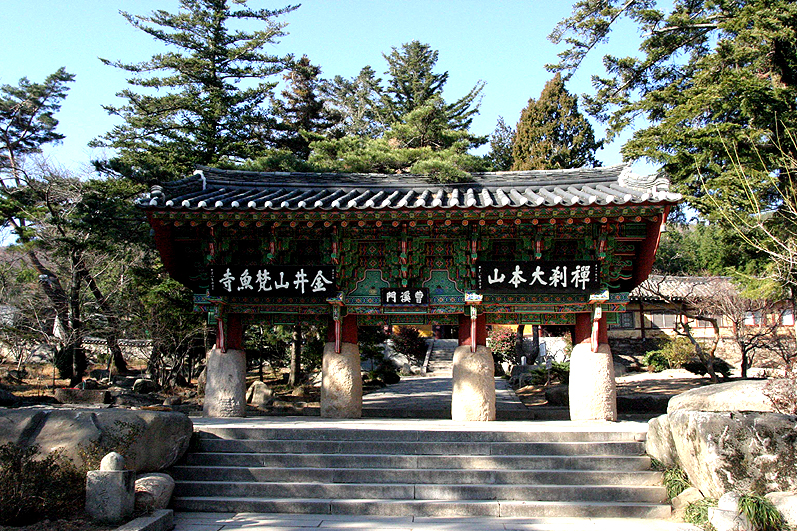
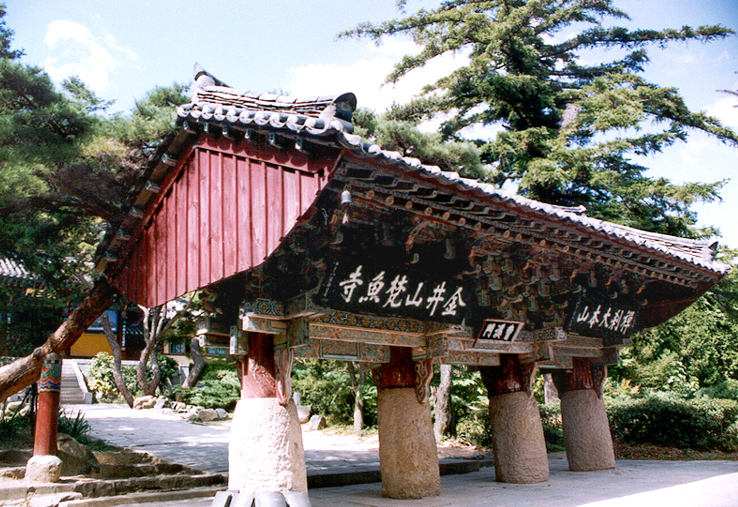
One of Beomeosa’s most distinctive structures is Jogyemun (조계문), its Iljumun (일주문), or One-Pillar Gate. Four tall stone supports stand in a single row beneath the wooden structure and roof. The name “One-Pillar Gate” refers to this arrangement: viewed from the side, the supports appear to line up as one. Take a moment to look at how the stone columns meet the timber above them before walking through.
Although the exact date the gate was built is unknown, it is believed to have been erected in 1614 (the 6th year of King Gwanghaegun’s reign), when the monk Myojeon restored and rebuilt several buildings within the temple grounds.
In 1781 (the 5th year of King Jeongjo’s reign), the monk Baeam repaired it into the structure seen today. The gate has a three-bay front (three sections across), and its roof is a mattebajung (hip-less gable roof) that forms the shape of the Korean character “in” (人) when viewed from the side — a simple, symmetric gable that slopes on two sides. The bracket sets (gongpo) that support the eaves are placed both on top of the columns and between them, a style known as dapo — a more elaborate bracket system that adds both strength and ornamentation.
One of the gate’s most distinctive features is that its columns stand on short wooden pillars set atop tall stone bases. Every wooden member of the gate is decorated with dancheong, the traditional Korean coloring on wooden buildings. Beomeosa’s Jogye Gate embodies the Buddhist teaching that all laws converge into one, which is why it is also called Samhaetal (Gate of Three Emancipations).
More than just a functional temple entrance gate, Jogye Gate achieves visual balance and refined design through the harmonious arrangement and joinery of its structural members. Expressing the structural beauty of traditional Korean architecture, it is regarded as a masterpiece among Korea’s Iljumun (One Pillar Gates).
Daeungjeon: The Main Worship Hall
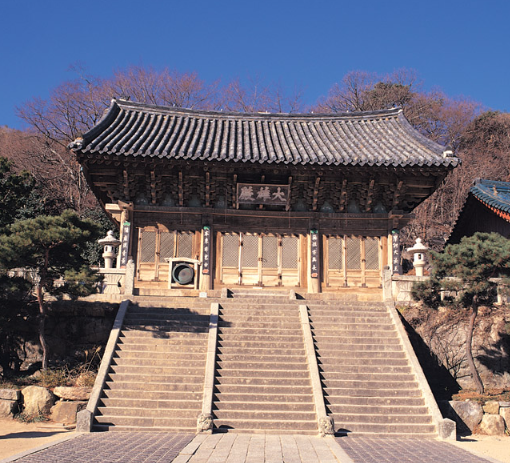
Daeungjeon (대웅전) is the temple’s main worship hall. Inside, Sakyamuni Buddha—the historical Buddha—is accompanied by figures associated with the past and future. Outside, look closely at the wooden brackets supporting the roof, the carvings, and the painted decoration beneath the eaves. These details reward a slower look, even if you are unfamiliar with Buddhist architecture. The hall remains a place of worship, so visitors should follow the signs and avoid interrupting anyone praying. heritage.go.kr
The Wooden Seated Sakyamuni Buddha Triad (목조석가여래삼좌상): The Main Buddha of Daeungjeon

As the principal Buddha of Daeungjeon Hall at Beomeosa, this triad was created as a “sugi” triad (a triad identified by named sculptures) of Sakyamuni Buddha, Maitreya Bodhisattva, and Jehwagalla Bosal. This is known from the Buddha-statue inscription (bulsang gimun) and the votive text (bulsang giin balwonchuk) found inside the statue’s interior cavity during its regilding. The inscriptions also confirm the exact date of creation — the 18th year of the Shunzi era (1661, the second year of King Hyeonjong’s reign in the Joseon Dynasty) — and that the statues were carved by Huijang, the head sculptor, together with Bohae, Gyeongsin, Ssangmuk, Noeyeong, Sinhak, and Cheongeon.
The head sculptor Huijang worked alongside Cheongheon, who carved the Wooden Seated Three Buddhas and Four Standing Bodhisattvas of Ssanggyesa Temple in Hadong (a Treasure) in 1639, and with Seungil, who carved the Wooden Amitabha Triad of Sudam Hermitage at Cheoneunsa Temple in 1646. In the 1650s, having received the title Seonjong Dae Seonsa (Great Seon Master of the Seon School), he created the Buddha statue of Daeunam Hermitage in Cheongdo (1654). His works have also been identified in the Jeolla and Gyeongsang provinces, and the Buddha triad of Beomeosa’s Daeungjeon is presumed to be a work from his mature period. The surviving records show that he was a leading sculptor-monk of the mid-to-late 17th century, active mainly in the Jeolla and Gyeongsang regions.
The triad shows well-balanced proportions and a dignified, harmonious form. The faces (sangho) combine fullness with a gentle smile, presenting a compassionate and graceful appearance. The folds of the robes are simplified with straight linear carving, leaving much open space, yet the overall effect is powerful and well-ordered. Below the knees, wide band-like folds spread symmetrically into a fan shape. These stylistic features have become the hallmark of Huijang’s school of sculptor-monks.
With the inscription confirming the exact names of the statues, the date of creation, and the group of sculptors, the Wooden Seated Sakyamuni Buddha Triad of Beomeosa’s Daeungjeon is a highly accomplished and valuable work. It is designated Treasure of Korea No. 1526.
The Murals of Daeungjeon: A Three-Buddha World in One Hall
Daeungjeon, the main Buddha hall of Beomeosa Temple in Busan, enshrines the Wooden Seated Sakyamuni Buddha Triad as its principal object of worship. Since such spatial triads of three Buddhas first appeared in the first half of the 17th century, Buddhist paintings depicting a similar triadic world were also produced — and the murals of Beomeosa’s Daeungjeon show how this three-Buddha world was realized within a single hall.
Inside the hall, the backdrop is the Yeongsan Assembly painting (Yeongsanhoesangdo), which hangs on the rear wall of the main altar. On the east wall is a mural of the Medicine Buddha triad (Yaksa Yeorae Samzondo), presiding over the Eastern Pure Land of Lapis Lazuli Light; on the west wall is a mural of the Amitabha Buddha triad (Amita Yeorae Samzondo), presiding over the Western Pure Land of Ultimate Bliss. A similar arrangement can be found at the Daegwangjeon Hall of Sinheungsa Temple in nearby Yangsan, revealing regional and iconographic parallels.

In addition, the upper walls above the hall’s two side doors feature a mural of Avalokiteshvara Bodhisattva (Gwaneum Bosal) on the east and a mural of Bodhidharma and Huike (Dalma·Hyega Danbido) on the west. This reflects the religious belief that Bodhidharma was an incarnation of Avalokiteshvara. Together with the two triad paintings, these four murals form a cohesive and complete program of iconography and theme. While murals of Avalokiteshvara and Bodhidharma can also be found elsewhere, such as at Unmunsa Temple in Cheongdo, Daeungjeon at Beomeosa is the only known example where all four — the three-Buddha world and the Bodhisattva/Bodhidharma paintings — appear together within a single hall.
These murals are therefore significant as works that reveal both the three-Buddha faith and the Avalokiteshvara/Bodhidharma faith of the late Joseon Dynasty, and that clearly express the devotional orientation of Daeungjeon’s inner space. They have also preserved their original form without repainting during subsequent repairs, making them valuable sources for understanding the activities and mutual influence of the regional painter-monk groups in the Yeongnam area during the first half of the 18th century.
The Three-Story Stone Pagoda

The Three-Story Stone Pagoda (삼층석탑) preserves the style of the Unified Silla period. The pagoda’s most distinctive feature is found in its base, which serves as the pedestal for the entire structure: instead of decorating the side faces of the upper and lower base tiers with pillar-shaped moldings, as was common, the builders carved large eye-shaped panel motifs (ansang) into them. The body of the pagoda (tapsin) narrows sharply from the second story upward compared with the first. The roof stones are flat and thin, with eaves that run horizontally, and the underside of each roof stone rests on four-tiered supports — a style typical of the late Unified Silla period. At the very top, only a jewel-shaped finial (boju), carved like a lotus bud, remains on the square capstone that once held the head ornament; everything else has been lost. Believed to date from the late Unified Silla period (around the 9th century), the pagoda is designated Treasure of Korea No. 250.
The Forest Around the Temple
The mountain setting is part of the visit. Wooded paths, large rocks, and the surrounding valley give visitors reasons to pause between the temple buildings. Beomeosa is also known for its wisteria habitat. Around April and May, the vines can produce hanging clusters of flowers, although the exact timing depends on the weather. You can enjoy the temple and its approach without planning a full mountain hike; visitors who want a longer walk can explore the surrounding trails separately.
Staying Overnight Through Templestay
Beomeosa offers Templestay, a program that lets visitors spend time following a temple schedule. Depending on the program, activities may include Buddhist services, meditation, making prayer beads, tea, or bowing practice. Relaxation programs allow more time for rest, while experience programs provide a more structured introduction to temple life. Finding your ‘True self’
Advance booking is needed. The listed overnight program uses the Seon Culture Training Center, about 800 meters from the main temple grounds, so follow the arrival directions in your reservation. Check the official Templestay listing for available dates, prices, and activities.
How to Get to Beomeosa
Take Busan Metro Line 1 to Beomeosa Station. From Exit 5 or 7, walk to the nearby stop for Bus 90, then get off at the Beomeosa Parking Lot stop and continue toward the temple entrance.
The subway station is below the mountain, so allow time for the bus transfer and final approach. If you are using a navigation app, search for 범어사 or use the address 250 Beomeosa-ro, Geumjeong-gu, Busan.
Visiting Respectfully
Beomeosa welcomes visitors while continuing its daily religious activities. A few simple habits help everyone share the space:
- Speak quietly, especially near worship halls.
- Follow shoe-removal instructions before entering buildings.
- Check photography signs and give people praying their privacy.
- Stay within visitor areas and respect signs marking monks’ living quarters.
Wear shoes comfortable enough for stone steps and sloping paths. Leave some time to look at the smaller details—the gate’s stone supports, carvings beneath a roof, or the changing light between the trees—rather than rushing from one building to the next.
Read Next
Temple Stay in Korea (템플스테이): How to Book & What to Expect

