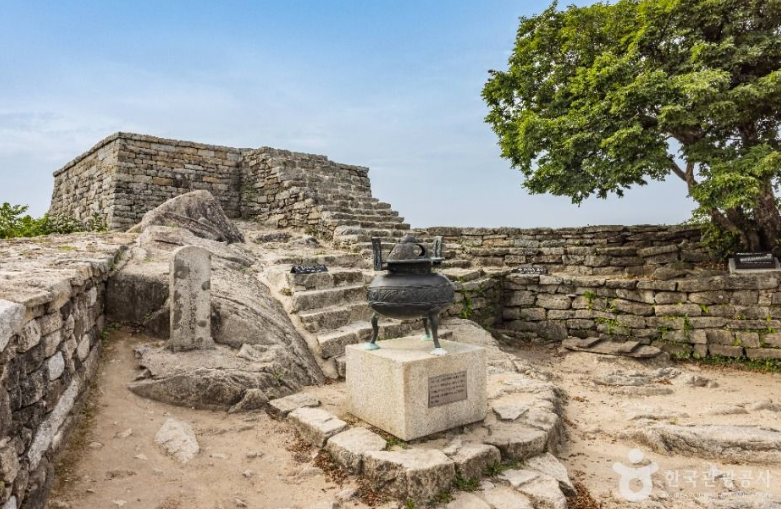

Gaecheonjeol (개천절) is one of South Korea’s official national holidays, observed every year on October 3. In English it is usually called National Foundation Day, and it commemorates the founding of Gojoseon (고조선), the first Korean state, said to have been established by the legendary king Dangun (단군) in 2333 BCE. The holiday’s name translates as “the day the heavens opened.”
Gaecheonjeol is a quiet, civic day. Offices and schools close, the national flag goes up over homes and public buildings, and memorial ceremonies are held at shrines and historic sites connected with Dangun.
For visitors, the day can pass almost unnoticed — yet it marks the oldest date on the Korean calendar. It is the day Korea counts its history from, and every October 3 the country notes, at least in passing, that the story is one year longer than the year before.
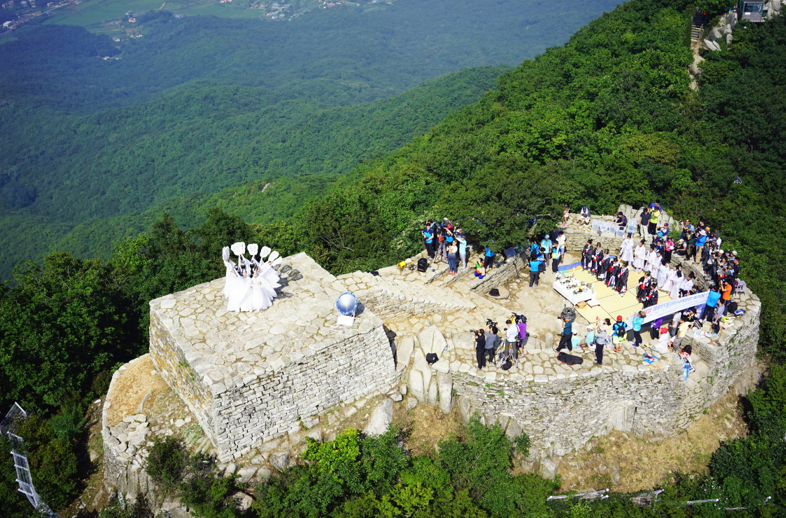
Photo: Korea Tourism Organization
What Does “Gaecheonjeol” Mean?
The name breaks into two parts. “Gaecheon” (開天) means “the opening of heaven,” and “jeol” (節) means a festival day. Gaecheonjeol is literally “the day the sky opened” — the moment when heaven’s order first reached the human world and Korean history began.
The holiday commemorates the opening of history by Dangun Wanggeom (단군왕검), the founder figure of Gojoseon. In Korean tradition, this is not simply the birthday of a kingdom but the starting point of the nation itself, which is why the day is known in English as National Foundation Day rather than “Gojoseon Day.”
The oldest records describe that opening more fully. Hwanung descended through the sky and came to the sandalwood tree on Taebaek Mountain, where he held court — the tale calls it Sinshi (신시), a “divine assembly” — governing human affairs and teaching the ideal of Hongik Ingan (홍익인간), broadly, to live for the benefit of all. Some traditions read the holiday as marking that descent itself, reckoned in an ancient sexagenary cycle year, before the founding Dangun would later complete. And so the day carries a double meaning: it celebrates the founding of the nation, and it stands as the people’s own old festival of thanks to heaven.
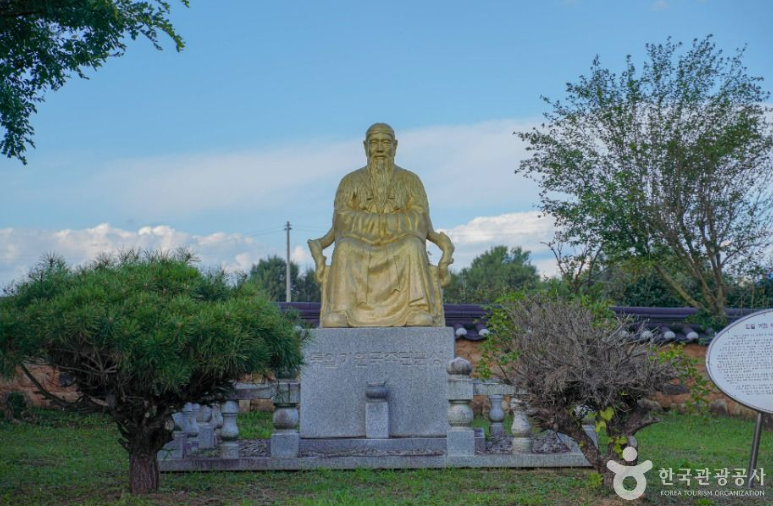
Photo: Korea Tourism Organization
When Is Gaecheonjeol?
Gaecheonjeol falls on a fixed date, October 3. The fixed date is a product of the holiday’s modern designation, explained below. The day also carries an older way of counting years. Dangi (단기), the Dangun calendar, counts the years from the legendary founding of Gojoseon in 2333 BCE — much as the Western calendar counts from the birth of Christ. By this count, 2026 is the year 4359.
The Story of Dangun and Gojoseon
The holiday’s meaning rests on Korea’s founding myth, preserved in medieval records including the 13th-century Samguk Yusa (삼국유사).
The name Gojoseon carries a small history lesson of its own. Korean history counts two states named Joseon: this ancient first kingdom, and the Joseon dynasty founded in 1392 by Yi Seong-gye (이성계), which ruled the peninsula into the late 19th century. To keep the two apart, the earlier state is written with the prefix “go” (고) — meaning “old” — hence Gojoseon, “Old Joseon.” The compound itself is old, first appearing in the Samguk Yusa, though there it served a different purpose: setting Dangun’s kingdom apart from a later state that arose in the same region. Today the name is used above all to tell the ancient kingdom and the later dynasty apart.
The story begins with Hwanin (환인), the lord of heaven, and his son Hwanung (환웅). Hwanung wished to rule the human world, and his father let him descend. Hwanung came down with three thousand followers to a sandalwood tree on Taebaek Mountain (태백산), bringing with him ministers in charge of wind, rain, and clouds — the essentials of a farming people’s life.
In the same mountain lived a bear and a tiger who shared one cave and prayed to Hwanung to become human. They were told to stay out of the sunlight for a hundred days, eating only mugwort and garlic. The tiger gave up partway; the bear endured, and after twenty-one days emerged as a woman. She was named Ungnyeo (웅녀) — “bear woman.” Ungnyeo later prayed beneath the tree for a child, Hwanung took her as his wife, and she bore a son: Dangun.
Dangun founded Gojoseon in 2333 BCE, in the year counted as the first year of the Dangun calendar. Gojoseon is regarded in Korean tradition as the first Korean state, and Dangun as the forefather of the Korean people. October 3 — traditionally recorded as the third day of the tenth lunar month of that year — is the date the holiday keeps.
October: Sangdal (상달), the Month of Thanking Heaven
The date is no accident. In Korean tradition, October was Sangdal (상달) — “the upper month,” the month held most precious in the year. The harvest was in, and families offered the new grain in thanks to heaven. Records describe harvest festivals of this kind in the old kingdoms, each with its own name: Dongmaeng (동맹) in Goguryeo, Yeonggo (영고) in Buyeo, Mucheon (무천) among the Ye — days of feast and ceremony held under the sky.
The heaven-offering altars of later centuries still mark the map: the Chamseongdan altar on Mani Mountain, the Samseongsa shrine on Guwol Mountain, the Sungnyeongjeon hall in Pyongyang. The number 3, meanwhile, was counted a lucky number in Korea — and the holiday keeps the third day of the tenth month: a precious month, a lucky day, and a reason to thank the sky.
Myth, History, and the Making of a National Day
The Dangun story is a legend, not an archaeology lesson. No records from Gojoseon itself survive, and historians debate when and where the state actually formed, or how much of the myth reflects real memory. The holiday commemorates the tradition — the story Korea has told about its own beginning — rather than a documented event.
The modern holiday grew out of the country’s hardest decades. In 1909, the scholar Nak Cheol revived the Dangun tradition as the Daejonggyo faith, and it was the faith that first made Gaecheonjeol a yearly festival of the people. Through the Japanese colonial period, the observance worked as a quiet school of national consciousness; the Korean provisional government in Shanghai marked it as a national day, and joint celebrations were held as far away as wartime Chongqing. After liberation, the Republic of Korea carried the day over as an official national holiday, replacing the old Daejonggyo hymn with the Gaecheonjeol song still sung today.
The date itself was fixed in 1949. The founding was traditionally recorded as the third day of the tenth lunar month of 2333 BCE, but a review panel convened that year by the Ministry of Education concluded that a lunar date from over four thousand years earlier could not be reliably converted to the solar calendar — and that the record “the third day of the tenth month” was worth keeping as written. The law on national days, promulgated on October 1, 1949, therefore set Gaecheonjeol on October 3 of the solar calendar. This is why it falls on a fixed solar date while Chuseok, tied to a living lunar calendar, moves each year.
How Koreans Observe Gaecheonjeol
Gaecheonjeol is observed quietly. The most visible custom is the national flag, raised on homes, offices, and public buildings across the country.
The day’s formal observance takes place on solar October 3. Public ceremonies at government offices and public organizations are held that day, and so are the rites at the country’s old altars. The best known is Chamseongdan (참성단), the stone altar on the summit of Mani Mountain (마니산) on Ganghwa Island, west of Seoul, said to be where Dangun offered sacrifice to heaven, where a grand rite is held each October 3; the rites are also held at the Dangunjeon hall on Taebaek Mountain and the Baekakjeon hall at Sajikdan in Seoul. Reaching the Manisan altar requires a hike of one to two hours, so the ceremony doubles as an autumn mountain pilgrimage.
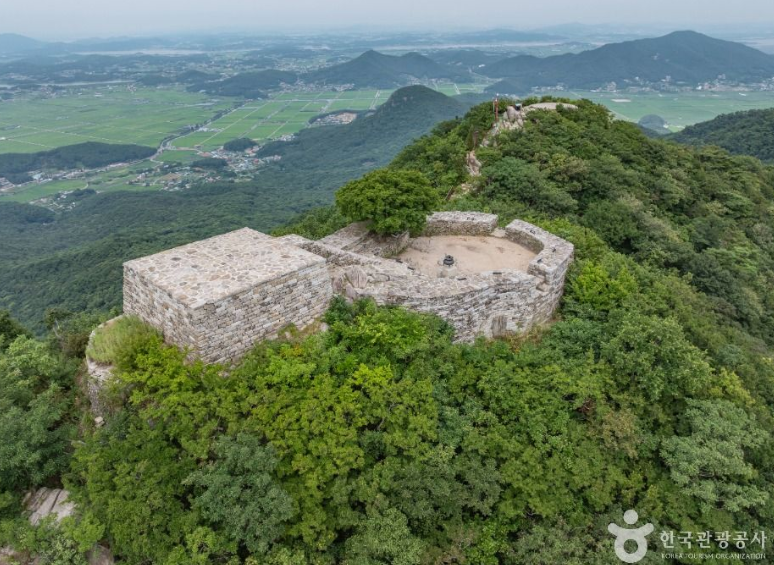
Photo: Korea Tourism Organization
The Day the Heavens Opened
Every country begins its story somewhere. Korea begins its on a mountaintop, with a bear who endured, a lord’s son who came down from the sky, and a half-remembered state on the peninsula’s rivers. Gaecheonjeol asks nothing of the day except a flag and a moment of remembrance. But the date it keeps — 2333 BCE, counted year by year as Dangi 4359 in 2026 — is the oldest fixed point on Korea’s calendar, and the quietest holiday in its autumn.