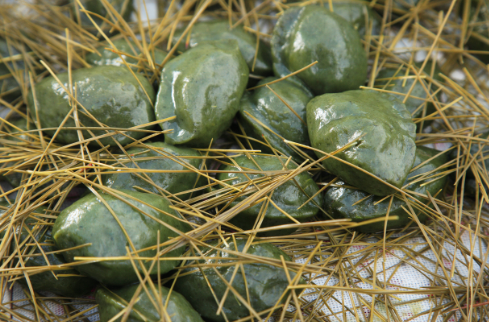

Songpyeon (송편) is the most famous food of Chuseok (추석), Korea’s autumn harvest festival. These are small rice cakes shaped like a half-moon, filled with sweet ingredients, and steamed over pine needles, which gives them a subtle pine fragrance. In the days before Chuseok, families gather in kitchens to shape the dough by hand, and children join in beside their parents and grandparents.
Around the holiday, songpyeon appears everywhere in Korea. Rice cake shops sell it by the pack and by weight, meant to be eaten within a day or two, and supermarkets sell it frozen for longer keeping — in the few families who still make their own, the evening before Chuseok is spent pinching rice dough into shape.
For many Koreans, songpyeon is not just something to eat during Chuseok. It is the taste of the holiday itself, and the food most closely tied to the festival’s meaning.
What Does “Songpyeon” Mean?
The name comes from how the rice cake is made. “Song” (송) means pine, and “pyeon” (편) refers to a rice cake mixed or filled with other ingredients. Songpyeon is literally “pine rice cake” — a rice cake steamed over pine needles.
The half-moon shape carries its own meaning. A full moon was the symbol of Chuseok itself, but songpyeon is shaped like a half-moon instead. A half moon is a moon still growing toward fullness, so the shape came to stand for growth and a future that continues to fill out.
When Do Koreans Eat Songpyeon?
Songpyeon is eaten at Chuseok, the harvest festival on the 15th day of the 8th lunar month. The eating of songpyeon at Chuseok is said to have become an established practice during the Joseon dynasty, and it has remained the holiday’s signature food ever since.
The making begins the night before. On the eve of Chuseok, family members gather around a table of rice dough and filling and shape songpyeon together, so that the fresh cakes can be steamed in time for the morning of the holiday.
How Songpyeon Is Made
The Dough and the Fillings
Songpyeon is made from rice flour kneaded with hot water into a soft dough. Each piece is shaped by hand into a small disc, a spoonful of filling is placed in the center, and the disc is folded over and pinched shut into its half-moon form. A well-made songpyeon is small — roughly the size of a thumb.
The classic fillings are simple and sweet. Sesame-filled songpyeon is especially popular: toasted sesame seeds sweetened with honey or sugar, the filling many Koreans reach for first. Other favorites include sweetened red bean paste, and chestnuts cooked and mashed with sugar. Each region and family favors its own filling, and mixed plates of several kinds are usual on the holiday table.
Shaping by Hand
Shaping songpyeon has always been a family activity rather than a task for one cook. On the night before Chuseok, everyone gathers to shape the dough — and there is a well-known saying that goes with the work: a person who shapes beautiful songpyeon will have good luck, or a beautiful daughter.
In my childhood, songpyeon was made this way in the countryside, at my grandmother’s house. She steamed the songpyeon in a big cauldron, laying pine needles inside it, and the family gathered the day before Chuseok to make them together. The whole afternoon went into pinching half-moons out of rice dough, and the evening was spent waiting for the cauldron to finish steaming.
Steaming Over Pine Needles
The step that gives songpyeon its name comes last. The shaped cakes are arranged on a bed of pine needles in a steamer. The needles keep the soft rice dough from sticking, and the steam passing through them gives the cakes their faint pine scent. After steaming, the cakes are quickly rinsed in cold water and brushed with a little sesame oil, which gives them their smooth shine.
In a home like my grandmother’s, the steamer of old was a big cauldron, and the pine needles went in directly — the room filling with the scent of pine as the cakes cooked through.
The Colors of Songpyeon
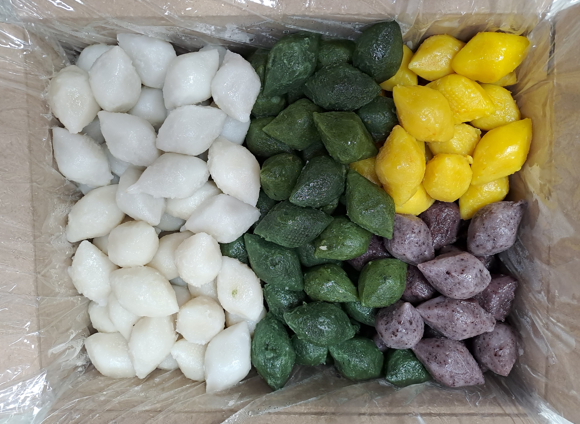
Not all songpyeon is white. The dough is often tinted with natural ingredients, and the most festive version is osaek songpyeon (오색송편) — “five-colored songpyeon.”
The colors come from plants and foods, not artificial dyes. Mugwort gives green, gardenia seeds or pumpkin give yellow, omija berries or beet give red and pink, and other natural ingredients give deeper tones. On the Chuseok table, a plate of five-colored songpyeon is one of the most recognizable holiday sights, and each color was read as part of the same wish for a full and healthy year.
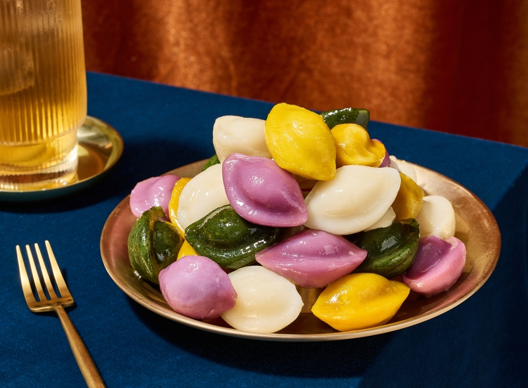
Photo: Korea Tourism Organization
Where to Find Songpyeon
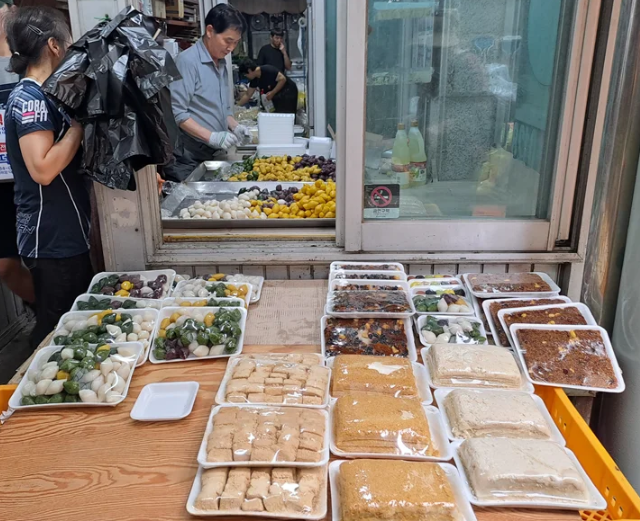
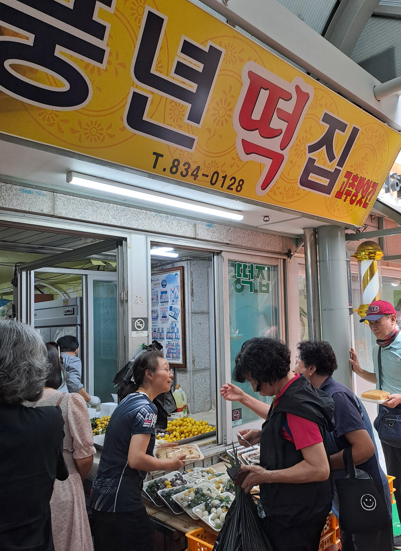
These days, most Koreans buy their songpyeon rather than make it. Around the holiday, they can be bought at rice cake shops and markets — often by weight, in kilogram units — or ordered online and delivered in time for the holiday.
For visitors in Korea, the easiest time to try songpyeon is the weeks around Chuseok. Rice cake shops sell it in small packs or by the kilogram, and convenience stores stock small packs for the holiday.
Outside the season, frozen songpyeon from supermarkets is the most reliable option, and the cakes can be steamed at home in minutes. Korean restaurants and cultural festivals abroad also serve songpyeon around the autumn holidays, and many Koreans still make it at home with rice flour and a steamer — keeping the custom their grandparents kept.