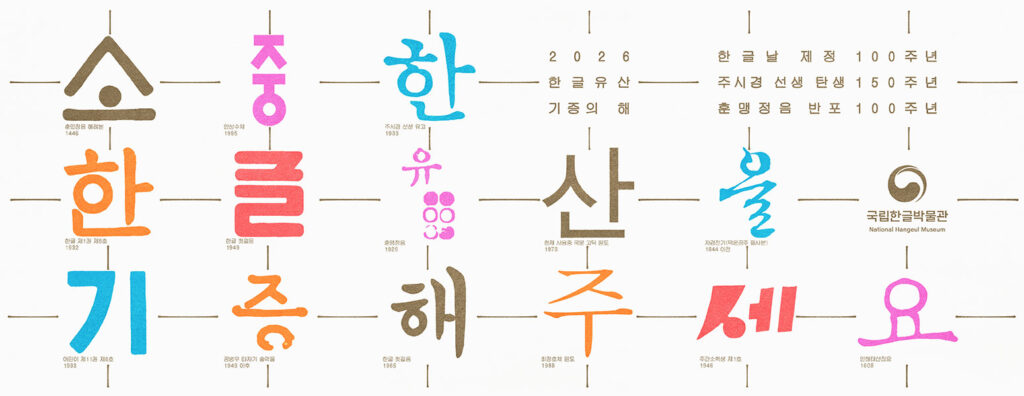

Hangeul Day (한글날) is South Korea’s national holiday dedicated to its own alphabet. It falls on October 9 every year.
Most holidays honor independence, harvests, or the new year. Korea’s calendar makes room for something rarer: a writing system. Hangeul is one of the few alphabets in the world with a known creator, a known date, and an original document to prove it — and Korea is one of the few countries that sets aside a public holiday for its script. For Koreans, the day is less about letters than about the idea behind them: that everyone should be able to write what they mean.
Why a Country Celebrates Its Script
Most alphabets grew slowly over centuries, shaped by borrowing and accident. Nobody knows who invented the Latin alphabet, so no country can celebrate its birthday. Hangeul is different. It was created in 1443 by King Sejong the Great (세종대왕, reigned 1418–1450), the fourth king of the Joseon dynasty, and announced to the nation in 1446.
The reason is written in the king’s own preface. Koreans spoke a language entirely different from Classical Chinese, the medium of all official writing, so many people “could not unfold their thoughts” in writing even when they had much to say. The new script was his answer: a writing system designed not for scholars but for farmers, fisherwomen, and clerks.
That was a radical act. In the fifteenth century, literacy in Korea — as almost everywhere — belonged to those who could spend years on Classical Chinese. A king who built an easy-to-learn script for ordinary people broke with the entire logic of his era. That story is why the alphabet earned a holiday, and why the holiday outlived the era that created it.
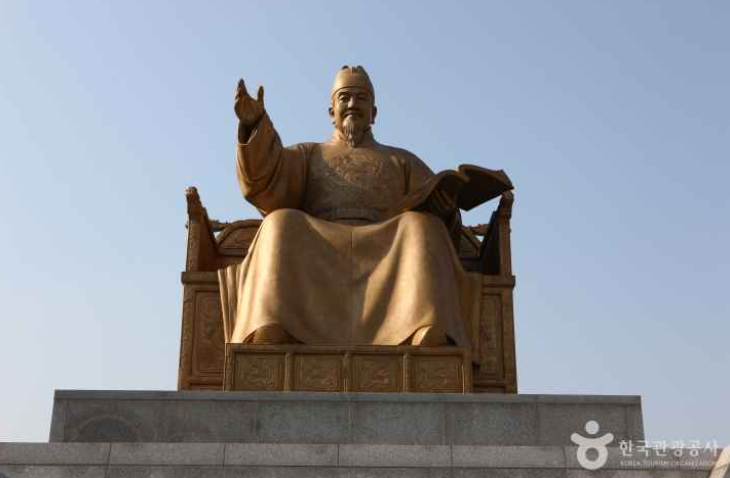
Photo: Korea Tourism Organization
Why October 9?
The holiday commemorates that 1446 promulgation.
The holiday itself has a story of its own. It was first celebrated in 1926, when the Korean Language Research Society (조선어연구회), a private scholarly group, marked the 480th anniversary under the name Gagya-nal (가갸날), after the first two letters of the traditional consonant chart. In 1928 the name became Hangeul Day, and the date was eventually fixed on the solar October 9.
What Koreans Do on Hangeul Day
The day opens with an official commemorative ceremony, where the government honors people who have contributed to the study and spread of the language: teachers, researchers, translators, and educators who teach Korean abroad.
In Seoul, people visit the statue of King Sejong the Great at Gwanghwamun Square (광화문광장), where flowers pile up at the base around the date. The National Hangeul Museum (국립한글박물관), which opened in 2014, holds special exhibitions and hands-on programs, and museums and libraries across the country follow suit.
Seoye (서예), brush calligraphy, is the day’s most popular hands-on tradition: writing your own name — or someone else’s — in bold, artistic hangul. Companies join in with Hangeul-themed advertisements and new typeface releases, and broadcasters and newspapers use the day to argue, once a year, about how best to protect and grow the language.
The date also reaches beyond Korea. UNESCO’s King Sejong Literacy Prize, established in 1989 and funded by Korea, is awarded to literacy programs around the world — a fitting tribute for a script invented to spread exactly that.
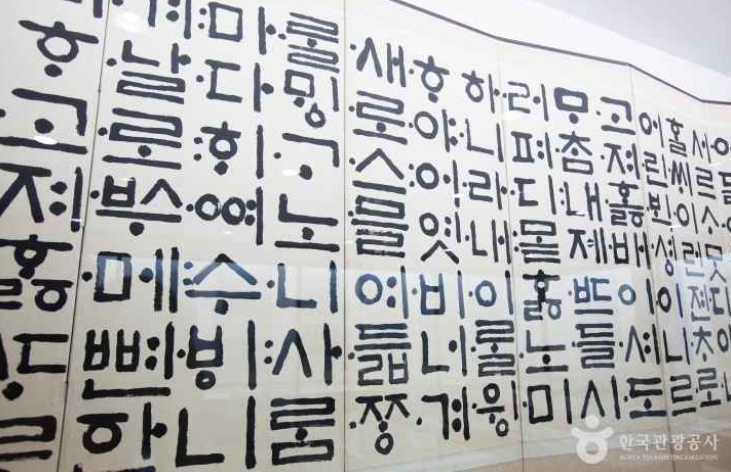
Photo: Korea Tourism Organization
How the Alphabet Works
Hangeul has 24 basic letters: 14 consonants and 10 vowels. (The original 1446 design had 28; four fell out of use over the centuries.) Letters combine into square syllable blocks — consonant above or beside the vowel — and blocks combine into words. From those 24 letters, the system can build more than 11,000 distinct syllables.
What makes the script famous is the design logic. The consonants are outlines of the speech organs that make each sound: ㄱ traces the tongue root rising toward the throat, ㅁ outlines closed lips, ㅅ suggests the teeth. The vowels are built from three strokes that stand for heaven (•), earth (ㅡ), and the human being (ㅣ). Related sounds are visually related, too: add a stroke to ㄱ and you get the stronger ㅋ; ㅅ becomes ㅈ, then ㅊ.
This is why Hangeul is called a scientific script. Jeong In-ji (정인지), the scholar who introduced the 1446 commentary on the new alphabet, put it plainly: a wise man can acquaint himself with the letters before the morning is over, and even a fool can learn them in the space of ten days. Korean children still learn to read within weeks, and the country’s literacy rate sits near 100 percent. The original commentary volume — known as the Haerye edition (해례본) — survives, and was inscribed in UNESCO’s Memory of the World register in 1997.
More Than Letters
A script designed on purpose, rather than inherited by accident, turned 570 years old with its original logic intact. Hangeul Day honors the simple fifteenth-century act behind it: making sure that everyone could write what they meant. October 9 is the day Korea says that mattered — and still does.
The National Hangeul Museum
If the holiday has a home, it is the National Hangeul Museum (국립한글박물관), which opened on Hangeul Day 2014 on the grounds of the National Museum of Korea in Yongsan, Seoul. It is the country’s only national museum devoted to a single script, collecting and exhibiting everything from the letters of the 1440s to modern hangul typefaces.
The museum is currently closed for restoration and expansion, with a reopening planned for late 2028. Its exhibitions and education programs continue in outside venues in the meantime — in 2026, the 100th anniversary of the holiday’s establishment, it is co-hosting the special exhibition From 1926 to Infinity (일구이륙 무한이륙) at the National Museum of Korean Contemporary History, running from October 2, 2026 to February 9, 2027. Details are on the museum’s official site (hangeul.go.kr).