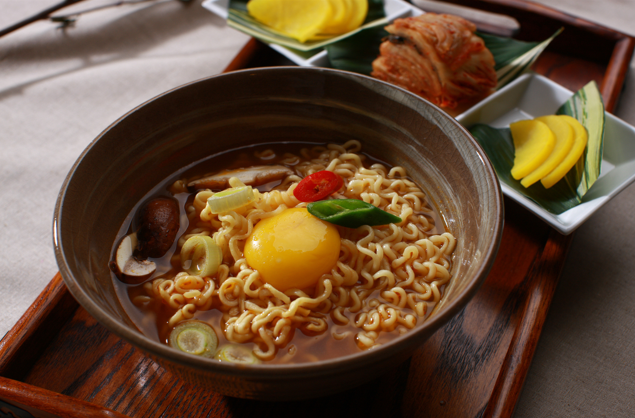

Korean ramyeon (라면) is the closest thing Korea has to a national daily food. It is cheap, ready in about five minutes, and sold on nearly every street corner. This guide explains what ramyeon actually is, the main types, how Koreans cook and customize it, where to eat it across Korea — and the famous phrase “라면 먹고 갈래?” (“Ramyeon meokgo gallae?”), which tells you a lot about what this food means in everyday Korean life.
What Is Korean Ramyeon?
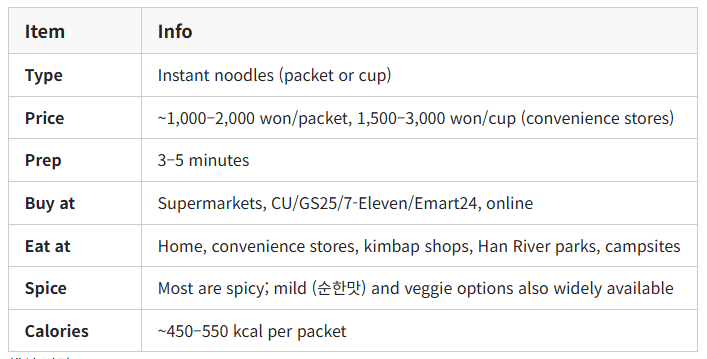
In Korea, “ramyeon” means instant noodles — nearly always sold in a packet or a cup.
- Packet ramyeon contains a block of noodles, a seasoning (soup base) powder, and dried vegetables. It is cooked in a pot.
- Cup ramyeon is the same idea in a disposable container: add hot water, wait, and eat straight from the cup.
Ramyeon’s defining traits are speed, low cost, and flexibility. A single packet costs little more than a bottle of water, cooks in minutes, and can be turned into a completely different meal by what you add to the pot.
A few numbers put its role in perspective. Korea’s first ramyeon was launched by Samyang in September 1963, and the market never slowed down: Koreans now eat among the highest amounts of instant noodles per person in the world — the country ranked second only to Vietnam in per-capita consumption in the latest World Instant Noodles Association data — with roughly 3.8 billion servings sold a year.
Another piece of the story is how the noodles are made. Most Korean ramyeon blocks are pre-fried in oil (유탕면) before packaging — which is exactly why they cook in three to five minutes. In recent years, air-dried, non-fried noodles (건면) have appeared in “well-being” lines, with a lighter, more delicate texture. [Source: Nongshim Ramyun Pedia]
The market has also grown far beyond Korea. Exports of Korean instant noodles hit an all-time record of US$1.52 billion in 2025, up about 22% from the year before, making ramyeon one of Korea’s most successful food exports. [Source: Korea Times]
The biggest single brand is Shin Ramyun, launched by Nongshim in 1986. Around its 40th anniversary in 2026 it passed 42.5 billion cumulative packs sold and 20 trillion won (~US$13.4 billion) in cumulative sales — the best-selling Korean ramyeon in the world. [Source: Korea Herald]
Types of Korean Ramyeon
orean ramyeon is usually classified in two separate ways, and confusing the two is a common mistake. By format — how you cook it: packet vs. cup. By style — what comes out: soup vs. stir-fried/dry. Any given product sits at the intersection of both axes.
By Format: How You Cook It
Packet Ramyeon (봉지라면)
The classic format: noodles, seasoning powder, and dried vegetables in an individual packet, cooked on a stove.
- Easy to customize — eggs, vegetables, kimchi, dumplings, or seafood go straight into the pot.
- You control the water amount and cooking time, so the noodle texture is up to you.
- The format Koreans cook most at home and while camping.
Cup Ramyeon (컵라면)
The same idea in a disposable cup, made with hot water only.
- No pot or stove required — add hot water and wait for the recommended time.
- The go-to in convenience stores, offices, schools, hotels, and while traveling.
- Many Korean convenience stores provide hot water dispensers, and some have dedicated ramyeon cooking machines.
By Style: What Comes Out
Soup Ramyeon (국물라면)
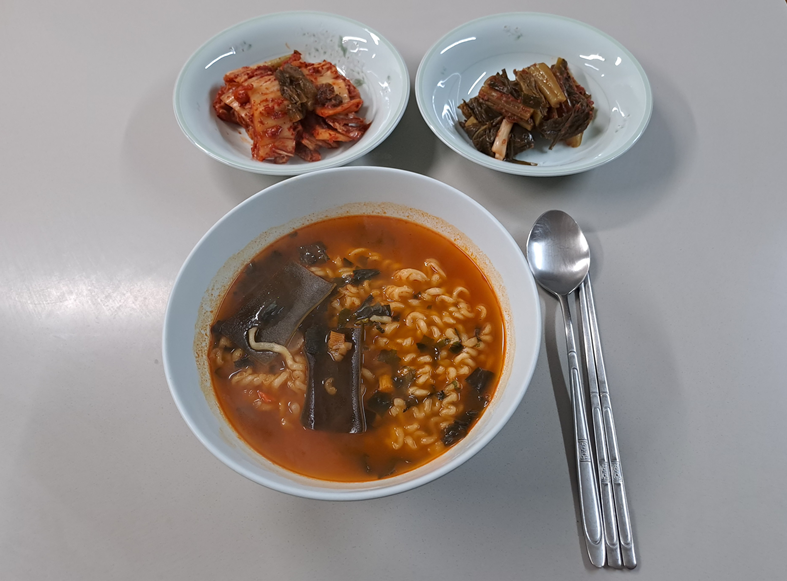
The most common style — noodles in a hot, seasoned broth.
- The broth is typically spicy, salty, and savory, with flavor bases such as chili, garlic, beef, seafood, or mushroom.
- Korean spice comes mainly from gochugaru (red chili pepper) and gochujang (fermented chili paste), so the heat is rich and savory rather than sharp.
- Sold in both packet and cup formats.
Stir-Fried / Dry Ramyeon (비빔·볶음라면)
Not every Korean ramyeon is soup. Some varieties are boiled, drained, and mixed with a concentrated sauce.
- Flavors range from spicy buldak-style “fire noodles” and black-bean jjajang to creamy carbonara-style and cold spicy bibim noodles.
- Most are sold as packets, but cup versions (e.g., cup buldak) exist too.
- This smaller but growing category shows how far Korean ramyeon has moved beyond a single “packet of soup noodles.”
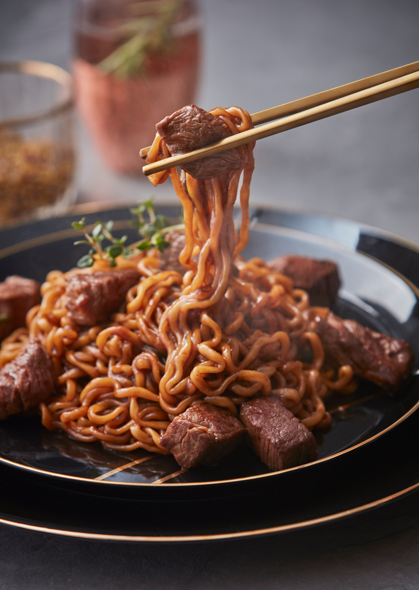
There Are Hundreds of Ramyeon Products — Literally
One of the most surprising facts about Korean ramyeon is simply how many different products exist.
- Nongshim alone — the maker of Shin Ramyun — keeps roughly 90 different ramyeon products in circulation at any one time, counting packet, cup, and bowl formats. GLOBAL NONGSHIM
- Across Nongshim (농심), Samyang (삼양), Ottogi (오뚜기), Paldo (팔도), and dozens of smaller makers, hundreds of distinct ramyeon products sit on Korean shelves at any given moment — and the number keeps growing as companies retire old products and launch new ones.
- What foreign visitors find in local supermarkets (Shin Ramyun, Buldak, a few cup noodles) is only a small fraction of the full Korean lineup.
Flavor families — from “ramyeon” to an entire category:
- Soup styles — beef (Shin Ramyun, Ansungtangmyun), spicy seafood (Neoguri), jjamppong (spicy seafood soup), kimchi stew, yukgaejang (spicy beef soup), sundubu (soft tofu stew), budae jjigae (army stew). Korean ramyeon regularly re-creates a full Korean dish in a single packet.
- Stir-fried & dry styles — black-bean jjajang (Jjapaghetti), cold spicy bibim, curry, and creamy cheese/carbonara flavors, plus the super-spicy buldak family.
- The Buldak line alone — Samyang’s Buldak (“fire chicken”) series now spans dozens of variants: original, 2x spicy, carbonara, creamy carbonara, jjajang, rosé, curry, habanero-lime, four-cheese, corn, kimchi… a single “flavor line” can fill an entire shelf.
- Limited and promotional editions — companies regularly roll out seasonal, collaboration, and convenience-store-only flavors, so the lineup changes throughout the year.
- Jjapaghetti in Parasite — when the Oscar-winning film showed characters making “ram-don” (Jjapaghetti + Neoguri), global interest in Korean ramyeon surged. Korean instant noodles have been quietly working as a food export and a pop-culture export at the same time.
Takeaway: “Korean ramyeon” is not one taste. It is an entire category — spicy and mild, soup and dry, hot and cold — with enough variety that even Koreans are regularly trying new products.
How to Cook Packet Ramyeon: The Basic Method
- Bring the amount of water stated on the package to a boil.
- Add the seasoning powder and dried vegetable sachet; stir.
- Add the noodles.
- Cook for the time shown on the package, stirring occasionally to separate the noodles.
- If you want, add extra ingredients — an egg cracked in near the end is the most popular.
- Serve immediately.
Two tips for better results:
- Water amount matters more than people expect. Too much water makes the broth thin; too little makes it overly salty. Follow the package line.
- Most Koreans prefer the noodles slightly firm. Noodles left sitting in hot broth keep softening and absorbing liquid, which is one reason ramyeon is usually eaten right away.
Popular Ingredients Koreans Add to Ramyeon
| Ingredient | How it’s used | What it does |
|---|---|---|
| Egg | Cracked whole into the boiling broth, stirred into the soup, or added cooked on top | Adds richness and makes the bowl feel like a complete meal |
| Green onion | Added early (flavors the broth) or late (stays fresh, crunchy) | Aroma, freshness, color |
| Kimchi | On the side as a banchan, or cooked right in the pot | On the side: crunch and sourness. Cooked in: a deeper, more fermented broth |
| Cheese | One slice of processed cheese added near the end | Melts into a creamy broth and softens the spiciness |
| Mandu (dumplings) | Frozen mandu dropped into the pot | A filling one-pot meal; fillings vary (meat, tofu, vegetables, glass noodles, kimchi) |
| Tteok (rice cakes) | Added to the pot | Goes soft and chewy while the noodles stay springy — a texture contrast Koreans love |
| Seafood | Shrimp, squid, clams, mussels, crab | Deepens the broth; especially popular for camping and coastal trips |
| Ham / Spam | Sliced in | Quick protein from the fridge; “ramyeon with spam” is a classic combo |
Ramyeon + Kimbap: The Classic Combo
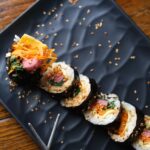
The most familiar casual meal pairing in Korea is ramyeon and kimbap — hot noodles and broth alongside a roll of rice, vegetables, seaweed, and egg.
- Available at kimbap restaurants (김밥집) and casual snack eateries almost everywhere, for a few thousand won total.
- A typical order: one roll of kimbap + one bowl of ramyeon, with kimchi or pickled radish on the side.
- For first-time visitors, it’s the simplest way to eat a genuinely standard Korean everyday meal.
“라면 먹고 갈래?” — A Phrase That Says a Lot
Literal meaning: “Do you want to eat ramyeon before you go?” / “Want to grab ramyeon?”
Everyday usage: It’s a casual, low-pressure invitation — a friend about to leave your place, or two people spending an evening together, ending with “ramyeon meokgo gallae?” No reservations, no planning, no formality. Ramyeon is the default “easy” food: if someone is hungry and neither of you wants to decide anything, ramyeon is the answer.
The popular-culture layer: The phrase is also famous in Korea with a playful, lightly suggestive undertone — “come over and eat ramyeon” as a euphemistic way to extend a date or invite someone home. It has been a running gag in Korean dramas, webtoons, and memes for years, so visitors will likely hear it on screen at some point. The tone depends entirely on who says it and how — from a friendly “quick bite” to a wink.
Why it matters in a food guide: No single dish shows how ordinary, domestic, and easy ramyeon is as well as this phrase. If a Korean says it to you, it isn’t a fancy dinner invitation — it’s the most casual one there is. And if you hear it in a drama, that’s the joke.
After the Noodles: Adding Rice to the Broth
A common Korean ritual: after the noodles are gone, drop a small bowl of cooked rice into the remaining broth.
- The rice soaks up the spicy, savory soup, and any leftover egg, kimchi or seaweed adds more flavor.
- It’s a satisfying way to end the meal — but the broth is salty, so it’s a heavier, treat-yourself-style finish.
Where to Eat Ramyeon in Korea
At home — The most common setting. A packet ramyeon takes five minutes and can be customized with whatever is in the fridge.
At a convenience store — The easiest place for travelers. Buy a cup ramyeon, use the store’s hot water machine (some stores have automatic ramyeon cooking machines), and eat at the counter or seating area. Convenience stores also sell kimbap, triangle kimbap (samgak kimbap), boiled eggs, and sausages to pair with it.
At a kimbap restaurant — Small kimbap shops across Korea serve freshly cooked, pot-boiled ramyeon, often with menu options for cheese or egg added. Order a bowl, or go for the ramyeon + kimbap combo above.
At the Han River (Seoul) — The most iconic setting. Convenience stores near Han River parks sell ramyeon cups and provide cooking machines; you cook the noodles yourself and eat them at a bench or mat overlooking the river. Hot ramyeon + a river view is one of the most recognizable images of casual Seoul.
While camping or hiking — Easy to carry, easy to cook, and a hot bowl after outdoor time is especially satisfying. It pairs well with eggs, green onion, dumplings, sausages, seafood, or leftover grilled meat.
Ramyeon specialty restaurants — Some restaurants and casual cafés in cities serve “premium” versions: ramyeon cooked to order with cheese, dumplings, seafood, or special broths, usually for a few thousand won. Different experience, same noodle.
Useful Korean Words for Shopping and Ordering
| Korean | Romanized | Meaning |
|---|---|---|
| 라면 | ramyeon | Instant noodles (the general word) |
| 봉지라면 | bongji ramyeon | Packet ramyeon |
| 컵라면 | keop ramyeon | Cup ramyeon |
| 순한맛 | sunhan-mat | Mild flavor |
| 매운맛 | maeun-mat | Spicy flavor |
| 매워요 | maewoyo | “It’s spicy” — good to know in advance |
| 김밥집 | kimbap-jip | Kimbap restaurant (where ramyeon is commonly served) |
| 계란 | gyeran | Egg |
| 파 | pa | Green onion |
| 김치 | kimchi | Kimchi |
| 치즈 | chijeu | Cheese |
Why Is Ramyeon So Popular in Korea?
- It’s fast. A basic bowl takes about five minutes.
- It’s cheap. One of the lowest-cost meals in the country.
- It’s everywhere. Supermarkets, convenience stores, restaurants, cafés, campsites.
- It’s customizable. The same packet becomes a different meal depending on what you add.
- It fits any situation. Home, work, school, travel, camping, a late-night craving.
- It’s nostalgic. For generations of Koreans, ramyeon is the taste of home-cooked simplicity — the food you grew up eating.
- It’s a global hit now. Korean ramyeon exports hit a record US$1.52 billion in 2025, riding the same wave as K-pop and K-drama.